IHRDC files criminal complaint in Argentina for crimes against humanity committed in Iran during Woman, Life, Freedom protests
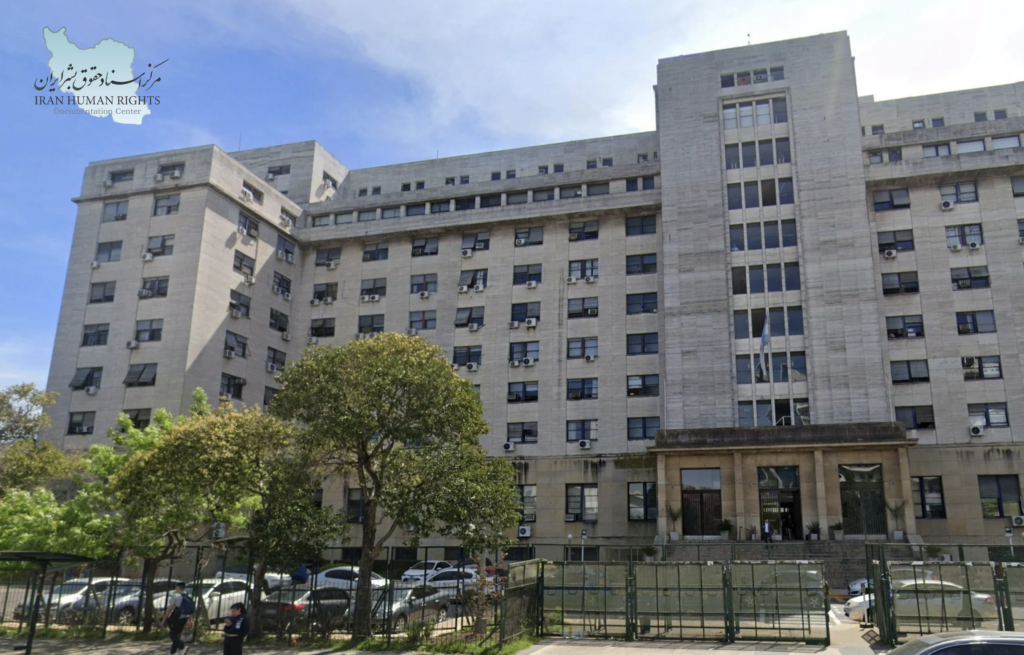
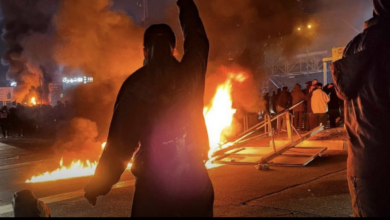
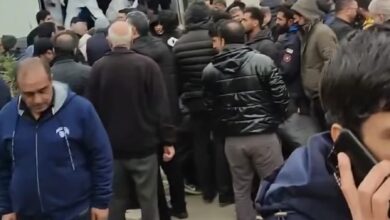
(17 December 2025) – A group of survivors and the Iran Human Rights Documentation Center (IHRDC), with support from the Strategic Litigation Project at the Atlantic Council, filed a criminal complaint in Argentina yesterday for crimes against humanity committed by the Islamic Republic of Iran (IRI) during the Woman, Life, Freedom protests in 2022.
The survivors who filed, and can be identified publicly, include Kosar Eftekhari and Mersedeh Shahinkar, who were both shot and blinded in the right eye at close range by IRI security forces, and Mahsa Piraei, whose mother Minoo Majidi was shot with hundreds of metal pellets and killed by IRI security forces. The complaint alleges that IRI officials and security forces are responsible for the crimes against humanity of gender persecution, murder, torture, and other inhumane acts such as targeted blinding.
This is the first complaint filed anywhere in the world by victims of crimes against humanity committed by the IRI in the context of the Woman, Life, Freedom movement. The complaint was filed with an investigative judge in Argentina requesting that a criminal investigation be opened into crimes against humanity committed by the IRI against this group of individual survivors during the brutal crackdown against Woman, Life, Freedom protests. It calls for the Argentine court to investigate senior members of the IRI’s intelligence services, military, police, and the Islamic Revolutionary Guard Corps (IRGC), as well as civilian government officials for their roles in this widespread and systematic attack against civilians.
Minoo Majidi’s murder by hundreds of metal pellets made global headlines when a photo of her daughter Roya Piraei, standing at her mother’s grave and clutching the hair Roya shaved off her own head in protest, went viral on social media. Now Majidi’s other daughter Mahsa Piraei is seeking justice for her mother, who was 62 years old when she was killed by IRI security forces as she protested for women’s rights.
“In our own country, Iran, we were unable to find justice for my mother’s killing because there is no fair judiciary or independent judicial system,” said Piraei. “Today, I am happy that this crime failed to kill our hope for justice, and that our efforts have borne fruit. With the help of human rights lawyers, we are taking our case to courts outside of Iran. I believe that our perseverance as justice-seeking families, and our insistence on preserving human dignity, is a global cause that knows no borders.”
Mersedeh Shahinkar was 38 years old during the Woman, Life, Freedom protests when she was shot in the right eye at close range by IRI security forces. Even after her injury and painful eye surgeries, she wore an eye patch and rejoined the protests to show that the IRI did not scare her into silence.
“We will stand, to our last breath, against this major dictatorship that has caused widespread human rights violations in Iran and the Middle East,” said Shahinkar. “We will continue our struggle against the Islamic Republic despite all obstacles and attempts to impede us.”
Kosar Eftekhari was 23 years old during the Woman, Life, Freedom protests when she too was shot in the right eye at close range by IRI security forces. Her injury was captured by a video taken at the time of the event which went viral on social media, showing her injured eye and blood streaking down her face.
“Those who shot at me and my fellow citizens—whom we witnessed killing people in the streets of Iran, killing Iranians through direct gunfire—were members of the Islamic Revolutionary Guard Corps,” said Eftekhari. “In this country where this case will be opened, we stand as living witnesses to the criminal nature of the IRGC and the Islamic Republic. I further hope that this action will extend from one country to all of Europe: that the leaders of the Islamic Republic and the IRGC will be tried by all countries.”
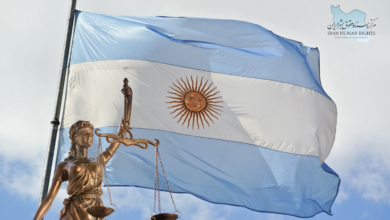
Argentina’s Constitution (art. 118) and Law 26.200 allow federal Argentine courts to investigate and prosecute core international crimes like genocide, crimes against humanity, war crimes and others enumerated in the Rome Statute of the International Criminal Court. Further, Argentina does not require the physical presence of the alleged perpetrators in its territory before an investigation can begin. This means that crimes against humanity committed by the IRI inside Iran against Iranian victims can be investigated and prosecuted by a federal court in Argentina. Similar complaints have been filed in Argentina regarding crimes against humanity in Venezuela, genocide against the Rohingya by Myanmar authorities, and crimes against humanity committed under the Franco regime in Spain.
“What is most important is that Argentina does not require the perpetrators to be within its territory to begin seeking justice,” said Nizar El Fakih, a member of the legal team filing the complaint. “With this filing, a group of Iranian women victims of these atrocities are paving a new path, opening the doors to justice for thousands of women and Iranian civil society. It is a powerful reminder that justice knows no borders, and that no atrocity, no matter how distant, will go unpunished.”
Beyond the direct evidence provided to support the claims of the group of individual complainants, the complaint also relies on the findings of the Independent International Fact-Finding Mission on the Islamic Republic of Iran (FFMI), an investigative body established by the United Nations Human Rights Council in November 2022. In its March 2024 report, and subsequent reports, the FFMI found that the IRI was responsible for various crimes against humanity as defined under international criminal law, including “murder, imprisonment, torture, rape and other forms of sexual violence, persecution, enforced disappearance and other inhumane acts.” In those reports, the FFMI also confirmed there is no viable avenue for accountability domestically in Iran and encouraged other states with universal or extraterritorial jurisdiction frameworks to open investigations into IRI repression during the Woman, Life, Freedom movement.
“The Iranian government’s violent crackdown on the Woman, Life, Freedom protests resulted in more than 500 protesters dead, thousands injured, and more than a dozen executed or sentenced to death—executions which continue to be carried out to the present day,” said Shahin Milani, Executive Director of IHRDC. “This filing is an important step towards justice.”
The complaint was filed by the group of survivors and IHRDC with Argentine lawyer Maximo Castex, and support from the Strategic Litigation Project at the Atlantic Council.
For more information on this case, read the FAQ here.
To read this press release in Persian, click here.
To read this press release in Spanish click here.
For further inquiries in either Persian, English or Spanish or to arrange an interview with the complainants or lawyers, please contact inquiry@iranhrdc.org