

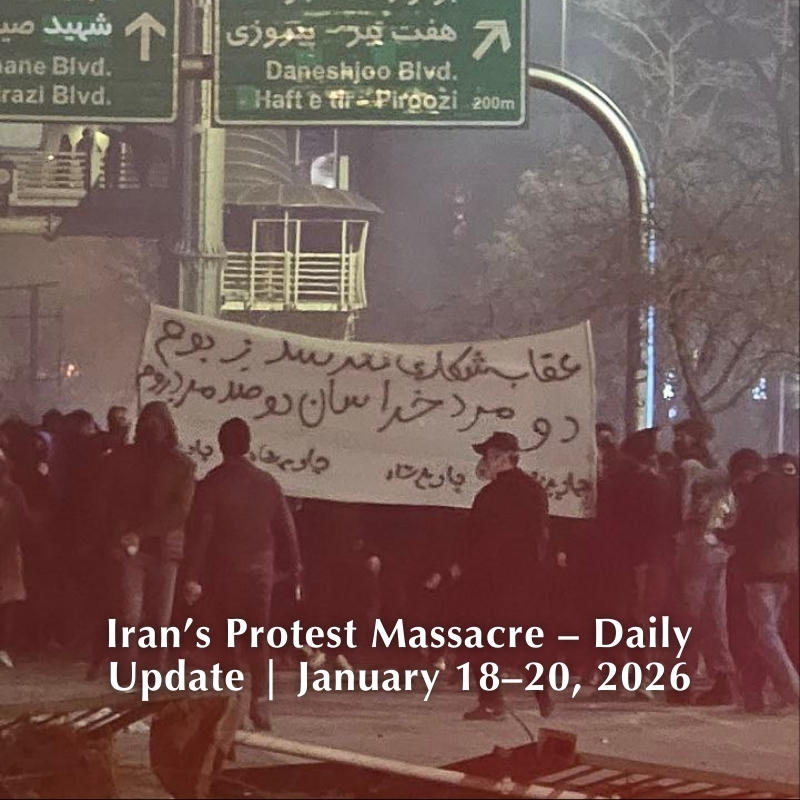

Iran – January 20, 2026
Amid ongoing nationwide repression in Iran and persistent severe restrictions on communication, credible reports over the past three days indicate escalating judicial threats, heightened risks for detainees, and emerging evidence of unprecedented violence against protesters and civilians across the country. Continued internet shutdowns and extensive filtering are further delaying verification, impeding independent monitoring, and obstructing access to legal protections.
- Judicial Threats and Accelerated Prosecutions
On January 18, 2026, the Islamic Republic judiciary spokesperson, Asghar Jahangir, stated that the “harshest Islamic punishments” would be imposed on individuals detained during the protests. He indicated that detainees classified by authorities as mohareb (accused of moharebeh, “waging war against God”) could face extremely severe sentences, including punishments that can carry the death penalty under Iran’s Islamic Penal Code. He further emphasized that protest-related cases would be processed rapidly and with maximum severity. Jahangir also alleged—without presenting evidence—that some detainees had links to Mossad and warned of punitive action against those who called for protests. Such threats of extreme punishment, combined with accelerated proceedings as occurred during prior years’ protests, heighten the risk of serious due process violations, including denial of access to counsel, coerced confessions, and unfair trials.
- Preliminary Reports on Protest-Related Casualties
On January 18, the Sunday Times, citing medical sources inside Iran, reported that at least 16,500 protesters had been killed and approximately 330,000 injured during the crackdown on protests, with estimates indicating that more than 8,000 individuals may have sustained blindness or severe eye injuries. HRANA has published lower confirmed totals to date, with additional cases under review, alongside reports of large-scale arrests and the public broadcast of coerced confessions. Due to the nationwide internet shutdown and severe information restrictions, these figures remain incomplete and cannot be independently verified. Nevertheless, the consistent reporting of eye injuries—which corresponds with patterns observed in prior years of repression in Iran—raises serious concerns regarding the scale and severity of harm inflicted.
- Tehran Protest Casualty: Mohammad Ali (Sepehr) Foroughi Dehnavi
IHRDC, based on a source familiar with the matter, reported that Mohammad Ali (Sepehr) Foroughi Dehnavi, a 43-year-old pharmacist and resident of Tehran, was killed during protests in the city. Independent verification of this report was not possible at the time due to ongoing communication restrictions.
- Risks of Arbitrary Detention in Secret Facilities
On January 19, IHRDC received an audio message from inside Iran describing dire conditions in detention centers amid ongoing communications blackouts. The report indicated that already-detained political prisoners were being transferred to solitary confinement, that visits and phone calls were nearly completely suspended, and that arrest levels had exceeded the official capacity of facilities. It further suggested that many individuals arrested during recent protests may be held in unregistered or unofficial locations, leaving families without information and raising concerns consistent with arbitrary detention, enforced disappearance, and heightened risk of torture or ill-treatment.
It is estimated that up to 100,000 protesters may be in custody, many in secret facilities. While this figure cannot be independently verified, the associated risk indicators merit urgent attention. The situation is particularly concerning given the Islamic Republic’s documented pattern of mistreatment of political prisoners, including deprivation of access to medical care and legal representation. Past incidents, including conditions at the Kahrizak detention center in 2009, have resulted in the deaths of detained protesters, underscoring the potential severity of current detention practices.
- Digital Repression and Continued Shutdown
On January 19, NetBlocks reported that Iran’s internet shutdown had entered its twelfth day, with overall connectivity remaining extremely limited despite intermittent access for some users. NetBlocks further assessed that authorities may be testing a heavily filtered version of a “national internet,” indicating a shift toward a controlled intranet rather than the restoration of open connectivity. These conditions continue to impede independent reporting, delay verification of deaths and arrests, and obstruct access to legal remedies and emergency support. As of January 20, the situation remains unchanged.
- Arrests of Individuals Allegedly Linked to a Bahá’í Network in Kerman
On January 19, Tasnim (affiliated with the IRGC) cited the Tharallah Corps in Kerman, claiming the dismantling of an “organized network” of Bahá’í individuals allegedly involved in unrest and alleging foreign coordination. IHRDC reported receiving information that Peyvand Naeimi, a Bahá’í citizen, was detained at his workplace in Kerman on January 8. Given that these allegations originate from security forces and are accompanied by a lack of transparency and publicly available information regarding due process, they should be treated with caution. Assertions of “networks” may serve to justify broad-based arrests, contribute to the stigmatization of minority communities, and heighten the risk of coerced confessions and unfair trials.
- Emerging Evidence of Targeted Shooting at Unarmed Civilians
On January 20, the IHRDC reported a video allegedly recorded in Tehran’s Haft-Hoz Square in the Narmak neighborhood. The footage depicts a young man with a gunshot wound to the leg, with bystanders attempting to apply a tourniquet. A green laser is visible in the video. The IHRDC noted prior witness testimony indicating that security forces have used green laser lights to aim at and target protesters. Due to severe internet restrictions, independent verification of the precise time and location of the recording is not currently possible; however, available indicators suggest the footage is linked to the recent crackdown.
- Eyewitness Account from Arak Alleging Mass Casualties and Severe Eye Injuries
On January 20, IHRDC published an eyewitness account from the city of Arak, Markazi Province, describing an intense security operation reportedly involving direct fire with live ammunition, pellet guns, and tear gas, as well as ambush-style tactics. According to the witness, a medical professional indicated that “nearly 70 eyes were removed,” and the witness further claimed that “at least 200” individuals were killed in a single day. The account also alleged the killing of a four-year-old child, additional shootings, obstacles to recovering bodies, and statements suggesting an elevated risk of sexual violence against detained women, as well as the detention and subsequent execution of an injured individual from a hospital. These allegations are not independently verifiable at this time; if substantiated, they would constitute serious violations of international law, including extrajudicial killings, arbitrary detention, torture or other ill-treatment, and sexual violence.
- Expansion of Repression Beyond Street protesters
On January 20, the Tehran Prosecutor’s Office announced criminal cases against 15 athletes and artists, 10 signatories of a statement by the Iranian House of Cinema, and 60 business units for alleged protest support, with some assets reportedly seized. State-affiliated media claimed courts may order compensation for alleged damages. IHRDC also referenced reported sealing of businesses and brief detentions of two sports figures at Tehran’s international airport. These measures are an extension of repression through economic and social pressure, raising concerns regarding potential violations of the rights to freedom of expression, peaceful assembly, and the prohibition of collective punishment.
- A Rare Account of Survival Amid Crackdown on Protesters
An exclusive reporting received by IHRDC describes a family’s search for their son during the nationwide protests in Iran. Over the course of three days, they conducted site visits to hospitals, Behesht Zahra Cemetery, and Kahrizak Forensic Center—locations widely reported to receive large numbers of protesters’ bodies—both situated near Tehran. At Kahrizak, the family found their son alive, despite severe gunshot wounds. According to the account, he had remained without food or water for three days, lying motionless in a plastic body bag used for the deceased, reportedly to avoid a fatal “finishing shot” by security forces. He was later transferred to a hospital for treatment.
This account, while a rare instance of survival, highlights the conditions of the crackdown, including the treatment of the wounded and obstacles faced by families seeking access to care amid hospitals, morgues, and security facilities. Due to severe internet restrictions, independent verification is not currently possible. Nonetheless, the account aligns with prior reports of violence, arbitrary detention, and restricted medical access during previous protests in Iran.
Conclusion
Developments from January 18–20, 2026, indicate an escalating pattern of judicial threats and accelerated prosecutions with potential exposure to capital punishment; continued digital repression; expanding detention risks, including the possible use of secret or unregistered facilities; emerging evidence of violent force and alleged targeted practices; and widening repression against protest supporters and vulnerable communities. These developments, when considered alongside earlier reporting—including mass arrests, forced confessions, and severe injuries documented during the current crackdown, as well as historical precedents such as the Kahrizak detention facility abuses—raise serious concerns that ongoing violations may be widespread and systematic. If substantiated at scale, these actions could constitute serious violations of international human rights law and potentially amount to crimes against humanity. The scope and gravity of these allegations underscore the urgent need for independent international investigations, robust accountability mechanisms, and immediate engagement by relevant United Nations bodies and other international actors.
Sources and Documentation
All referenced reports, updates, and visual documentation are publicly available on the official social media channels (Telegram / Instagram) of the Iran Human Rights Documentation Center, where ongoing developments continue to be published as documentation progresses.