


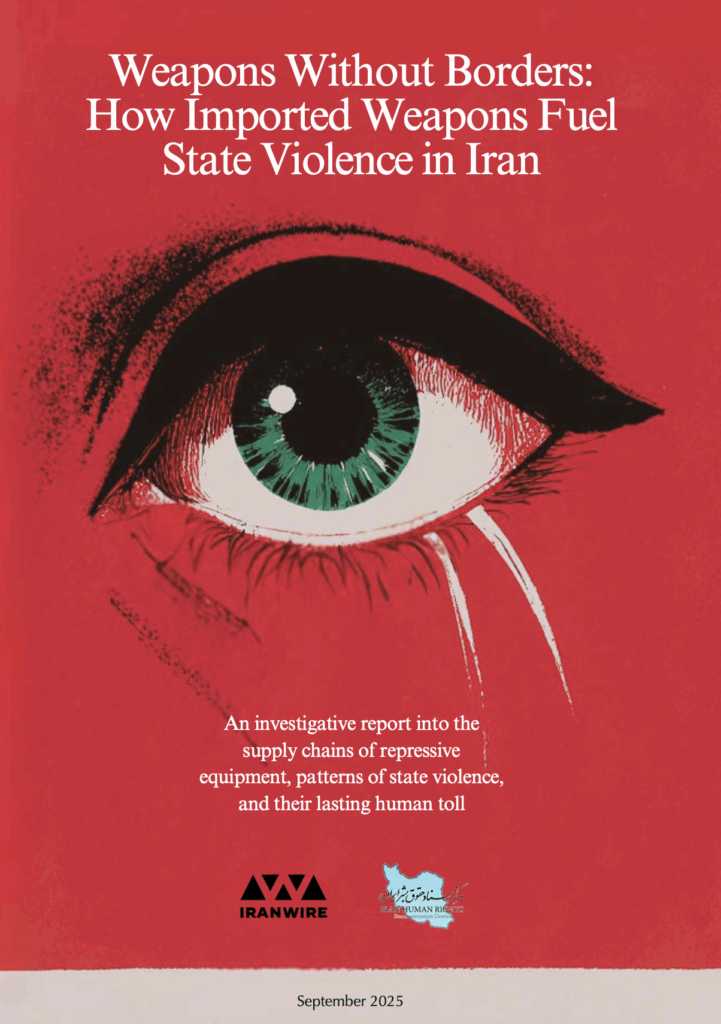
New Haven, September 29, 2025 – A detailed investigation released today by the Iran Human Rights Documentation Center (IHRDC) and IranWire uncovers how imported weapons and repressive technologies are fueling systematic state violence in Iran. Titled “Weapons Without Borders: How Imported Weapons Fuel State Violence in Iran,” the report maps the flow of arms, the actors behind them, and the devastating human consequences.
The report documents how Iran’s security forces and state agencies obtain weapons, surveillance tools, and equipment from international suppliers—often through complex networks designed to evade scrutiny.
Imported weapons have strengthened the regime’s capacity to suppress dissent, crack down on protests, and commit human rights abuses with impunity. The report highlights patterns showing that companies supplying such arms bear both moral and legal responsibility when those weapons are used to violate human rights. The human toll is stark: hundreds have been permanently disabled or killed.
This investigation offers the first comprehensive, evidence-based look at how external actors become complicit—directly or indirectly—in state violence in Iran. It underscores that human rights abuses are not solely domestic matters; they are enabled by an international ecosystem of trade, politics, and profit.
IHRDC calls for enhanced transparency and due diligence from arms-exporting companies to ensure they do not facilitate violations, as well as accountability mechanisms at both national and international levels—including sanctions, investigations, and human rights oversight. The report also urges greater support for victims and families seeking justice, reparations, and thorough documentation of abuses.
Joint Research Project of IranWire and the Iran Human Rights Documentation Center
September 2025
Download PDF Version
WARNING:
This report contains descriptions and images of violence and injuries, including graphic photographs, which some readers may find disturbing.
Executive Summary
This report examines the systematic use of so-called “less-lethal” weapons by Iranian law enforcement, security, and paramilitary forces during the 2022 nationwide protests following the death of Mahsa “Zhina” Amini. The investigation reveals a coordinated pattern of violence that violated both domestic law and international human rights obligations, potentially meeting the threshold for crimes against humanity.
Iranian law enforcement and security forces deliberately targeted protesters with shotguns, paintball guns, pellet rifles, and tear gas canisters, aiming at the head, face, and other sensitive parts of the body, in direct contravention of domestic operational guidelines and Iranian laws governing the use of firearms by armed personnel. Hundreds of documented cases resulted in permanent blindness and severe injuries, violating the right to life and the prohibition of torture and cruel, inhuman, or degrading treatment under the International Covenant on Civil and Political Rights. Extensive video evidence, including point-blank shootings of unarmed protesters, demonstrates that these so-called less-lethal weapons were often used as instruments of mutilation, prolonged suffering, and potential extrajudicial killing.
This repression was facilitated by an international supply chain. Equipment sourced from Turkish defense manufacturers (Hatsan, Akkar, Sarsılmaz) and North American recreational suppliers (Tippmann, DYE Precision), as well as ammunition components from French-Italian Cheddite Co., was diverted for use by Iranian security forces. Transfers of shotgun production technology to the sanctions-listed Iranian entities indicate potential breaches of international export controls. Manufacturers and intermediaries bear a legal and ethical responsibility under the UN Guiding Principles on Business and Human Rights to conduct downstream due diligence, and failure to prevent diversion or misuse of items like less-lethal weapons may constitute complicity under international law.
Beyond the immediate physical and psychological toll, the misuse of less-lethal weapons constitutes a serious violation of international law. Addressing these abuses requires urgent, targeted international measures that combine legal accountability, corporate responsibility, and transparent oversight of global supply chains. Indifference to this matter enables its repetition, while decisive action can reinforce the protection of human dignity.
To prevent further abuse, this report recommends: formally classifying shotguns, paintball markers, and similar launchers as dual-use products under international frameworks with mandatory end-user verification; requiring manufacturers and intermediaries to implement comprehensive downstream due diligence to monitor end-users and prevent diversion to repressive forces; and strengthening governmental and international oversight—including supply chain reporting and early warning systems—to ensure accountability and provide victims with remedies under international law.
Introduction
Following the death of 22-year-old Mahsa “Zhina” Amini in the custody of Tehran’s Morality Police on September 16, 2022, Iran witnessed a massive wave of nationwide protests that continued for months. Chanting “Woman, Life, Freedom”, thousands of Iranians took to the streets, calling for justice and an end to the ruling regime. In response, the Islamic Republic unleashed a campaign of violence and repression, deploying a wide range of weapons against its own citizens.
The weapons used included automatic and semiautomatic rifles, handguns, and machine guns. In addition, security forces made extensive use of so-called less-lethal weapons, including shotguns, pellet guns, paintball guns, and tear gas launchers. This was not unprecedented.
In November 2019, Iran had experienced another wave of nationwide protests sparked by a sudden, steep increase in fuel prices by the government. Over the course of almost one week, thousands of Iranians demonstrated across the country. Security forces used unprecedented violence to suppress the protests, killing hundreds and injuring many more.[1]
A comparison of the 2019 and 2022 crackdowns reveals important differences in the regime’s methods of repression. In 2019, the government relied primarily on overwhelming lethal force—employing Kalashnikov rifles and, in some cases, heavy machine guns—to fire directly at protesters’ heads and chests, seeking to silence dissent through mass killings. In 2022, however, the crackdown was more varied, gradual, and deliberately complex. Rather than focusing solely on mass shootings, authorities pursued a multi-layered strategy designed to inflict both physical and psychological suffering, establish long-term social control, and instill fear. This strategy combined lethal violence with psychological warfare, torture, targeted blinding, and permanent maiming.
Whereas shotguns and paintball guns were rarely used in 2019—and largely confined to special riot police units—their deployment in 2022 became widespread, across multiple cities and branches of the security forces. Protesters were deliberately targeted with direct fire from shotguns, paintball guns, and tear gas canisters aimed at the head, face, and other vital organs. These actions were systematic, deliberate, and extensive. Although classified as “less-lethal,” these weapons were used to kill, incapacitate, and inflict maximum pain.
The human toll was devastating. Hundreds were killed, and thousands more were permanently injured or disabled. Hundreds of protesters lost their eyesight. In one case, Seyed Javad Mousavi, a resident of Isfahan’s Khorasgan district, died after being shot in the eyes.[2] In another, Mohammad Hossein Erfan, who was blinded during the November 2019 protests in Karaj, Alborz Province, succumbed to his injuries in February 2024. [3]
The targeted blinding of protesters—with rubber bullets, metal pellets, and shotgun or paintball rounds fired at the face—constitutes serious physical harm intentionally inflicted by state agents. Under international law, such acts may amount to torture or cruel, inhuman, or degrading treatment, as they are used not only to punish but also to deter dissent.
This deliberate shift in strategy reflects the regime’s preference for creating lasting wounds rather than producing political corpses. While the direct use of lethal military weapons appeared to decrease, the organized nature, intensity, and consequences of the 2022 crackdown were even more profound. By inflicting complex and enduring physical and psychological harm, the state extended its violence beyond individual victims, embedding a deep and lasting scar in the collective memory of Iranians.
To examine these repressive policies, their human impact, and the supply chain for instruments of repression involving both Iranian and international entities, the Iran Human Rights Documentation Center (IHRDC) and IranWire collaborated on this report. Researchers conducted fact-finding through interviews with victims of the 2022 protests, analysis of weapons and suppliers, and engagement with corporate and international bodies. The legal team reviewed the documentation from both legal and technical perspectives, supplemented the record with additional evidence, and integrated interpretive analyses.
In addition to at least 14 individuals who lost their lives as a result of being shot with less-lethal weapons, at least 141 people have been identified who suffered serious injuries or permanent disabilities due to these weapons. From this number, at least 122 were injured by pellet (shotgun) rounds, eight by paintball projectiles, and nine by having been directly hit by tear gas canisters. The Kurdish-populated provinces in western Iran, with at least 49 cases, and the provinces of Tehran and Alborz, with 45 cases, together account for over 66 percent of the identified victims. Furthermore, in just two timeframes—September 20–21, 2022, and November 15–16 of the same year—at least 21 and 20 individuals, respectively, were seriously injured or permanently disabled across various parts of the country due to the use of less-lethal weapons.
It is noteworthy that the names of some victims have been excluded from the final tally due to the absence of sufficient and reliable information from independent sources capable of verification. Accordingly, the list of individuals harmed by the use of less-lethal weapons does not encompass all affected persons.
To prepare this report, the medical files of a number of individuals with eye injuries were shared with a global group of ophthalmology specialists. The results of their evaluations show that the pattern of eye injuries points to deliberate targeting. According to these specialists, the trauma caused by blindness is psychologically comparable to the experience of being diagnosed with cancer. This conclusion underscores the profound physical and psychological damages inflicted by this suppression tactic.
This report explores the manner in which the Islamic Republic has used less-lethal weapons, identifies the violations of domestic and international laws by the Iranian government, finds the companies and intermediaries who provide the regime with these weapons, and reviews the characteristics of the injuries inflicted on the protesters.
Methodology
To prepare this report, a combination of investigative research methods was employed, with a principal emphasis on Open-Source Intelligence (OSINT) research. Identification of weapons relied on reviewing a substantial collection of publicly available photographs and videos depicting security personnel from multiple branches and agencies deploying or carrying these arms, primarily sourced from social media platforms. Distinctive markings, manufacturer identifiers, and design characteristics of the weapons were systematically cross-referenced with verified manufacturer specifications to confirm their types and origins.
In addition, passive research techniques were applied, encompassing the monitoring of news channels, social media groups, and online chatrooms in which members of the Basij security battalions, the Islamic Revolutionary Guard Corps (IRGC), and police units shared visual documentation and information regarding weapons and tactical equipment. Notably, two Telegram channels, “Iranian Militarism” and “Iranian Defensive Power”, were included in this review. No direct interactions with individuals in these channels occurred; data collection was strictly observational, ensuring compliance with ethical research practices. Information obtained through these channels included two manuals detailing the use and maintenance of shotguns, published by the Imam Ali Security Battalions, a paramilitary unit under the IRGC with a documented role in riot suppression.
The Imam Ali Security Battalions function as specialized riot-control units under the authority of the IRGC’s Sarallah Headquarters in each province. Formed in response to the nationwide protests following the disputed 2009 presidential election, these battalions receive training in the use of light security weapons—including shotguns and submachine guns—alongside tactical driving and motorcycle operations. Their primary mandate is crowd control, and they are generally deployed in situations where Police Command of the Islamic Republic Iran, also known as FARAJA, is unable to restore or maintain public order.[4]
In the course of this research, a pamphlet titled Guide to Using Shotguns was analyzed and compared with documented actions of FARAJA forces during the 2022 protests. The analysis suggests potential violations of both domestic law enforcement regulations and internationally recognized standards governing the use of force.
Moreover, IranWire obtained a forensic weapons report prepared by an official expert from the Ministry of Justice, which had been submitted to a branch of the military prosecutor’s office concerning the killing of a civilian during the protests. This document was pivotal in confirming the deployment of a specific type of shotgun in crowd control operations.
To strengthen the identification of weapons and trace their procurement channels, interviews and consultations were conducted with military and arms experts, including Michael Eisenstadt (Washington Institute for Near East Policy), Chris Cobb-Smith (Chiron Resources), N.R. Jenzen-Jones (Forum on the Arms Trade), and members of Calibre Obscura.[5]
Additional interviews were conducted with Fariborz Karami Zand, a former Iranian police officer, who provided information on the types of weapons used and the methods of their procurement. Two experts from the United Nations Independent International Fact-Finding Mission on the Islamic Republic of Iran were also interviewed; they corroborated the use of shotguns and paintball guns in causing severe injuries during the 2022 protests and emphasized the involvement of intermediaries in arms imports.
Furthermore, dozens of interviews were conducted with individuals injured during the protests, several of which are referenced in this report. Medical evidence was reviewed to corroborate the types of munitions used. Interviews with six physicians—including ophthalmologists and emergency medicine specialists in Tehran who had examined the gunshot wounds sustained by protestors—provided key insights regarding weapon type, shooting distance, and targeting practices. In addition, dozens of medical records from injured individuals were analyzed to assess the severity, nature, and location of their injuries. These findings were further reinforced by a specialized report prepared by IranWire in collaboration with health researcher Katherine Hignett, who reviewed and analyzed the medical files of 20 individuals affected during the 2022 protest suppression.[6]
To illustrate the scope and systematic nature of violations committed by the Islamic Republic’s law enforcement and security forces in the use of less-lethal weapons against protesters and bystanders, two separate lists have been compiled: one documenting the 14 identified citizens who were killed, and another detailing 141 identified individuals who sustained injuries. These lists are based on a comprehensive review of medical records, forensic reports, and eyewitness testimonies, OSINT data, and include detailed information. The first list, presented in Appendix I, contains all relevant information regarding fatalities. The second list, in Appendix II, includes the names of injured individuals who have publicly discussed their experiences and are currently in safe locations abroad. To protect the safety of other individuals, their names have been withheld.
Over 500 photographs and videos were systematically reviewed to document weapon use, deployment methods, resulting injuries, manufacturer markings, and other distinguishing features. From this collection, more than 130 items were selected for reference throughout the report. With a few exceptions, all images were sourced from publicly available materials. Each image was verified for authenticity, geolocated when possible, and cross-referenced against credible reporting sources. Where feasible, analysis identified the time and place of recording, the original source, and the visible content. For images obtained from recognized and reliable outlets that have previously appeared in news or investigative reports, brief explanatory notes have been provided.
Two visual catalogues of weapons suspected to have been used in suppressing the 2022 protests were shared with 23 witnesses to corroborate identification. The objective was to determine the types of weapons observed in officers’ possession, the units to which those officers belonged, and the locations where the weapons were deployed. Some witnesses participated anonymously due to concerns about being identified or arrested. While these testimonies were not relied upon to establish the precise types of weapons used, they contributed to a more comprehensive understanding of the scale of weapon deployment and the forces involved.
Additionally, numerous videos depicting the shooting of protesters were closely examined to assess the circumstances, distances, manner, and apparent purpose of each discharge. All non-visual online sources cited in this report have been archived, and a comprehensive inventory of both visual and non-visual materials has been systematically organized and securely stored.
To assess potential violations by security and law enforcement personnel in the use of less-lethal weapons, the instructions provided to these forces were reviewed and evaluated against the United Nations Guidance on Less-Lethal Weapons in Law Enforcement and the Basic Principles on the Use of Force and Firearms by Law Enforcement Officials, particularly provisions concerning proportionality, necessity, and accountability.[7] The legal analysis involved a systematic comparison of observed law enforcement conduct with these international and also domestic standards.
Selected case studies were conducted on incidents for which clear, multi-angled footage was available, allowing for detailed examination of the aiming and deployment of weapons by security forces. These cases were specifically chosen to facilitate precise documentation of potential legal and procedural violations.
All companies identified in the report as suppliers of equipment were contacted regarding the use of their products in the suppression of protests in Iran. Among these, only the Turkish company Akkar responded, acknowledging commercial relations with an entity under the supervision of the Defense Industries Organization of the Islamic Republic of Iran (DIO), also known as SASAD, a subsidiary of the Ministry of Defense and Armed Forces Logistics of the Islamic Republic of Iran.
The identification of the types of weapons used relied on a combination of methods, including analysis of external features, trademark verification, review of court documents, interviews with weapons experts and a former Iranian police officer, examination of materials published by former and current security force members regarding organizational weaponry, assessment of training manuals prepared by the police and Basij security battalions, and the response from one of the weapon manufacturers. This multifaceted approach played a central role in ensuring accurate identification.
All footnotes in this report adhere to Bluebook citation standards. To ensure accuracy, fidelity, and consistency, proper nouns in the footnotes—including names of places, individuals, and organizations—originally written in Persian have been transliterated in accordance with the conventions of the International Journal of Middle East Studies (IJMES). The report also underwent multiple rounds of linguistic and editorial review to reinforce clarity, precision, and coherence.
Research Challenges
Investigating the procurement and use of repression equipment by the Islamic Republic of Iran presents significant obstacles grounded in both structural opacity and active concealment, compounded by the country’s systematic circumvention of international sanctions. Iran’s historical record of human rights violations, suppression of dissent, and participation in regional conflicts has resulted in extensive arms embargoes and human-rights related sanctions, creating barriers to transparent supply chains.
The Iranian government actively restricts external access to procurement records and commercial contracts related to repressive tools. Internal mechanisms, including the “Headquarters for Combating Sanctions,” provide legal cover for importers to circumvent sanctions, permitting non-transparent dual-use imports without standard documentation, including misrepresentation of origin or destination countries. These practices severely impede traceability, rendering legal accountability for arms transfers and violations of international sanctions extremely challenging.
Within this framework, importers are also allowed to clear certain goods without presenting a bank tracking code. These provisions are primarily intended for manufacturing units and the supply of raw materials to industries. In some cases, Iran’s Customs Administration permits the clearance of goods on credit and without full documentation or bank guarantees, granting importers additional time to complete the required paperwork. For instance, in April 2023, Ali Vakili, the Director of Imports at the Islamic Republic of Iran Customs Administration, issued a directive allowing production units to clear up to 90 percent of their raw materials without a banking tracking code until November 21, 2023.[8]
In February 2024, the hacktivist group “Uprising Until Overthrow” (Ghyam Sarnegouni) claimed to have accessed servers connected to the Islamic Consultative Assembly (Iran’s Parliament). The group appears to have ties to the opposition organization People’s Mojahedin Organization , also known as PMOI or MEK, though the extent of any direct affiliation remains unclear.[9] On February 13, 2024, the Parliament’s Public Relations Office confirmed the hack, noting unauthorized access to certain documents and asserting that some leaked information had been manipulated.[10] Among the documents was the text of the resolution from the 48th session of the Headquarters for Combating Sanctions.[11]
There is no official, publicly available information detailing the Headquarters for Combating Sanctions as a formal institution within the Iranian governmental structure. Evidence, however, indicates the existence of entities tasked with countering sanctions. In June 2010, the Minister of Foreign Affairs announced the establishment of the Special Economic Measures Headquarters, intended to coordinate government agencies to mitigate the effects of sanctions.[12]
Similarly, in June 2018, the First Vice President announced the formation of a sanctions-combatting headquarters approved by the Supreme National Security Council.[13] Around the same period, at the 46th meeting of government and private-sector representatives in Tehran Province, a proposal was made to establish a headquarters led by the First Vice President to counter U.S. sanctions.[14] While the exact structure and relationships of these entities remain unclear—and none has been formally designated as the Headquarters for Combating Sanctions—they appear to play an effective role in facilitating sanction circumvention through inter-agency coordination.
The first clause of the leaked resolution from the 48th session grants broad authority to importers, explicitly permitting the import of sanctioned and dual-use items that, in addition to civilian applications, may be used for military purposes or acts of repression. The clause states:
“In order to facilitate the import of sanctioned and dual-use goods, to accelerate the implementation of projects needed by the country, and to prevent the disclosure of information about sanctioned goods, the import and clearance of sanctioned, dual-use goods—including those of Iranian companies explicitly sanctioned—is permitted, upon the determination and responsibility of the relevant minister or heads of independent agencies under the supervision of the vice presidents, provided that the registered order matches the actual goods, in the following cases:
-Non-submission of a certificate of [the country of] origin or acceptance of a certificate of origin issued for destination countries other than Iran;
-No requirement for the certificate of inspection from the [country of] origin;
-Acceptance of inconsistent documents—export tariff of the country of origin, the destination, the name of the recipient and so on—or inconsistent names;
-Endorsement of the bill of landing where the original bill of landing cannot be provided;
-Acceptance of a non-original bill of lading solely by submitting an endorsed name-change, without requiring presentation of a letter of reconciliation.”[15]

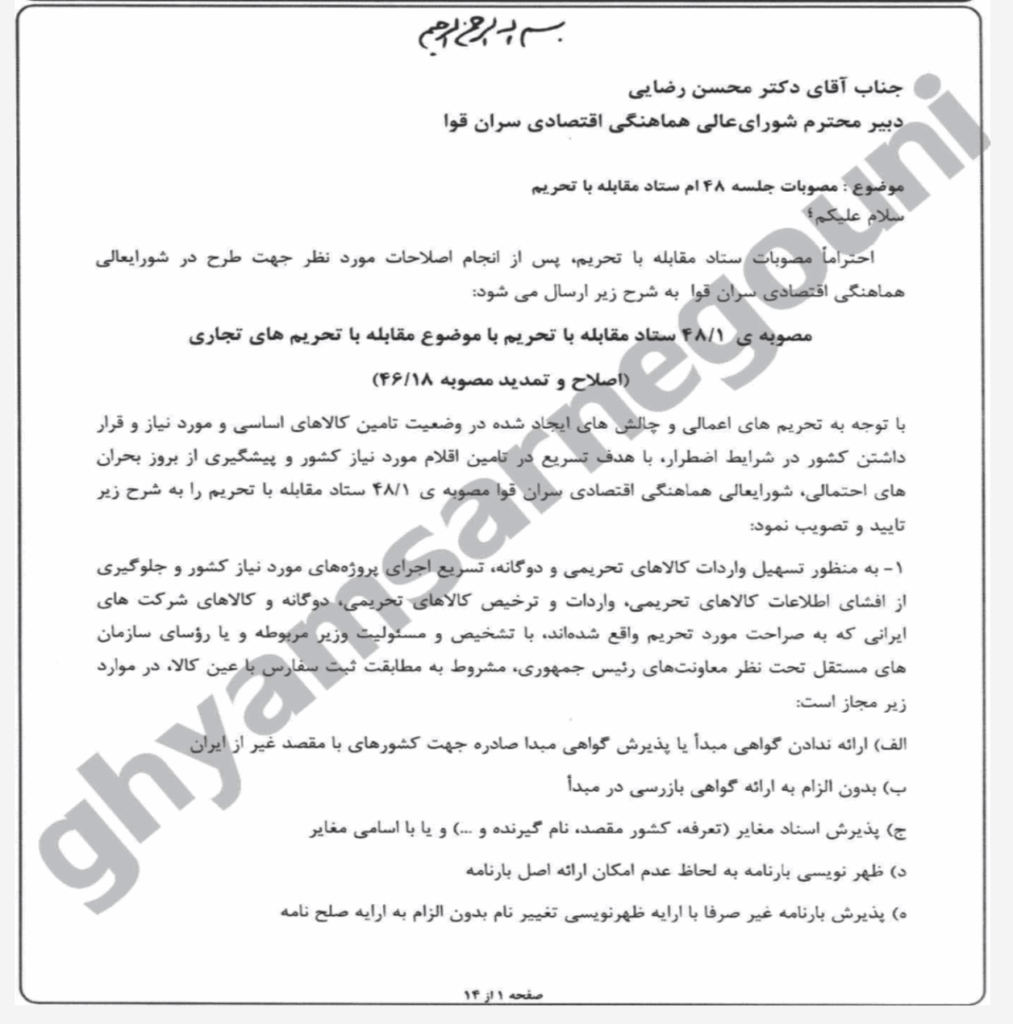
These provisions effectively allow importers to register sanctioned goods as permissible, alter the declared country of origin and destination, and conduct payments through unofficial channels and intermediaries. As a result, tracing the movement of goods and associated financial transactions becomes exceedingly difficult.
Another significant research challenge stemmed from the fear of government retaliation, discouraging knowledgeable individuals from providing information. The regime’s longstanding record of persecuting dissidents deters potential witnesses and whistleblowers from cooperating, creating substantial barriers to data collection. This fear is well-founded, given the government’s history of targeting opposition members and individuals who have disclosed sensitive information.
Financial sanctions further complicate investigations. Severe restrictions on Iran’s banking system and limited access to the global money transfer infrastructure have prompted widespread reliance on informal financial channels. Transfers are often routed through multiple intermediaries across different jurisdictions, employing various methods to obscure the flow of funds. This multi-layered process makes it extremely difficult to trace financial movements or identify the principal sources of funding used to acquire tools of repression. Funds are frequently routed through informal networks, undermining transparency and contravening international anti-money-laundering obligations.
Despite these obstacles, this report successfully identifies some elements of the supply network for repressive equipment, drawing on corroborated OSINT, expert interviews, forensic documentation, and eyewitness testimony. These methodological approaches ensure that the findings adhere to rigorous standards of verifiability and legal relevance.
1. Iranian Importers of Weapons, Munition and Military-Security Equipment
United Nations Security Council Resolution 1929 imposed broad restrictions on the sale of weapons, munitions and related components to the Islamic Republic of Iran.[16] This resolution falls under Chapter VII of the UN Charter, rendering the restrictions binding on all UN Member States, with potential legal consequences for non-compliance, including referral to the Security Council sanctions committee. While Resolution 1929 did not explicitly ban conventional weapons, it called on states to exercise caution, vigilance, and self-restraint in selling such weapons to Iran.[17]
Certain restrictions on the sale of light and conventional armaments to Iran were officially lifted in October 2020, following the provisions of the Joint Comprehensive Plan of Action (JCPOA)—the nuclear agreement signed on July 14, 2015, between Iran and major world powers—and its subsequent endorsement by the UN Security Council Resolution 2231 on July 20, 2015.[18] The remaining restrictions ended on October 18, 2023.[19] If triggered, the snapback mechanism under Resolution 2231 would restore the provisions of the pre-JCPOA sanctions resolutions adopted between 2006 and 2010, including Resolution 1929, which imposed extensive restrictions and an arms embargo. Accordingly, snapback would reinstate the arms-related restrictions and other measures of these resolutions, though its scope remains subject to legal and political debate within the Security Council.
The European Union’s restrictive measures against Iran, particularly concerning arms and related materiel, are governed by a series of legal instruments, with Council Decision 2012/35/CFSP being a key component. This framework establishes a comprehensive and total prohibition on the sale, supply, transfer, or export of all arms and related materiel to Iran, including all firearms, ammunition, and their components, regardless of their intended use or the supply chain involved. This prohibition, which creates significant legal liability, is also intrinsically linked with the EU’s dual-use export controls, which prohibit the transfer of items with both civilian and potential military applications. The legal framework is deliberately designed to prevent circumvention, holding sellers and intermediaries liable even if items are transferred indirectly. Enforcement of these sanctions is a shared responsibility among EU Member States, and violations can lead to serious penalties under domestic laws of EU countries, including administrative fines, criminal prosecution, and the seizure of goods.[20]
Among the most significant Iranian companies involved in importing and manufacturing equipment used to suppress urban protests are Naji Pas, Entebagh Gostar Sepehr, and Naji Pars Amin—each of which is affiliated in some manner with the Cooperative Foundation (Bonyad Taavon) of the Law Enforcement Command of the Islamic Republic of Iran, also known as FARAJA.
Article 2 of the charter of the FARAJA Cooperative Foundation states that the foundation is a “non-profit institution with independent legal identity, affiliated with NAJA.”[21] The name of the Law Enforcement Force of the Islamic Republic of Iran, formerly abbreviated in Persian as NAJA, was later changed to the Law Enforcement Command of the Islamic Republic of Iran, with the Persian abbreviation FARAJA. Its stated goal is to improve the livelihood and the welfare of FARAJA personnel, and it has branches and affiliated institutions in various parts of the country.[22] According to a ruling by the General Board of Iran’s Administrative Court of Justice, the FARAJA Cooperative Foundation is not considered a governmental entity.[23] Despite this, the Foundation—whose representative sits on the board of directors of Naji Pas Company—was added to the U.S. Treasury’s sanctions list in 2020 for its role in facilitating human rights abuses, thereby prohibiting U.S. persons from engaging in transactions with it.[24]
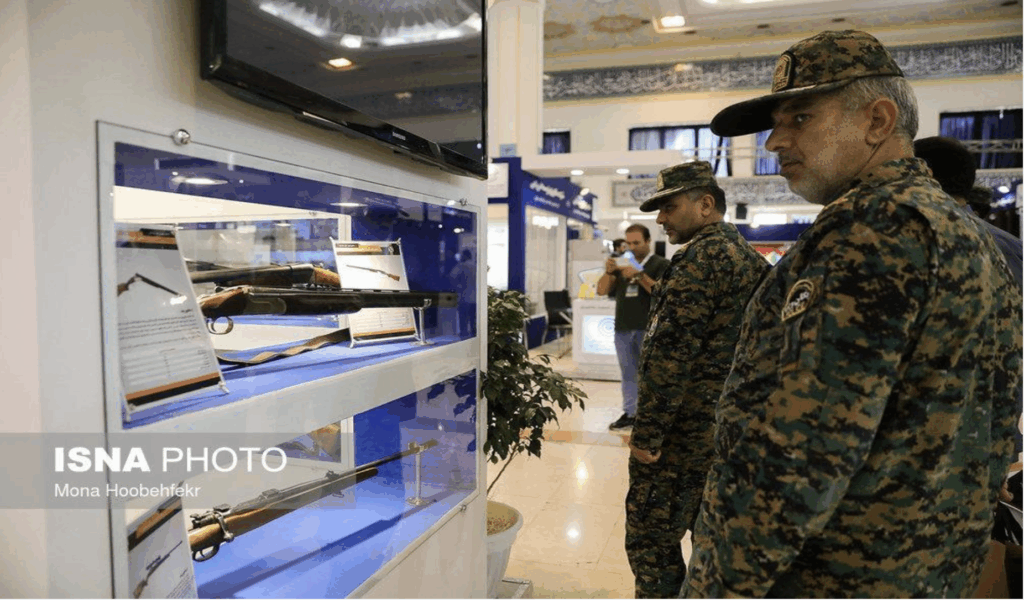
Naji Pas Company was established in 2003 with the aim of selecting and purchasing the equipment required by police from domestic and foreign sources, and its current CEO is Reza Asgharian.[25] The company provides business consulting services, participates in domestic and international competitive biddings, carries out imports and exports, equips factories, and also organizes the International Police Equipment and Supplies Exhibition, under the brand name IPAS Expo, in Tehran every year.[26]
IPAS Expo was first held in 2001, at the suggestion of the Commander of the Islamic Republic of Iran Police Force. Responsibility for organizing the exhibition was assigned to the Police Cooperative Foundation, formerly known as the NAJA Cooperative Foundation and now known as the FARAJA Cooperative Foundation.[27] Alireza Aliabadi, former CEO of Naji Pas Company, stated that, products and technologies from 29 countries were presented at the exhibition in 2017.[28] IPAS Expo is inaugurated each year by the Commander-in-Chief of the Law Enforcement Force of the Islamic Republic of Iran .[29]

Over the past years, representatives from the companies “Naji Research and Development,” “Naji Pooshesh Zahedan,” “Najm Khavarmianeh Chain Stores,” “Tavan Tamin Shafaq,” and “Tavan Sarmayeh Pouya” have periodically served in Naji Pas Company’s board of directors.[30] All these companies are affiliates of the FARAJA Cooperative Foundation. Naji Research and Development Company is a provider of information technology to police offices.[31] Naji Pooshesh Zahedan is one of the main providers of military apparel in Iran.[32] Najm Khavarmianeh Company, through its chain stores, supplies consumer goods and offers services such as credit cards to FARAJA personnel.[33] Tavan Tamin Shafaq Company is responsible for supplying and distributing the goods needed by the police force, and Tavan Sarmayeh Pouya Company is active as a holding company in areas such as energy and investment.[34]
Evidence shows that Naji Pas Company played a pivotal role in providing equipment that led to serious injuries, including the blinding of some protesters in 2022. On October 20, 2022, at the height of nationwide protests, Reza Asgharian, the company’s CEO, announced that “more than 95 percent of the country’s security equipment is provided by private companies.”[35] According to statistics recorded in the Iranian Commercial Companies Database, Naji Pas Company has officially received at least €9,764,431 in foreign currency in recent years.[36]

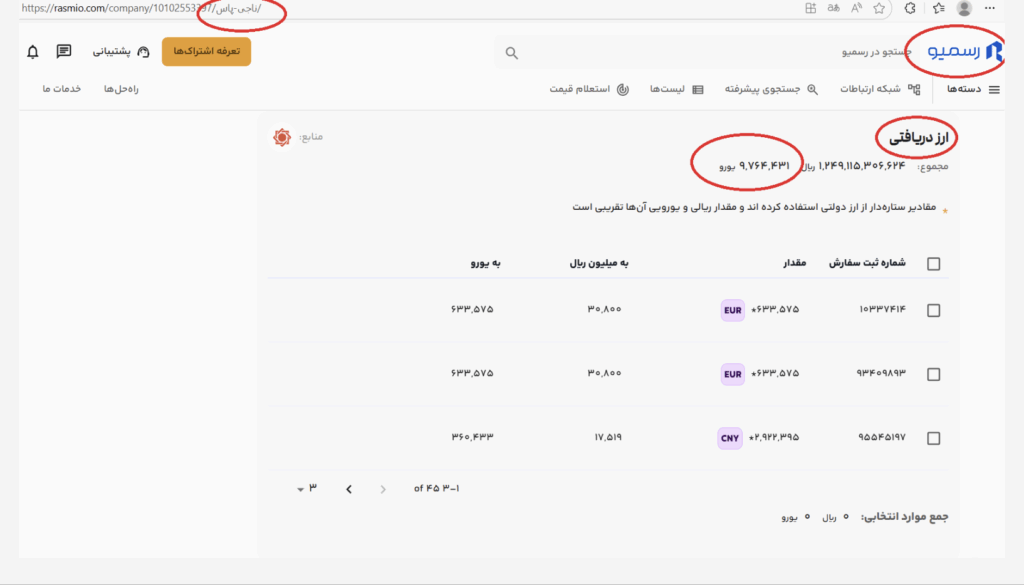
The substantial inflow of foreign currency to Naji Pas indicates that these funds may have been used to finance the purchase of weapons and ammunition. Such transactions raise significant concerns under the Financial Action Task Force (FATF) Recommendations, particularly regarding customer due diligence, the reporting of suspicious transactions, and the requirement for enhanced scrutiny of politically exposed persons and entities operating in high-risk jurisdictions.[37]
These concerns are especially pronounced given Naji Pas’s involvement in procuring security and military equipment—activities that warrant heightened oversight under FATF standards. As a member state, Türkiye is obligated to monitor high-risk transfers and politically exposed persons and entities. Notably, several of the Turkish-made shotguns referenced in this report were exhibited for the first time at the IPAS Expo.[38]
Reza Asgharian and Naji Pas Co. were placed on the U.S. Treasury Department’s sanctions list in March 2023.[39] Given this designation, any international supplier providing equipment to them risks exposure to secondary U.S. sanctions, including asset freezes and restrictions on the export of U.S.-origin technology.
Entebagh Gostar Sepehr Co., whose CEO is Gholamreza Ramezanian Sani, specializes in the production of telescopic sights for sniper rifle and a complete supply of riot control equipment for security forces.[40] Ramezanian Sani was placed on the sanctions list by the United States Treasury Department in March 2023.[41] The company Naji Pars Amin is also one of the private entities active in the field of protection and surveillance services in Iran, operating with an official license from FARAJA.[42] The U.S. Treasury Department also sanctioned this company and its CEO, Bahram Abdollahinejad, for their role in preparing the groundwork for the violent suppression of protests in 2022.[43]
The Iranian government systematically withholds data on imports of security and law enforcement equipment, particularly weapons and ammunition. While official figures published by the Iranian Chamber of Commerce report that imports of items such as shotguns, paintball guns, and related ammunition are zero, international trade statistics tell a different story. These discrepancies between domestic reporting and United Nations trade data suggest potential violations of international trade sanctions and indicate heightened money laundering and terrorism financing risks, as funds may be channelled through unregulated networks and front companies.
According to information published by the United Nations, the following items were exported to Iran between 2013 and 2023 from Türkiye alone:
- $6,295,912 worth of shotguns and similar items under Commodity Code 9303;[44]
- $6,266,076 worth of sports shotguns and similar items under Commodity Code 930320;[45]
- $6,124,259 worth of cartridge and other munitions under Commodity Code 9306;[46]
- $3,484,322 worth of munitions and cartridge components for shotguns under Commodity code 930629;[47] and
- $1,051,384 worth of firearms, parts for firearms, and accessories under Commodity Code 9305.[48]
2. Intermediary Front Companies and Money Changers
Numerous Iranian companies cooperate with the Islamic Republic in acquiring military equipment or parts, but neither their websites nor their official articles of incorporation reveal the true nature of their activities. One of these companies is “Pardazan System Namad Arman” (PASNA), whose director is Mehdi Khoshghadam.[49]
Pardazan System Namad Arman Company is an importer of military, electrical, telecommunication, and mechanical equipment, as well as tools related to the oil, gas, and petrochemical industries. The company was established in February 2011 with the goal of circumventing U.S. sanctions by creating front companies in Malaysia, China, and Hong Kong.[50] According to the U.S. Treasury Department, the company provided financial, material, and technological support to the Iran Electronics Industries (IEI) also known as SA Iran, which is affiliated with the Iranian Defense Industries Organization (DIO), also referred to as SASAD. After being placed on the U.S. sanctions list in 2017, Pardazan System Namad Arman changed its name to “Faraz Tejarat Ertebat.”[51]
Under U.S. sanctions laws, the use of front companies acting on behalf of sanctioned entities may give rise to secondary sanctions exposure. Likewise, EU regulations prohibit the provision of assistance to such entities, and national implementing measures may criminalize attempts at circumvention.
In March 2023, Mehdi Khoshghadam—also known as “David Lei” and “Pouyan”— was charged with conspiracy to illegally export American technology to Iran and money laundering, and he was officially added to the U.S. sanctions list shortly thereafter.[52]
“Amvaj Nilgoun Bushehr,” is an import-export company which was incorporated in 2011.[53] According to the U.S. Department of Treasury, this company has served as a front company for Pardazan System Namad Arman and is part of an international sanctions evasion network that has facilitated the procurement of electronic components for Iran’s military program, including those used in unmanned aerial vehicles (UAVs).[54] The company was added to the U.S. sanctions list on April 19, 2023.[55]
According to open-source information, the company has received close to one million euros in official currency, even though its last registered capital was only 100,000 tomans, worth a mere $1.01 in the free-market exchange rate in September 2025.[56] This significant discrepancy between reported capital and transactional flows indicates potential suspicious activity under FATF criteria.
In addition to referencing intermediary companies, it is necessary to pay attention to two key concepts in the military and security equipment supply chain. The “official rate” applies to any foreign currency that is allocated to individuals or companies by Iran’s Central Bank at a rate lower than the free market rate for purposes such as managing foreign currency exchange market, controlling inflation, or supporting specific economic activities. This term encompasses all forms of currency that are allocated through government intervention in the market.[57] The “preferential currency” is a specific subset of official rate, designated for the import of essential goods—such as medicine and basic foodstuffs—with the aim of supporting vulnerable populations. The exchange rate for this type of currency is usually significantly lower than the free market rate.[58]
Evidence suggests that a number of front intermediary companies exploit the preferential exchange rate to purchase weapons or, at least, parts related to the manufacturing of military weapons. This happens despite the fact that, in January 2024, the Iranian parliament halted the allocating of foreign currency at the preferential rate for the import of 200 essential consumer goods, citing a shortage of foreign currency resources, and also reduced the foreign currency budget apportioned for medicine and food by five billion dollars.[59]
Even though no precise information on the amount of foreign currency allocated to the import or domestic production of military armaments within Iran is officially published, in some exceptional cases, information on this subject can be obtained from company databases, as well as statements from the U.S. Treasury Department or the U.S. Department of Justice. In June 2024, the U.S. Treasury Department announced that a sprawling “shadow banking” network aimed at laundering billions of dollars in oil and petrochemical revenues has helped to finance Iran’s military and security forces. According to this report, foreign currencies obtained from these activities were used to purchase and procure military equipment.[60]
“Omid Sepah Exchange Company” and “Hekmat Iranian Exchange & Foreign Currency Services Company” operate as representatives of Bank Sepah in Tehran and conduct banking transactions through front companies, relying on Bank Sepah. Between 2020 and 2023, according to the U.S. Treasury, a person by the name of Ramin Jalalian conducted transfers to the Islamic Republic Ministry of Defense and Armed Forces Logistics (MODAFL) worth over $30 million. This collaboration was carried out through three exchange companies: Omid Sepah, Hekmat Iranian, and “Ansar Exchange”—the currency exchange arm of Ansar Bank, which is controlled by the Revolutionary Guards Corps (IRGC). All three of these exchange companies are listed on the U.S. Department of the Treasury’s sanctions list.[61]
A number of exchanges outside of Iran play an intermediary role in importing weapons into Iran. For example, since 2019, two exchange offices that operate in Türkiye, “Seyyed Mohammad Mosanna’i Najibi” and “Sadaf,” have been transferring funds to the Islamic Republic Armed Forces and the IRGC, using front companies in Türkiye, the United Arab Emirates (UAE), China, and the Marshall Islands. The procurement division of MODAFL, in cooperation with the IRGC and in cooperation with these exchanges, has made the necessary arrangements to transfer tens of millions of dollars.[62]
The names of 27 front companies based in the UAE, the Marshal Islands, and Türkiye affiliated with Najibi’s exchange firm have been placed on the U.S. Treasury Department’s sanctions list. Among these companies are “Nourian Exchange” and “Iranian Exchange,” owned by Siavash Nourian. He has carried out activities such as establishing front companies and accounts, holding MODAFL’s funds in offshore accounts, converting foreign currencies, transporting foreign currency using couriers, retrieving revenue from oil and petrochemical sales, and transferring funds to suppliers of MODAFL and the IRGC.[63]
Seyyed Reza Mir Mohammad Ali is a key confidant of the MODAFL’s procurement division and the IRGC. He is also the CEO and owner of Iran-based “Atropars Company,” also known as “Atropars Exchange,” which is one of the 27 companies on the U.S Treasury Department’s sanctions list used by MODAFL to conduct financial activities outside of Iran.[64]
None of the official websites of arms manufacturing companies, intermediary firms, or the reports and sanctions lists of the United States and the European Union provide details of the specific weapons that these companies have collaborated to import into Iran.
In addition to these companies, cryptocurrency exchanges have become one of the most important tools for the Iranian government to move funds and bypass sanctions. For example, the Iran-based crypto exchange “Nobitex” has transferred about $8 billion to Iran through cryptocurrency exchanges with the crypto giant “Binance.” The company has also used some of its resources to bypass sanctions.[65] In 2023, the Israeli Ministry of Defense announced that it had seized cryptocurrency accounts worth millions of dollars that belonged to the IRGC. These accounts were used to conduct various transactions, including the procurement of weapons.[66]
Nobitex Co. was founded in 2017 under the legal name “Rahkar Fanavari Noyan” by a group of graduates of Sharif University of Technology in Tehran, with Amir Hossein Rad as its CEO.[67] Binance Exchange, one of the world’s leading cryptocurrency exchanges, was founded in China in 2017, but it moved its central office out of the country after it came under pressure by the Chinese government. As of now, however, it has yet to decide where to base its global headquarters.[68]
3. Sports Federations of the Islamic Republic of Iran
One of the ways the Islamic Republic of Iran imports less-lethal weapons—such as shotguns and paintball guns—is by purchasing the equipment through the country’s sports federations and associations. According to Fariborz Karami Zand, a former police officer, as well as several distributors of sports and hunting equipment interviewed for this report, the Shooting Sports Federation and various martial arts federations have served as key channels for such imports—particularly paintball guns—due to the military’s effective control over these organizations.[69] These activities may have violated EU and U.S. sanctions on dual-use items, as such sporting equipment can be classified as military-use goods when supplied to security forces.

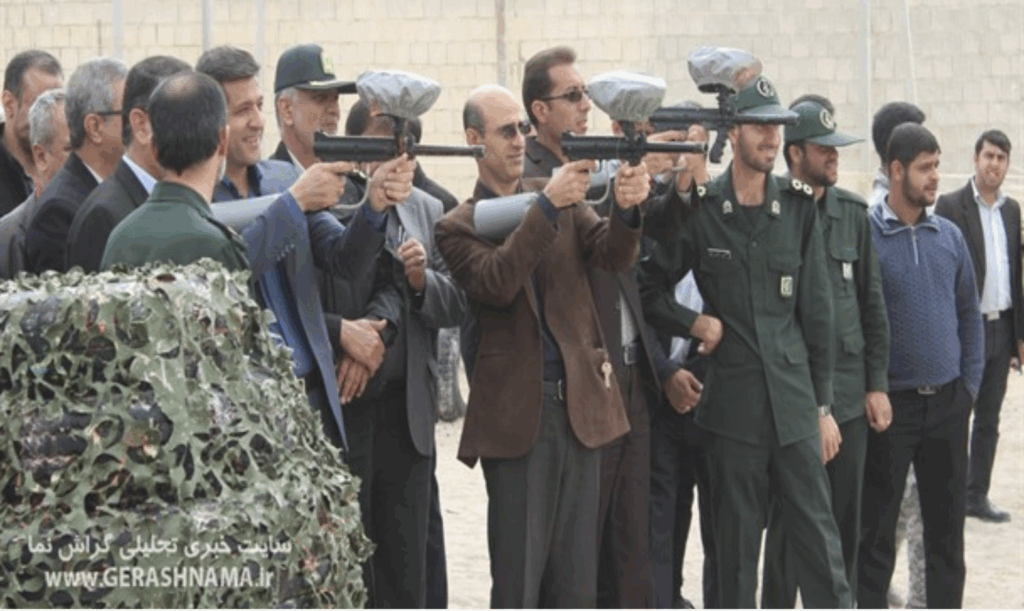
Starting with the second term of Mohammad Khatami’s presidency in 2001, the presence of elements affiliated with the IRGC and the Ministry of Intelligence in the structure of the Physical Education Organization (now known as the Ministry of Sports and Youth), along with the National Olympic Committee and various sports federations increased. This trend continued during the presidency of Mahmoud Ahmadinejad (2005-2013) and accelerated with the administration of his successor, Hassan Rouhani. Finally, during the administration of Ebrahim Raisi, a number of federations—particularly martial arts federations—came under the complete control of the IRGC and the Ministry of Intelligence.[70]
Within shooting sports, both single-barrel and double-barrel shotguns are widely used in disciplines such as trap, clay, and skeet shooting. Competitions in these categories are held under the supervision of the Shooting Sports Federation of the Islamic Republic of Iran.[71] The current president of this federation is IRGC Brigadier General Morteza Ghorbani, who is also an advisor to the Chief of Staff of the Armed Forces and a senior advisor to the commander-in-chief of the IRGC.[72] The federation’s vice president is Abbas Mohammadi, a colonel with the IRGC Intelligence Organization. Changiz Mosayebzadeh, a member of the federation’s board of directors, serves as the director of the Physical Education Department of the Islamic Republic of Iran Army.[73]

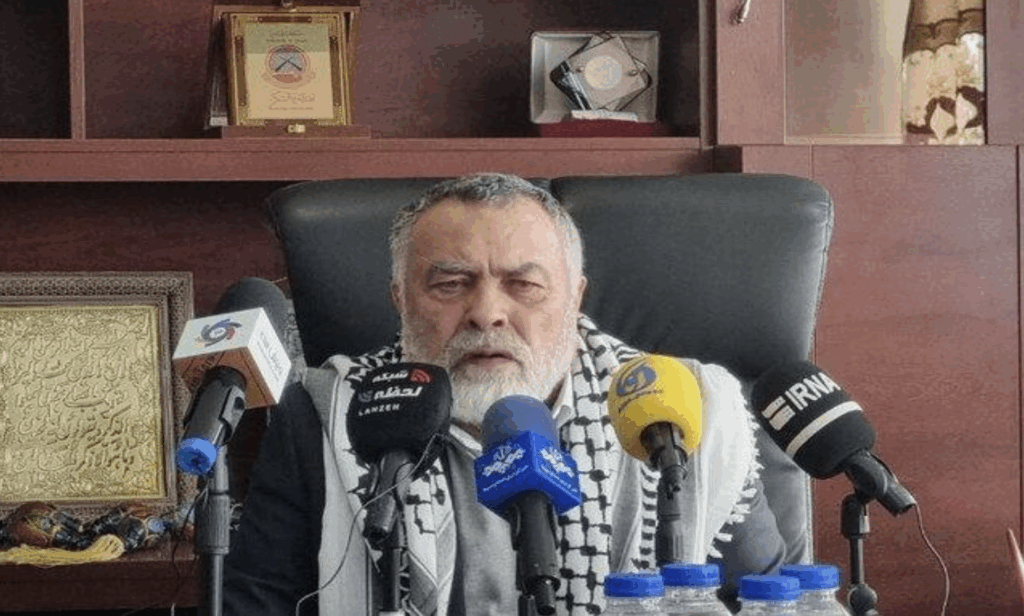
Paintball in Iran is organized under the supervision of the Iran Paintball Association, which operates as a subsidiary of the Iran Sports for All Federation. This association oversees national, regional, and international competitions held annually.[74] Its current head is Brigadier General Reza Azarian, a former commander of the Iranian Army.[75] His predecessor, IRGC Second Brigadier General Mehr Ali Baran Cheshmeh, previously served as an instructor at the Police Academy.[76] The Iran Sports for All Federation, which oversees the association, is currently headed by Ali Khalili.[77]
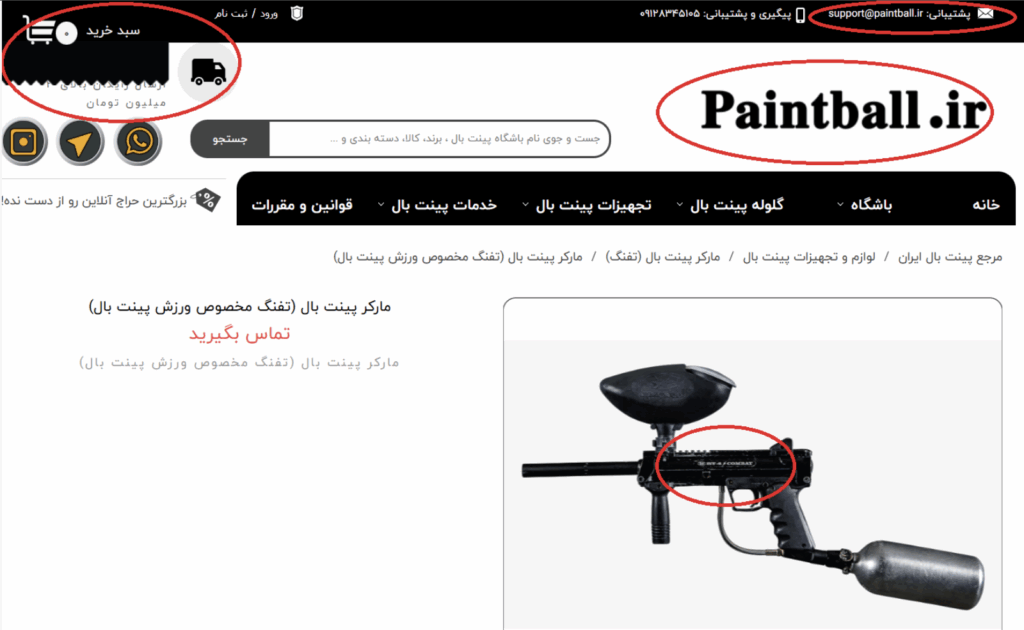
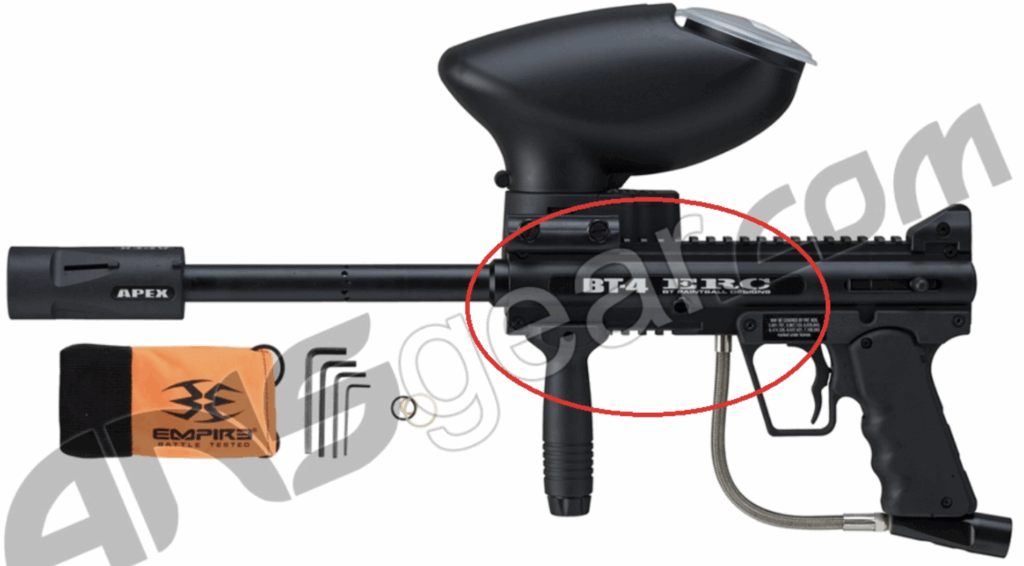
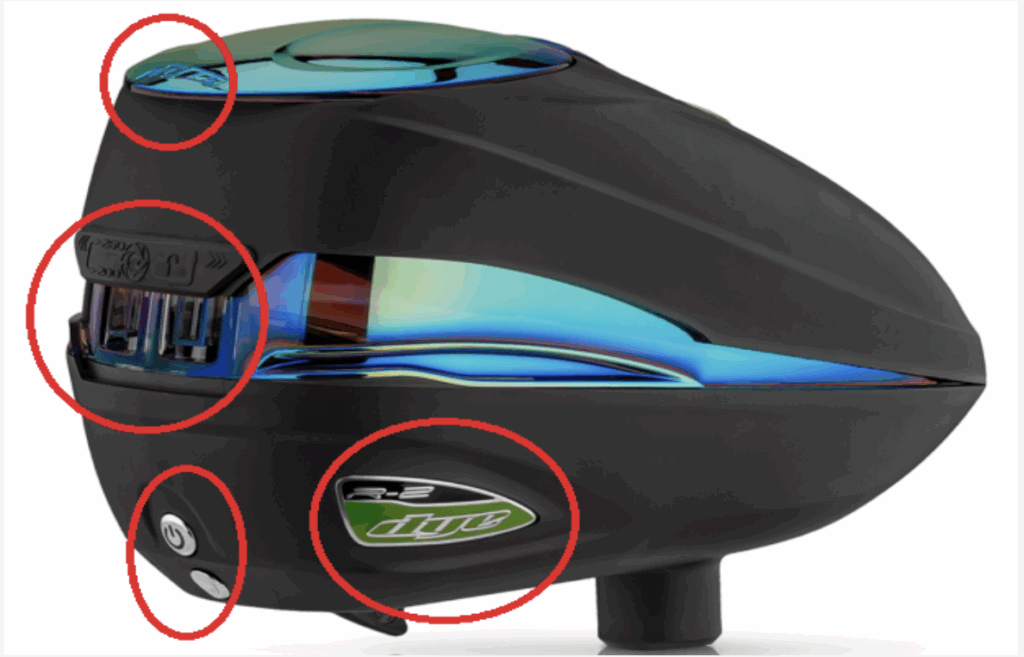
The Paintball Association of the Islamic Republic of Iran appears to play a central role in supplying paintball guns to Iranian security forces. At least one model of paintball gun—the Empire BT-4 Combat Marker, manufactured by the U.S.-Canadian company Tippmann—is listed for sale on the association’s official website. The website also offers parts such as paintball “hoppers” or “loader,” manufactured by the American company DYE Precision, also known as DYE.[78] A paintball hopper or loader is a device responsible for storing paintballs and continuously feeding them into the marker (paintball gun).
The concentration of IRGC and intelligence officials across these federations highlights a high-risk nexus. Financial institutions operating under FATF standards should have designated these federations as high-risk clients, applied enhanced monitoring of their transactions and reported suspicious activity to the appropriate authorities. The deliberate use of ostensibly civilian organizations to obscure weapons procurement represents a clear case of sanctions evasion, exposing international partners to heightened reputational and legal risk.



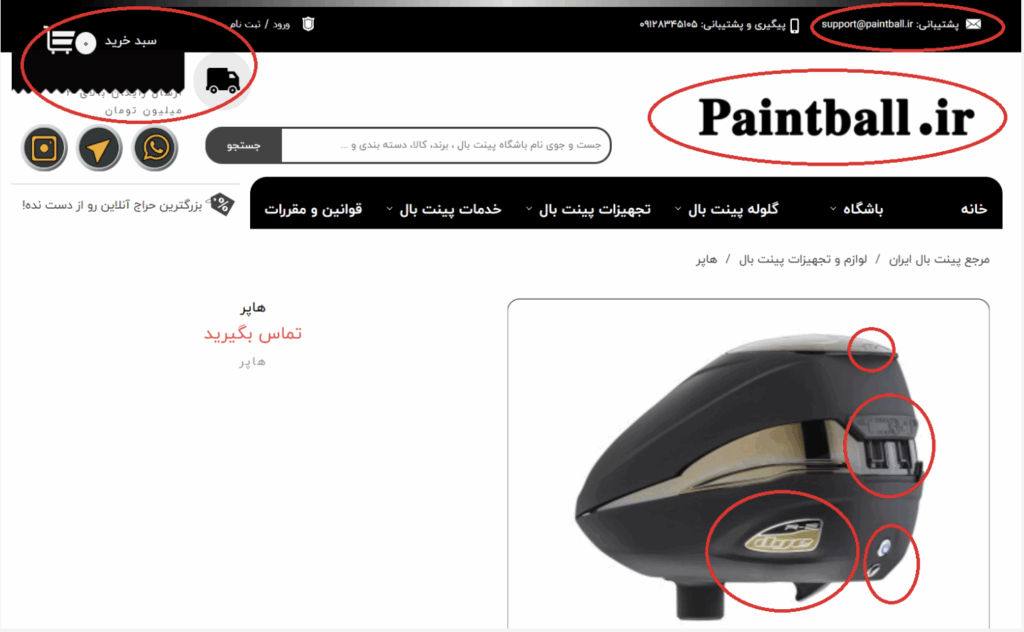

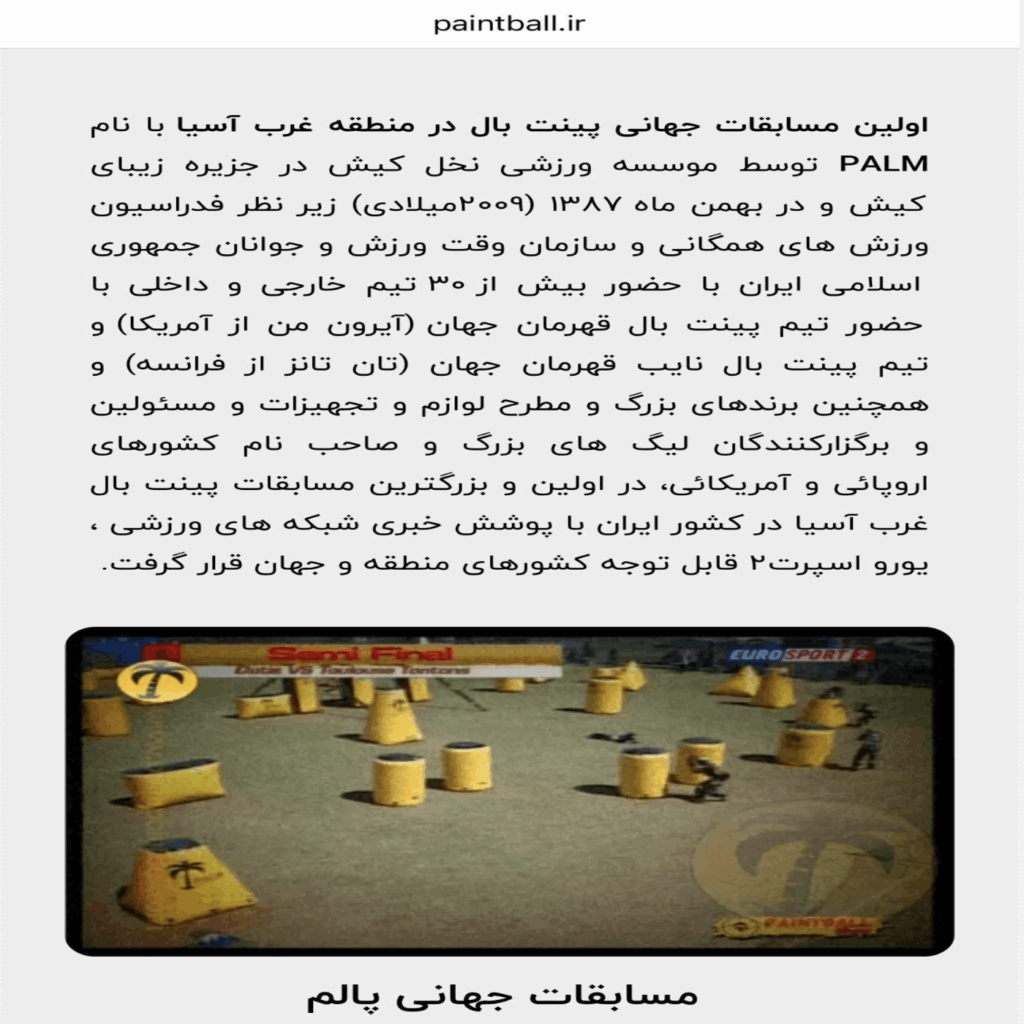
In response to inquiries by IranWire researchers, the United Paintball Federation—the international federation for this sport—denied that Paintball Association of the Islamic Republic of Iran is a member.[79] This comes despite the fact that the Iran Paintball Association claims affiliation with the United Paintball Federation, and, in recent years, it has actively participated in regional tournaments, including international contests organized by the Paintball League Middle East (known as “PALM”). The first edition of this tournament was held in 2009 with the participation of teams and important paintball equipment manufacturers from the United States and Europe.[80]


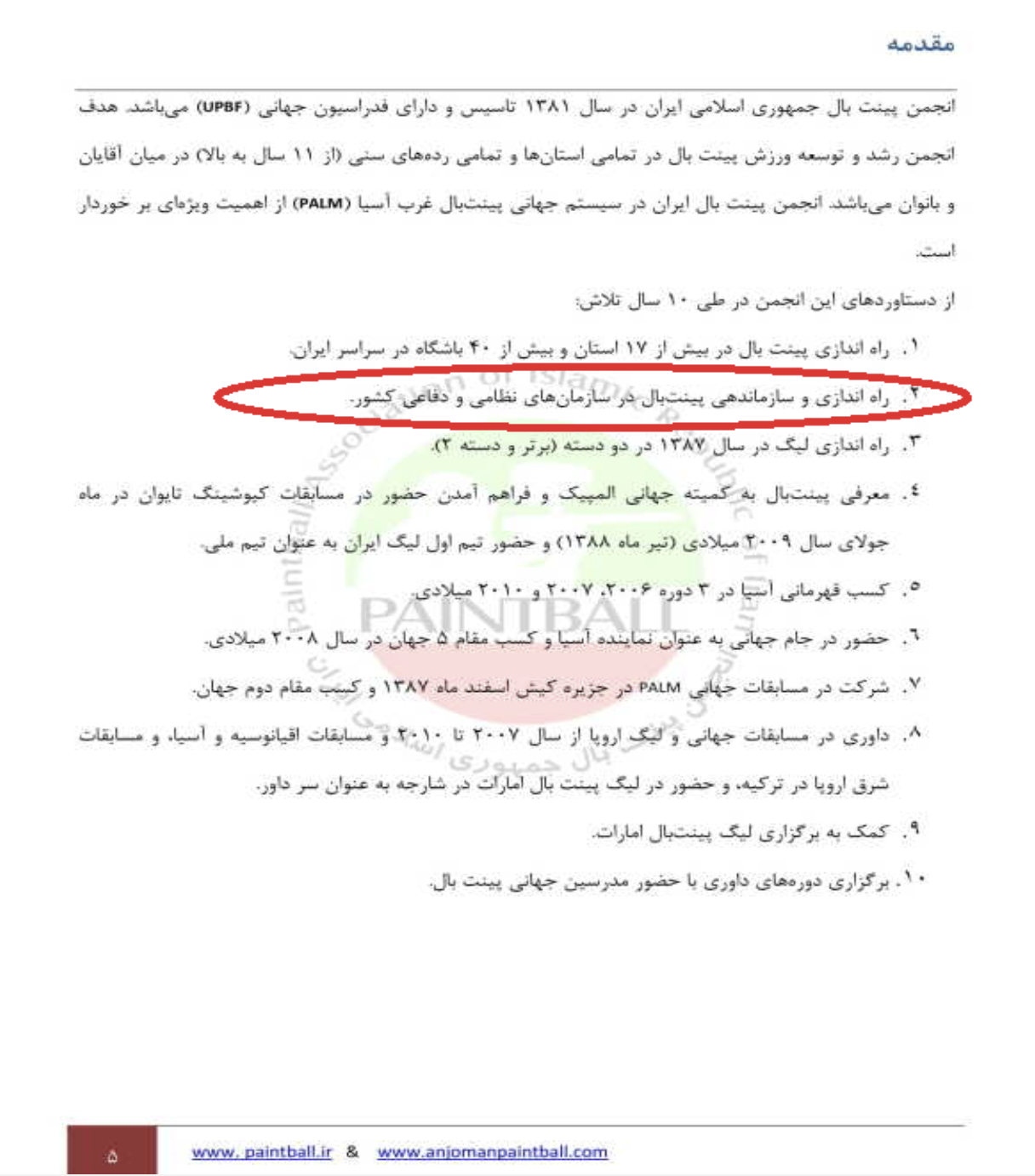
In a section of the “Paintball Regulations Collection, 2015,” the Paintball Association of the Islamic Republic of Iran cites “launching and organizing [the use of] paintball in the country’s military and defense organizations” as one of its achievements.[81] This, combined with the Islamic Republic’s systematic practice of concealing imports of weapons, makes it more likely that Iran Paintball Association plays a role in meeting the needs of the security forces. Similarly, it appears that the Shooting Sports Federation of the Islamic Republic of Iran also plays a role—under the guise of procuring sporting equipment—in supplying certain parts or ammunition needed for shotguns used by security forces.
In July 2009, Hamid Nateghi, the CEO of Zubin Sport Shooting and Hunting Services Co. and the representative of the Shooting Sports Federation in the field of weapon imports needed by athletes, announced that the volume of weapons and ammunition imported for shooting sports had increased twentyfold compared to previous years. “While in 2004 and 2005, our total imports in these two categories did not reach even 500 million tomans, fortunately, today the value of these imports has exceeded 10 billion tomans,” he said.[82] Based on the exchange rate at that time (950 to 990 tomans per US dollar), the sum of 10 billion tomans corresponded to a value exceeding 10 million US dollars.
Citing the Ministry of Sports and Youth’s news website, Mehr News Agency reported that Masoud Soltanifar, the then Minister of Sports, expressed satisfaction in 2019 with the performance of the Shooting Sports Federation of the Islamic Republic of Iran in importing the weapons and ammunition needed for this sport. According to this report, the ministry had allocated one billion tomans to the federation for importing shooting equipment.[83] Before that, in an interview with IRNA in April 2018, Reza Malek Mohammadi, the then Secretary of the Shooting Sports Federation, announced that he had obtained a license to import weapons and munition from a German company. He also emphasized that the federation faced no legal impediments in importing what is needed by the shooters.[84]
4. The Shotgun
A shotgun is a firearm with a smooth, unrifled barrel—meaning it lacks the grooves that impart spin to a projectile—and an effective range generally under 100 meters. Depending on the ammunition, it can discharge multiple lead or metal pellets simultaneously, with the resulting kinetic energy and tissue damage directly proportional to the size, number, and velocity of the projectiles. Shotgun bores are measured in “gauge,” a system based on the weight of a lead sphere that fits the barrel. For example, a 12-gauge shotgun corresponds to a lead sphere weighing one-twelfth of a pound (approximately 32 grams) and has a shell diameter of 18.53 millimetres. Gauge numbers are inversely proportional to bore diameter, meaning a smaller number corresponds to a larger bore. A common misconception is to confuse the bore measurement with the size of the pellets. In reality, a single shell can contain multiple small pellets, fewer large pellets, or a single slug—without altering the shell’s external dimensions.[85]
Shotgun shells, also called cartridges, vary in the type and characteristics of their projectiles but typically consist of five main components: the hull, which is the external casing, usually made of plastic with a brass or steel base; the primer, located in the base and responsible for igniting the propellant; the gunpowder, which serves as the propellant housed within the shell; the wad, usually made of fiber or plastic, which seals gases, cushions recoil, and guides the projectiles; and finally, the pellets or slug, which serve as the primary projectiles.[86]

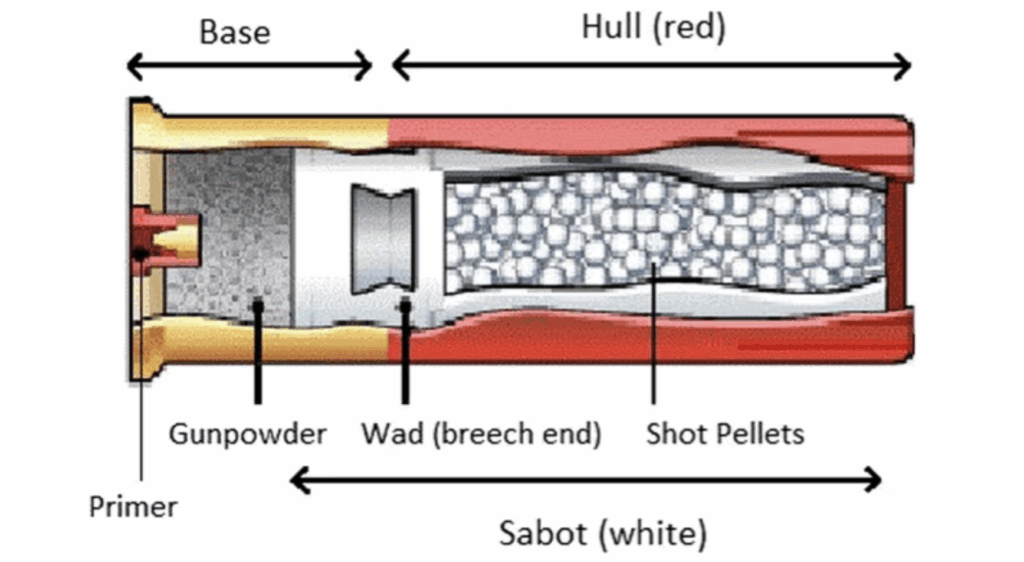
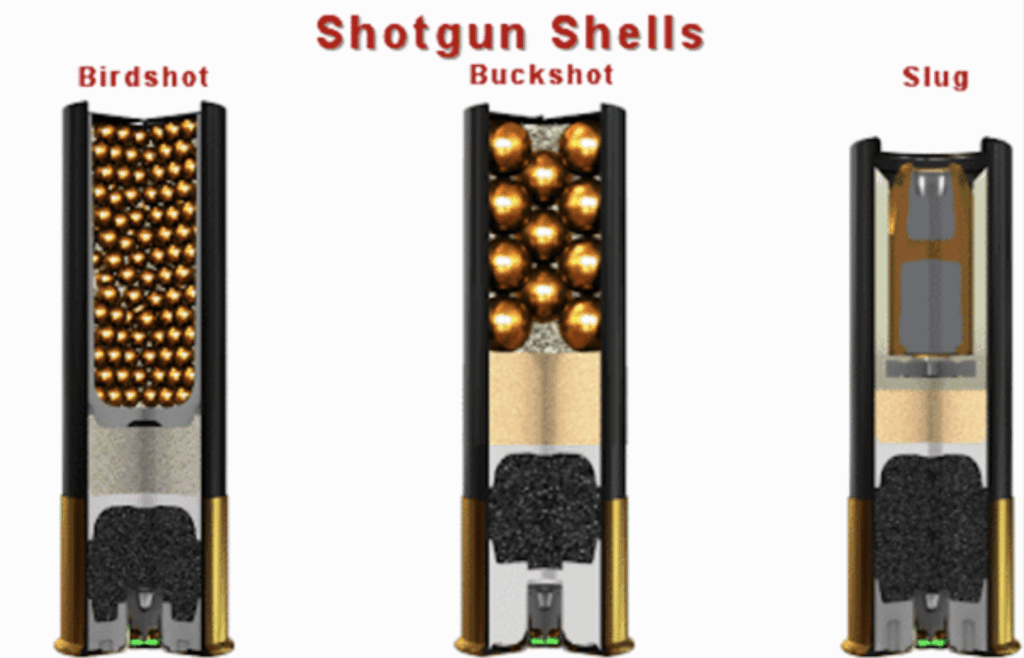
Shotgun shells can be categorized into birdshot, buckshot, and slugs, each presenting different lethality and operational use.[87]
Birdshot consists of multiple lead or steel small pellets, typically 1.75 to 5.8 millimeters in diameter, dispersed over a wide radius. A shell may contain 25 to 700 pellets, with an effective range of about 45 meters, and while primarily intended for hunting, each pellet carries relatively low impact energy.[88]
Buckshot, by contrast, contains fewer but larger pellets, usually 5.08 to 15.2 millimetres in diameter, which produce a narrower spread but significantly higher impact intensity. A buckshot cartridge generally carries 8 to 28 pellets and has an effective range of around 35 meters.[89]
Finally, slugs are single large projectiles, weighing between 10 and 58 grams, which may be spherical or hollow-conical in shape. They are capable of inflicting lethal tissue damage and penetrating targets at distances up to 100 meters, potentially constituting a use of force capable of causing death.[90]

The large pellets used in shotgun shells vary in both material and hardness, factors that significantly influence the type and severity of injuries they cause. These projectiles may be composed of lead, copper, copper-clad alloys, or soft or hard rubber, each with distinct ballistic and wounding characteristics upon impact with the human body.[91] Substantial documentary evidence indicates that the security forces of the Islamic Republic extensively employed shotguns in suppressing the 2022 protests.[92] In at least one documented instance, these forces appear to have used slug ammunition in a lethal manner against unarmed protesters and bystanders.
On October 27, 2022, Motaleb Saeed-Pirou, a 40-year-old resident of the city of Baneh in Kurdistan Province, was fatally shot by security forces of the Islamic Republic with what appeared to be a shotgun. He died shortly thereafter. CCTV footage from the scene shows plainclothes security forces firing at him from close range as he sat in the driver’s seat of his car, about to drive away. At the time and place of the shooting, there were no gatherings or protests taking place. According to the coroner’s report, the cause of death was “extensive damage and laceration to the left lung, heart, and abdominal viscera” caused by a gunshot wound. Photographs of Mr. Saeed-Pirou’s body, which were later published, reveal a deep and wide laceration above his waist, suggesting the likely use of a slug-type projectile. The deployment of such ammunition—known for its high destructive power—strongly indicates that the shots were fired with intent to kill.[93]

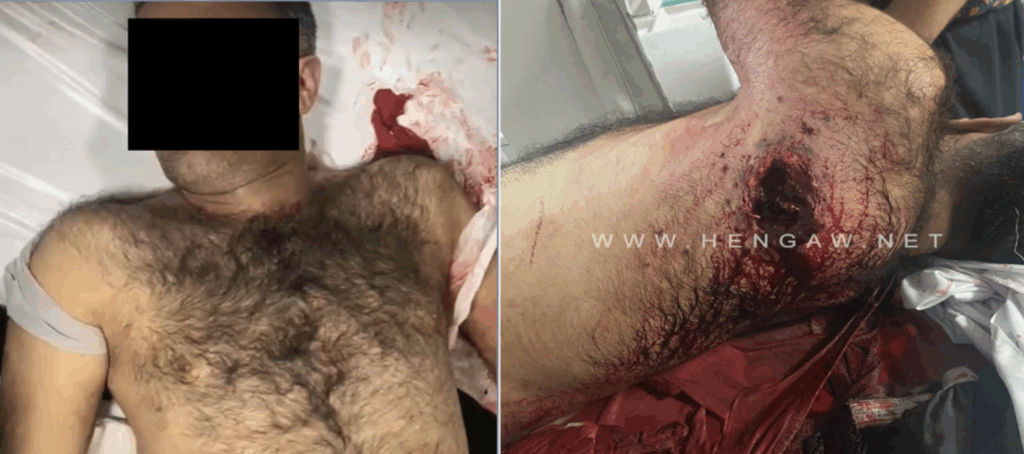

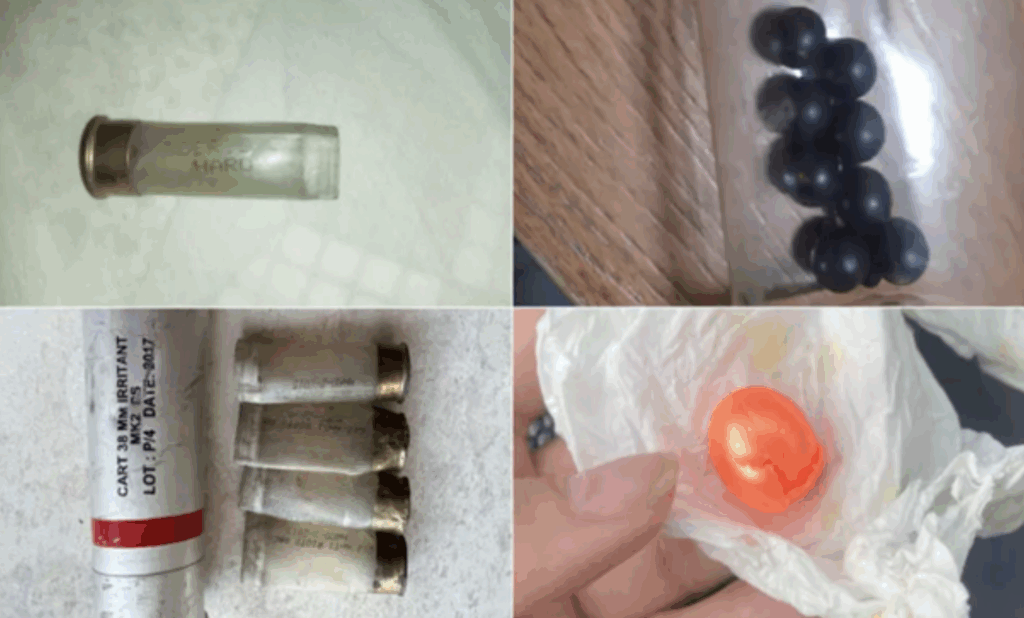


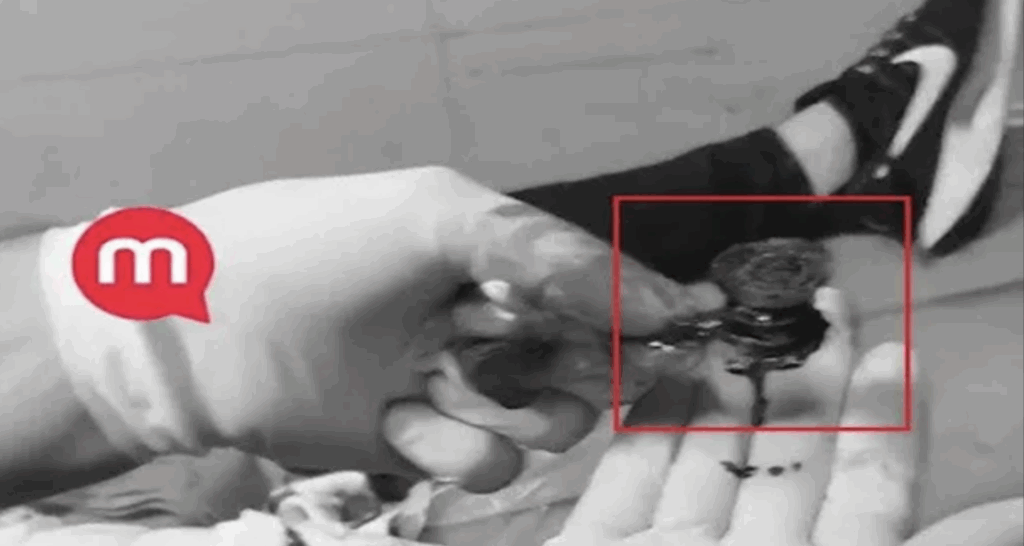

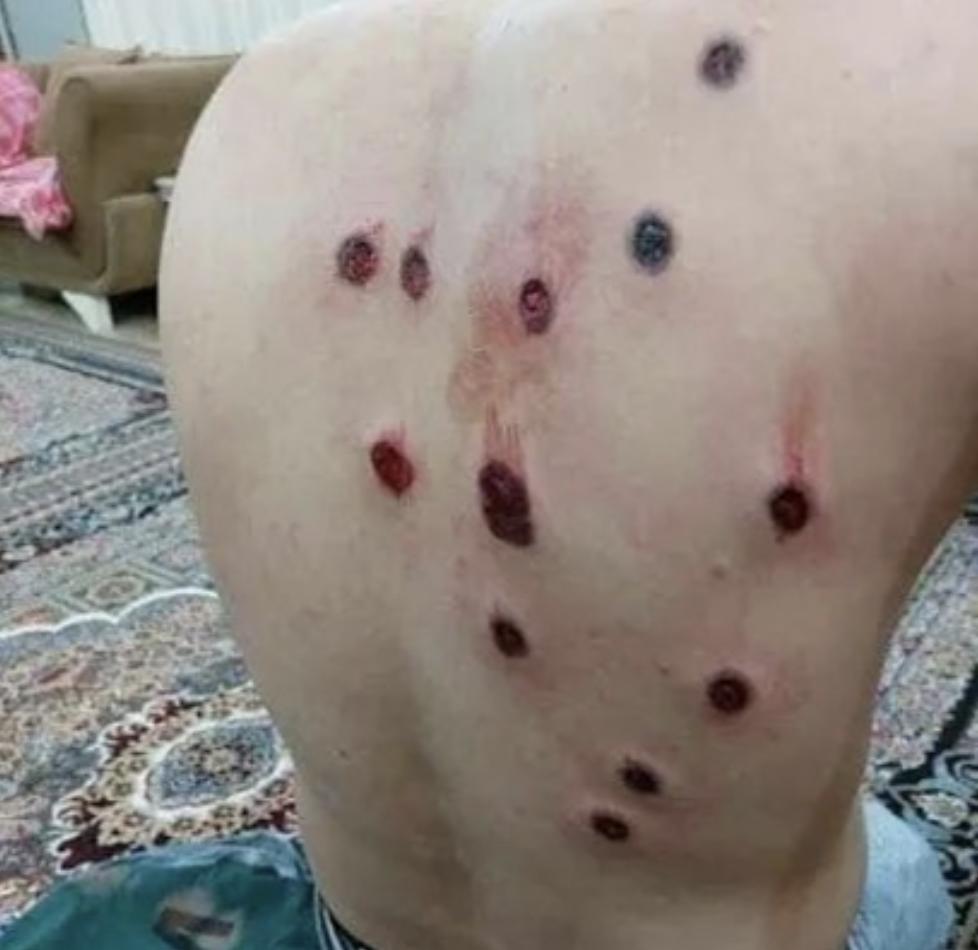
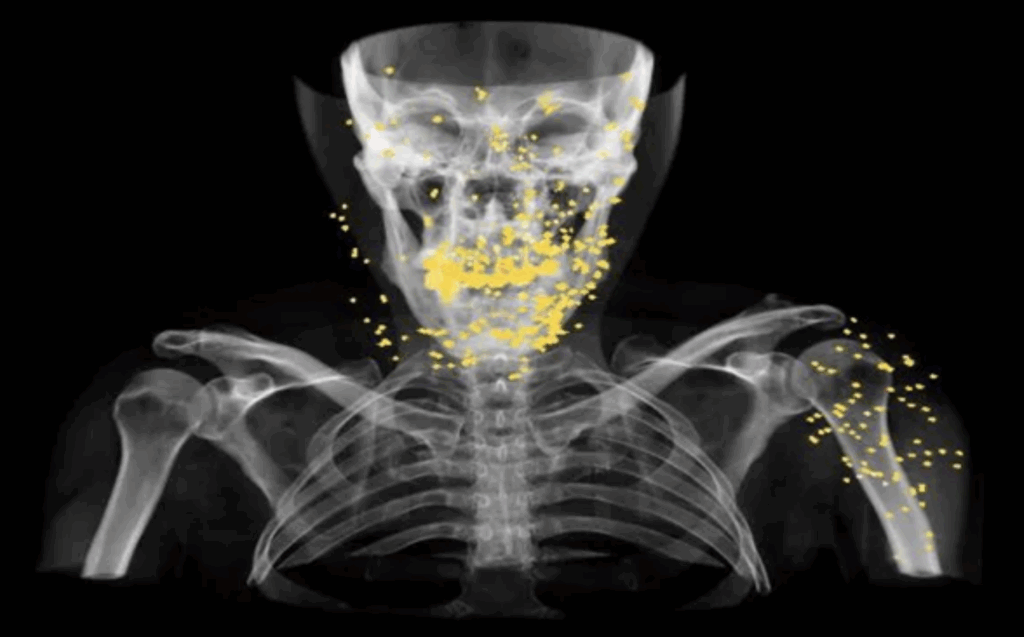
Medical records of numerous victims who were shot in the head and eyes with shotgun projectiles demonstrate that the ammunition was discharged at close range. One such case is that of Hossein, a middle-aged man who lost both eyes and was permanently blinded. His medical file documents the presence of at least 300 pellets embedded around his eyes. At the time, he and his wife were attending the 40th-day memorial ceremony for Hadis Najafi, a young protester, in Karaj in Alborz Province. Witness accounts and medical evidence indicate that Hossein was shot with a shotgun while lying motionless on the ground as an act of submission.[94] Out of fear of reprisals by the Iranian government, he has chosen to remain anonymous.

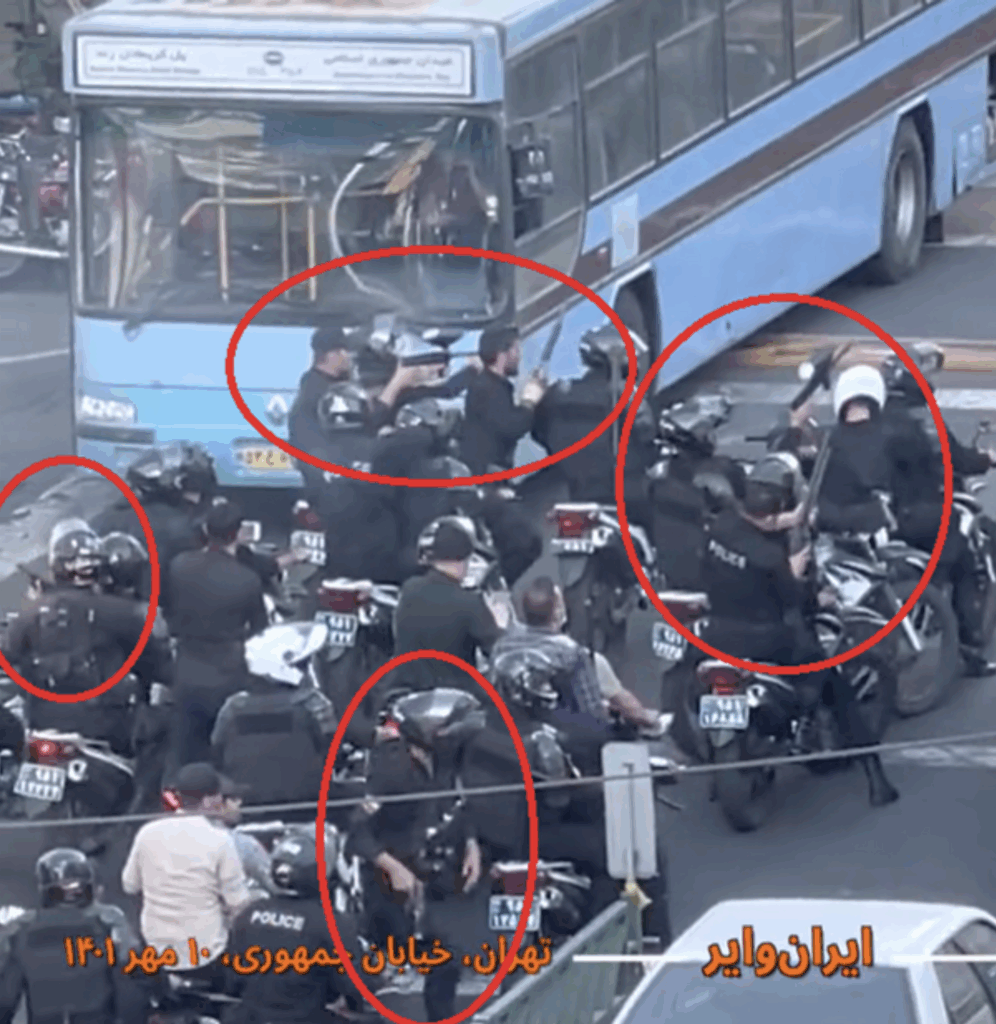
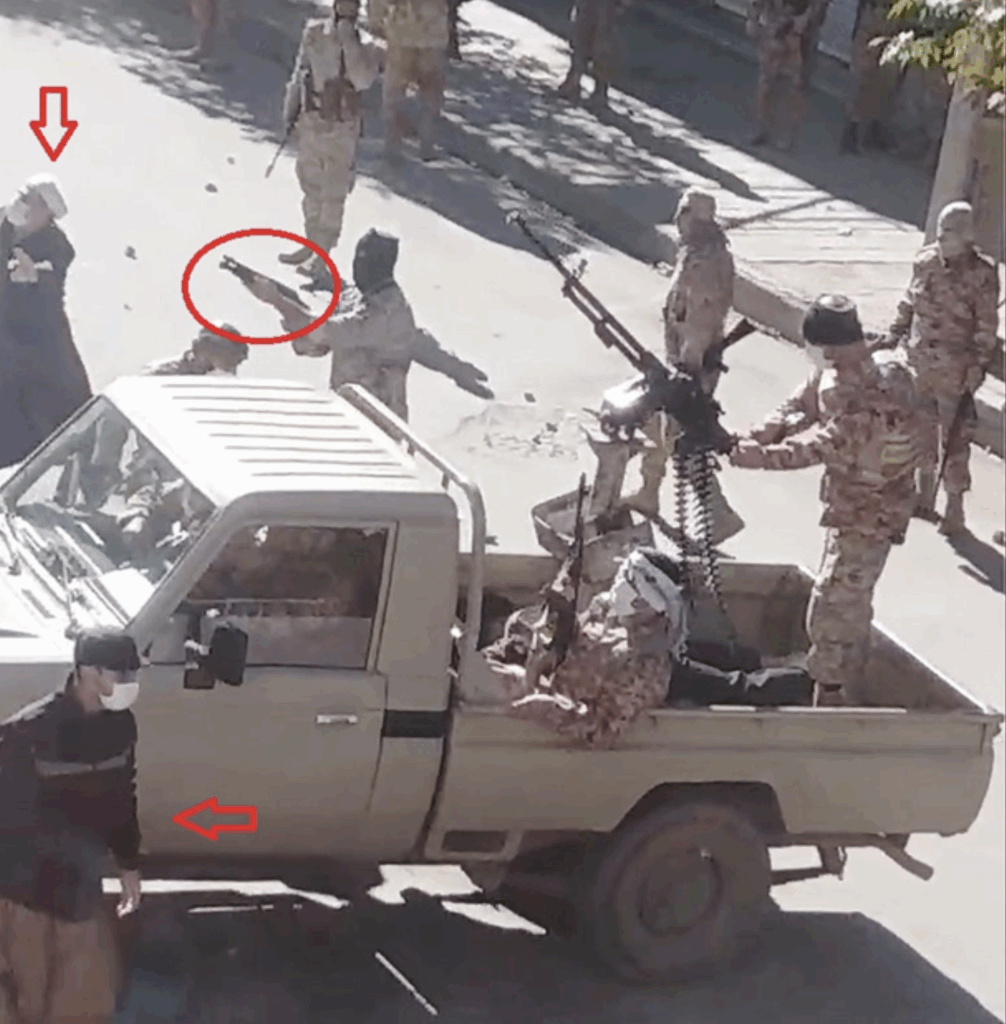
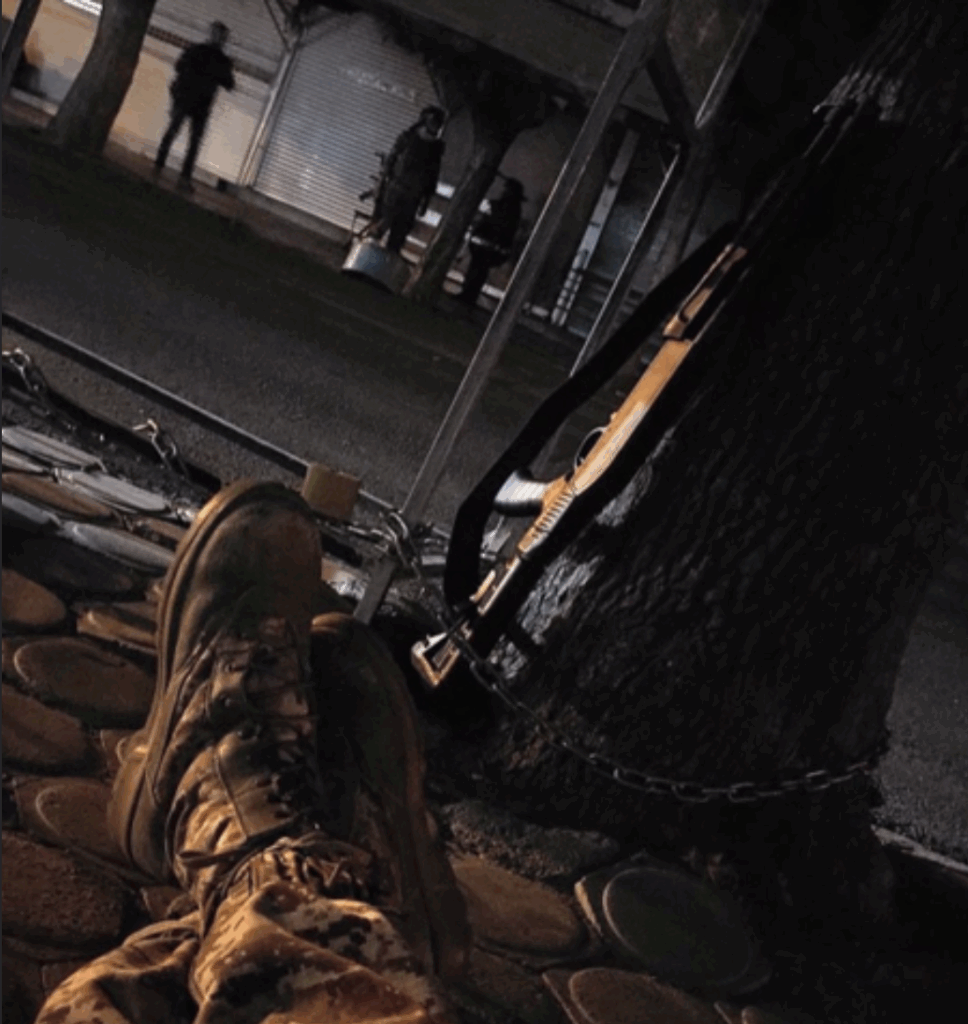
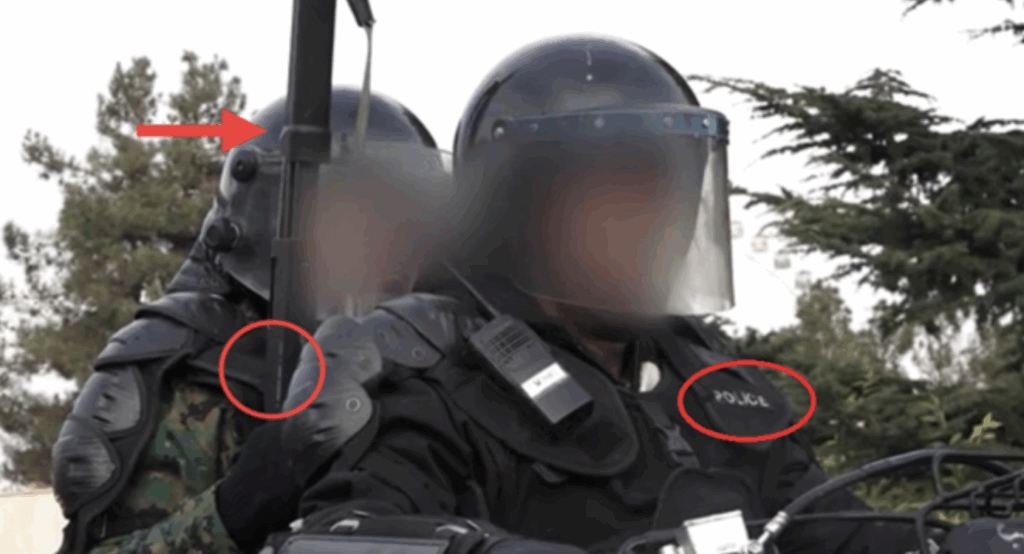
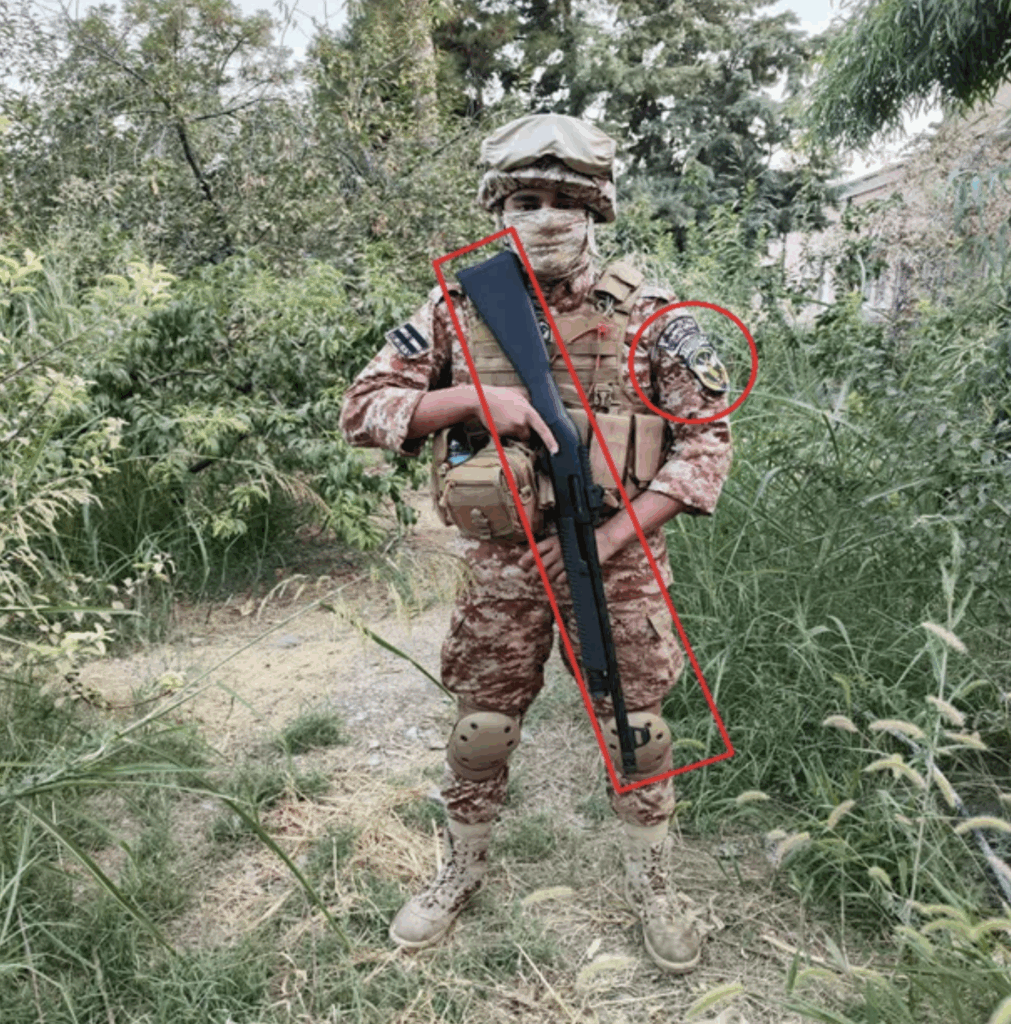
Shotguns have been extensively used in the suppression of protests, with all major security units—including FARAJA Special Units, the IRGC, Basij, and plainclothes agents—documented deploying these weapons.[95] Images reviewed for this report indicate that shotguns have been widely distributed across all units involved in crowd control operations. Numerous propaganda videos circulating on social media depict various branches of the security forces deploying shotguns in crowds and on the streets across multiple cities. The prevalence of these weapons has become so pronounced that they now constitute a recognizable element of these forces’ visual identity.[96] It appears that at least some Basij forces do not hesitate to publicly declare their unrestricted access to shotguns and even their potential misuse of them.[97]
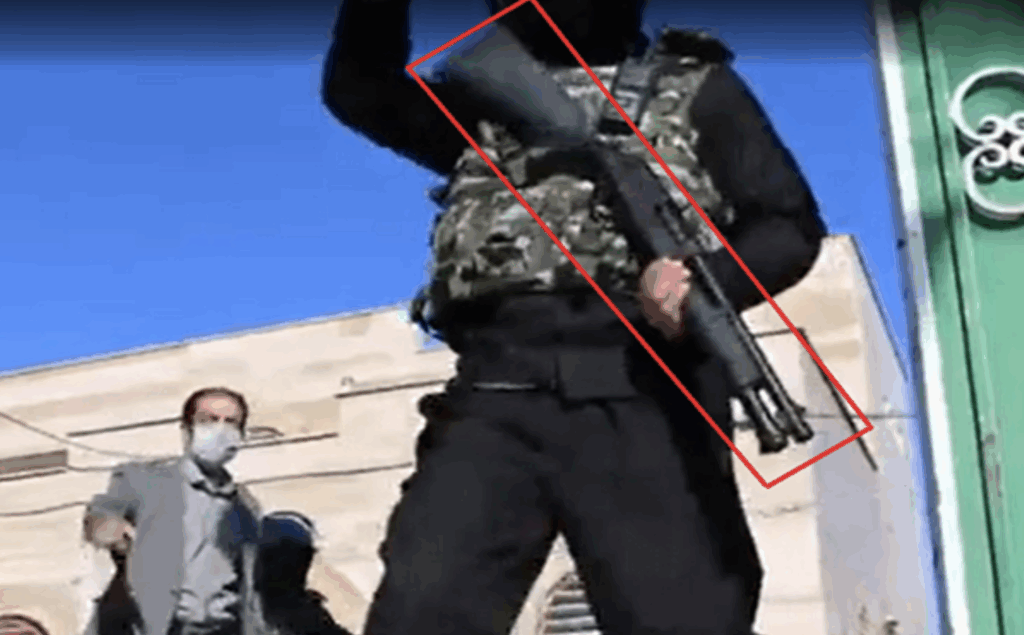

A member of the IRGC Imam Ali Security Battalion in Delfan County, Lorestan Province, holding a shotgun. Source an undated video posted on Aparat

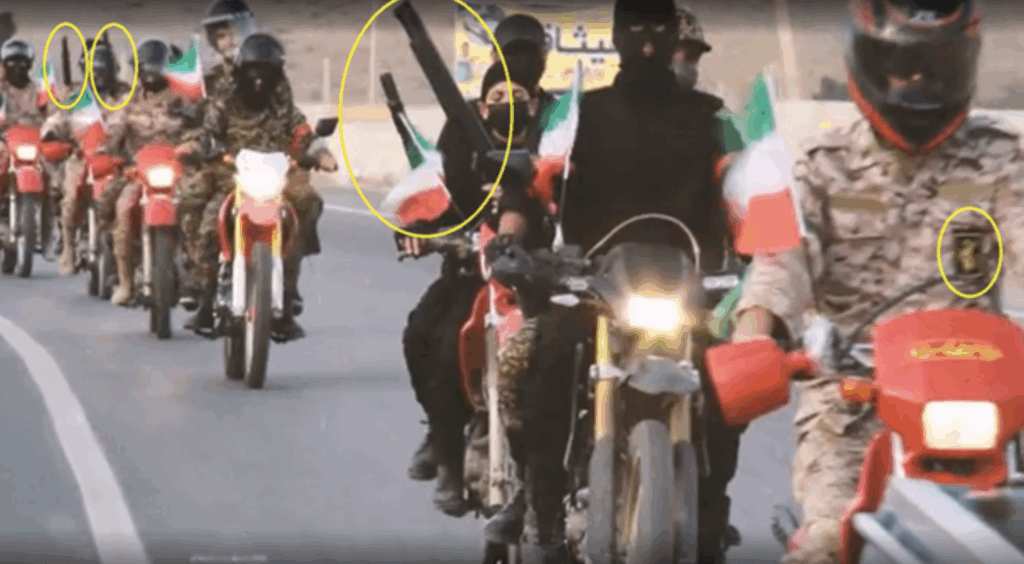
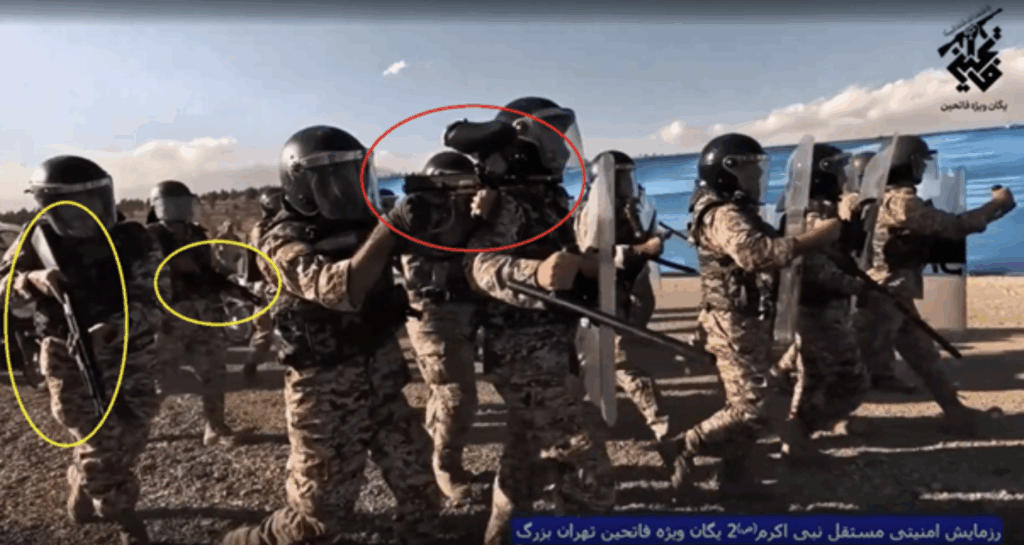
Moreover, witnesses interviewed for this report identified shotguns in the possession of personnel from the Special Units of FARAJA, Basij forces, the IRGC, and plainclothes agents.[98] Furthermore, available training manuals from these security units confirm that shotguns are standard-issue weapons for at least the Special Units of FARAJA, the Imam Ali Security Battalions, and the Fatehin Special Unit—the Basij Organization’s special operations force tasked with crowd control.[99]
Between 2012 and 2023, based on data reviewed for this report, total arms exports from Türkiye to Iran under commodity codes 9303 and 930320—with duplicate entries removed to prevent double counting—amounted to approximately USD 10 million. Commodity code 9303 encompasses a broad range of firearms and related items, including shotguns, sporting guns, muzzle-loading firearms, and oversized pistols, among others.[100] In contrast, commodity code 930320 specifically refers to shotguns intended for hunting and target shooting, including combination shotgun-rifles featuring both a shotgun barrel and a rifle barrel.[101]
The 2022 protests reveal clear patterns of violence and human rights violations by the Islamic Republic against peaceful protesters, resulting in lasting harm. The documented use of indiscriminate and excessive force constitutes a violation of the right to life and the prohibition against cruel or inhuman treatment. Evidence from arms trade data further indicates the diversion of weapons for crowd suppression, raising serious concerns under international arms trade and humanitarian law.


5. Manufacturers of Shotguns and Their Munitions
Security and law enforcement forces of the Islamic Republic of Iran employ a wide range of shotguns manufactured both domestically and internationally. To ensure reliable identification, this report applies multiple criteria recognized in legal and forensic practice, including distinctive visual characteristics, manufacturer trademarks, and corroboration with security unit training manuals. Weapons are included in this section only if conclusive visual evidence or multiple corroborated documentary sources confirm their identification. Any weapon not meeting at least one of these criteria is excluded.
Of 23 witnesses who reviewed images of 30 shotguns, most identified models with either a pistol grip without a stock, a retractable stock, or a fixed stock without a pistol grip as commonly used by Iranian security forces. Witnesses frequently reported observing these weapons in the possession of members of the FARAJA Special Unit, Basij forces, and plainclothes agents. While these responses are from non-expert observers, they were used solely to indicate the most commonly observed types of shotguns based on appearance. They were not relied upon for definitive identification of model or manufacturer, in accordance with established evidentiary standards and principles of legal reliability.
5.1. Foreign Manufacturers of Shotguns and Their Ammunition
This section analyzes a range of documentary evidence, including numerous photographs and videos, demonstrating the use of shotguns by the Islamic Republic’s security forces. A significant proportion of these weapons are manufactured by Turkish companies, either supplied to Iran as finished products or through the transfer of production technology to firms affiliated with Iranian military and security organizations.
In addition, at least one U.S.-made shotgun model and several domestically produced Iranian models have been identified in the possession of the Islamic Republic’s military and security forces.[102] Due to limited independent information regarding the full extent of these specific models’ deployment during the 2022 protests, this report concentrates exclusively on shotguns for which reliable, documented evidence exists of their use in suppressing demonstrators and that are of particular significance.
5.1.1 Hatsan Co., Türkiye
Hatsan was founded in 1976 in Izmir, Turkey, and today employs over 600 people to manufacture a wide range of hunting and defensive weapons, including the Escort series of shotguns.[103] The company’s annual turnover is estimated at over USD 130 million, and its products are exported to approximately 106 countries.[104] At least one source has indicated that Iran is among the countries importing Hatsan’s products.[105] The company was founded by Abdullah Taşyağan and is currently managed by Bahtiyar Taşyağan, who has publicly acknowledged support from the Turkish government in expanding Hatsan’s operations.[106]
A social media post on a Facebook page titled “Iran-Hatsan Air Guns,” active since 2015, featured a photograph of Bahtiyar Taşyağan, with comments suggesting he planned a trip to Tehran.[107] There is no verified record confirming whether this visit occurred or its outcomes. If such business travel had in fact taken place, and if Hatsan products were transferred to Iran and subsequently provided to security forces, this could give rise to legal implications under international export control regulations and applicable sanctions laws.
Based on the evidence reviewed for this report, multiple shotguns used by the Islamic Republic of Iran’s security forces appear to be manufactured by Hatsan. Investigations by the researchers of IranWire and IHRDC show that several models of weapons used by the security force bear clear and undeniable visual similarities to the Hatsan Escort shotguns.[108] The following models can be highlighted:
- Hatsan Escort Aimguard Tactical TS Pump Action Shotgun with Retractable Stock;[109]
- Hatsan Escort Aimguard Shotgun with Fixed Stock;[110]
- Hatsan Pump Action Escort Slugger Shotgun;[111]
- Hatsan Pump Action Escort Slugger Tactical Shotgun;[112]
- Hatsan 12GA Repeating Rifle Escort Defender.[113]
Photographic evidence from at least two Imam Ali Security Battalions’ training manuals, examined for this report, shows personnel handling shotguns bearing the Escort trademark.[114] Additionally, a channel close to the IRGC security units on Eitaa—an Iranian messenger service similar to Telegram—corroborates the use of these models.[115]
“The Hatsan Escort shotgun was purchased in large quantities from Türkiye at our country’s request, and among its advantages are its lightness and resistance to repeated use. This type of weapon is one of the most common pellet shotguns used by security battalions and Basij […] One of its accessories is the shotgun red dot sights, which make the use of this weapon more effective in the field during conflict and riot.”[116]

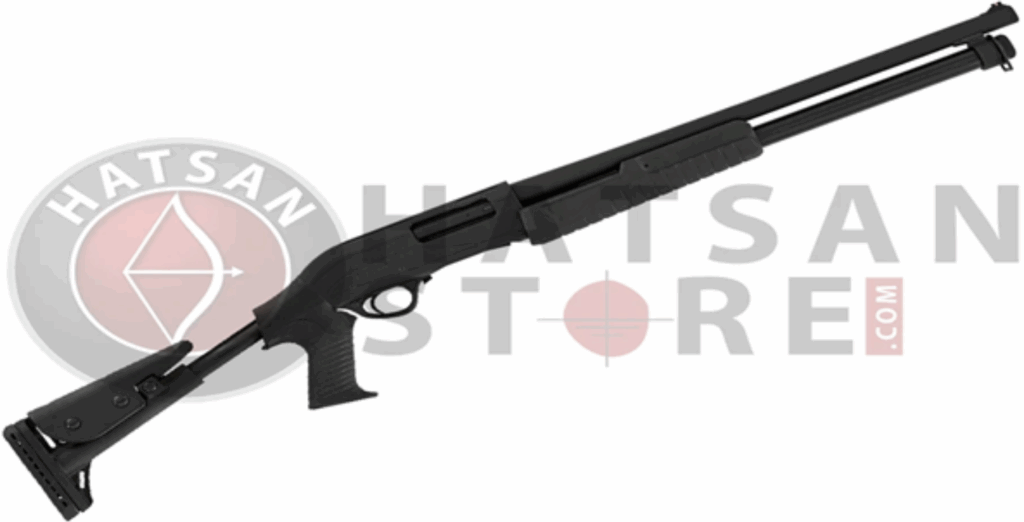

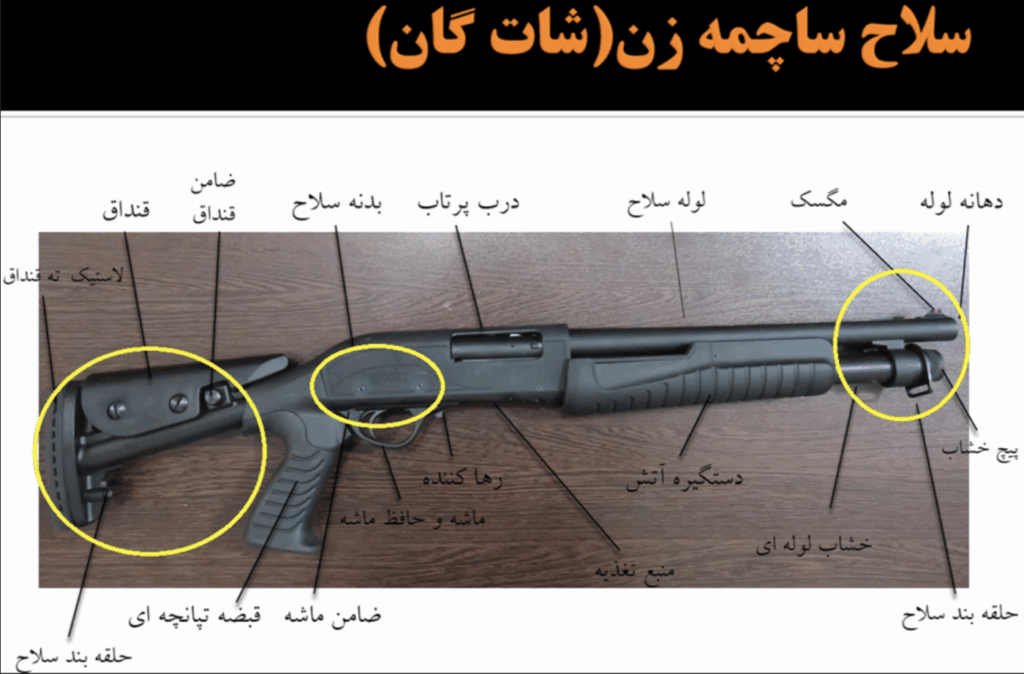

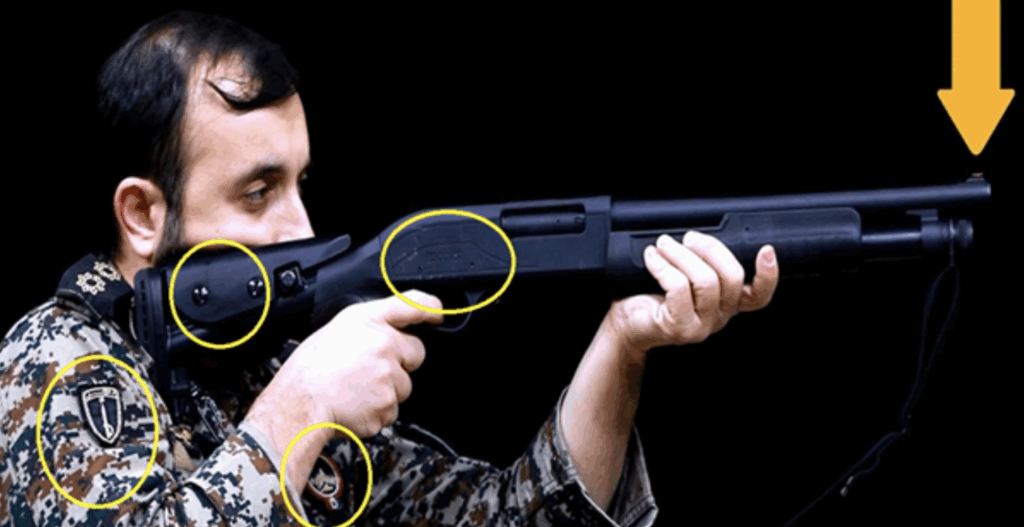

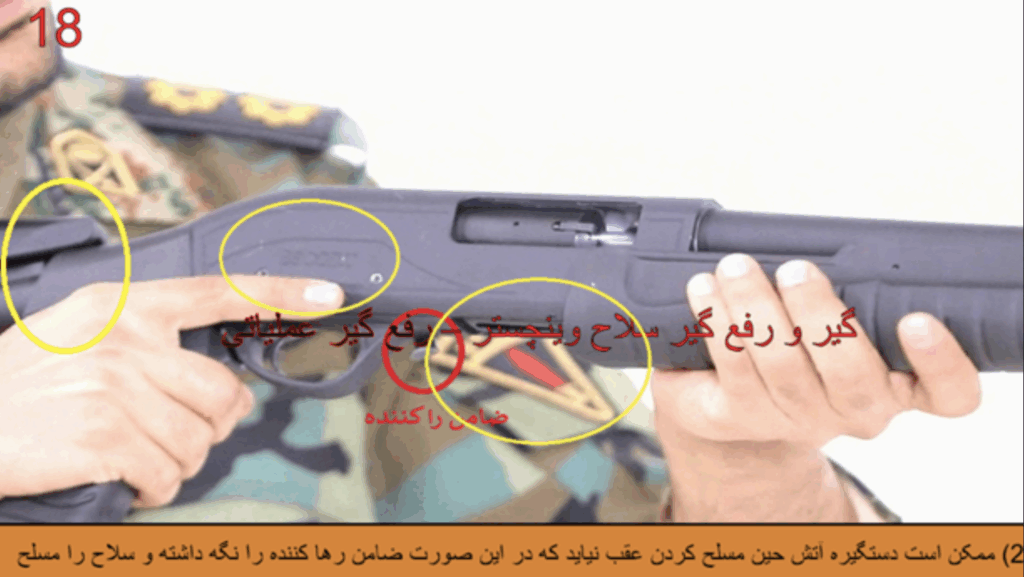

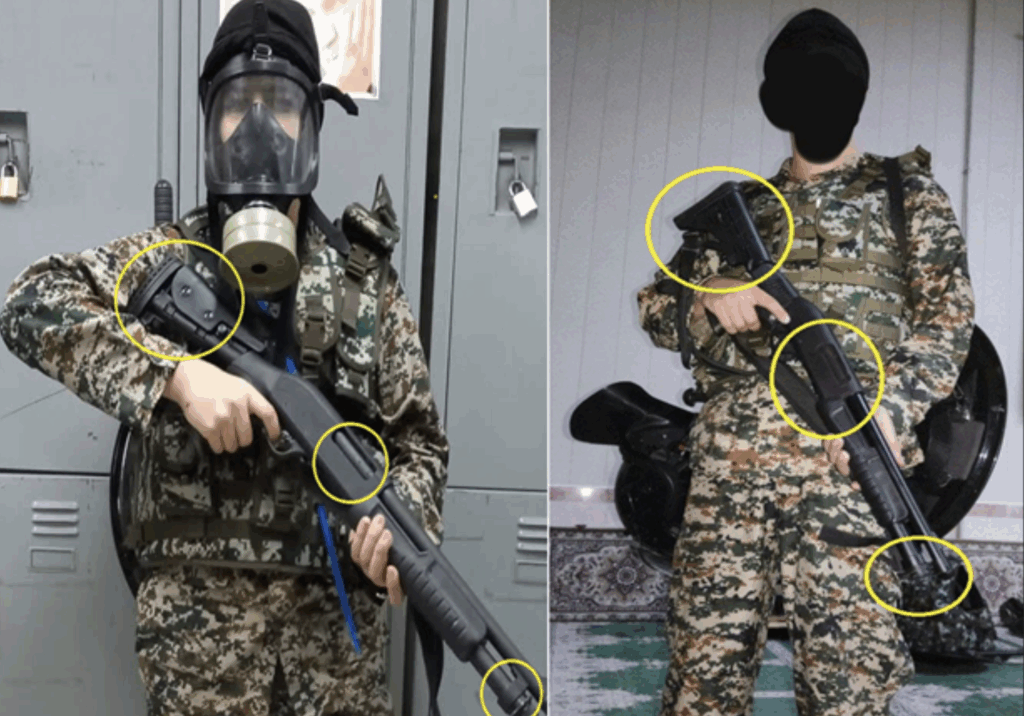

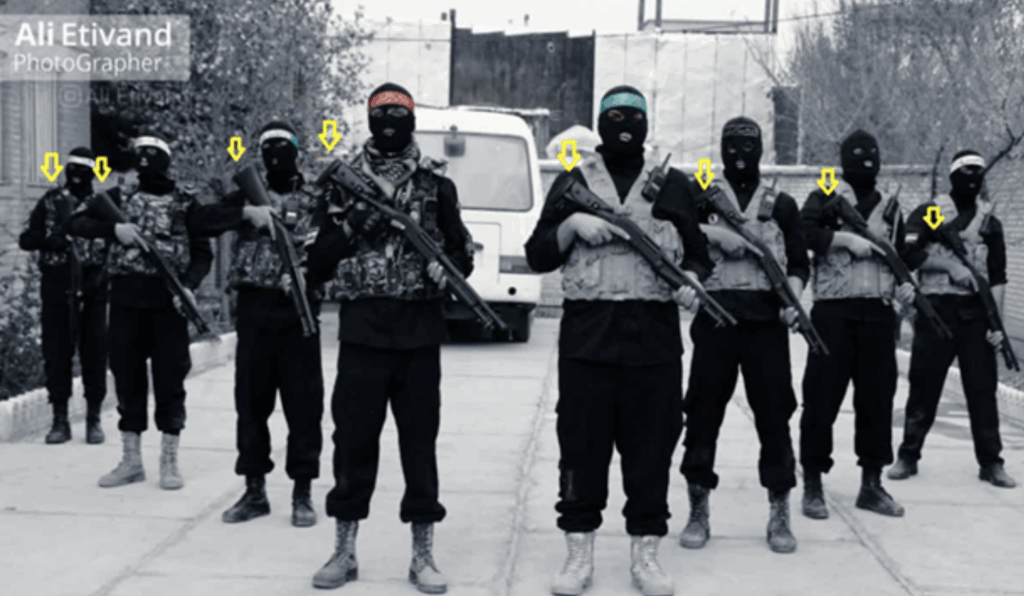

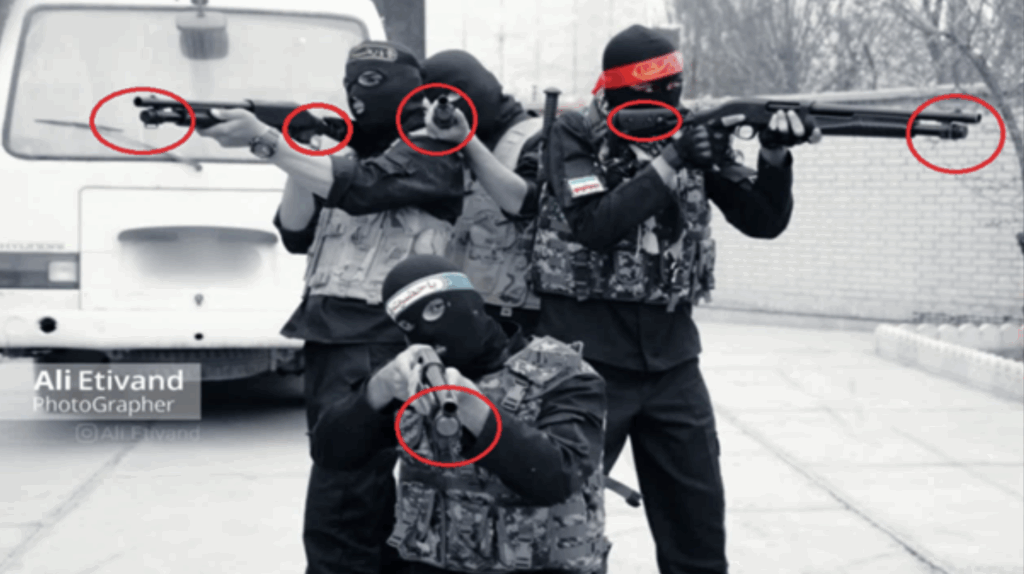

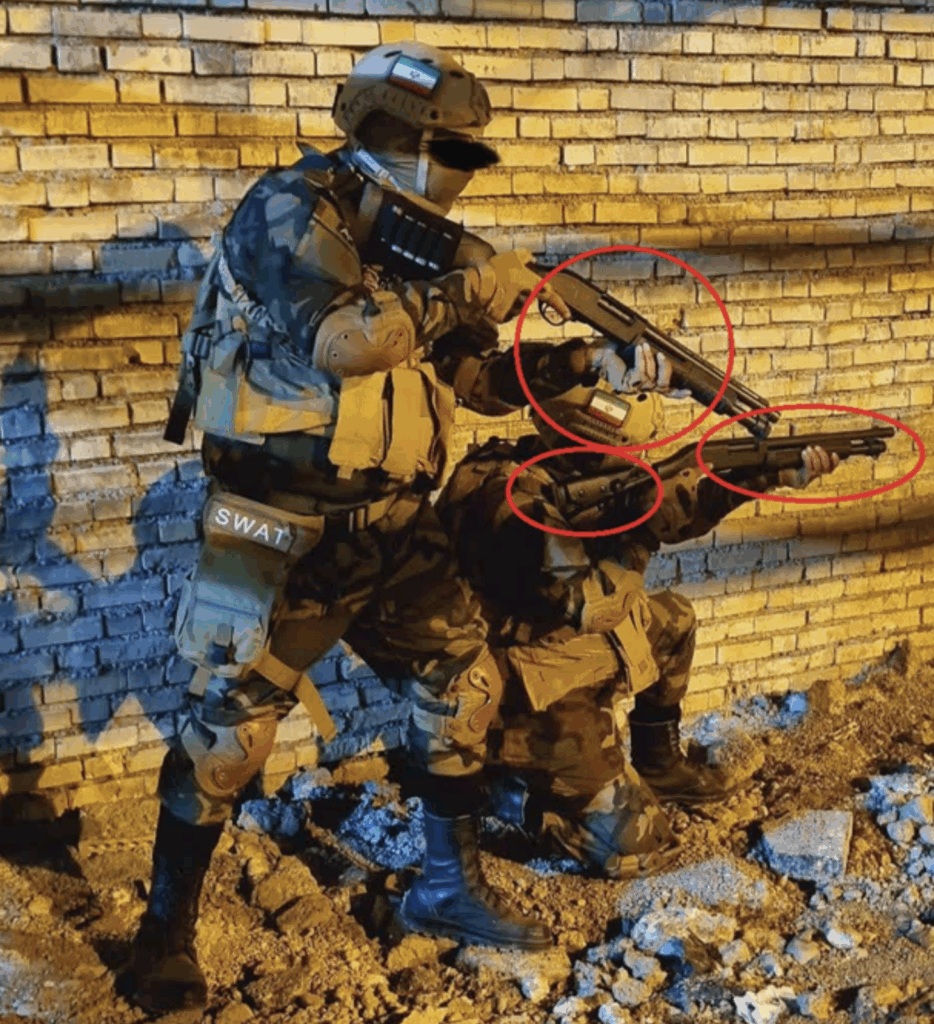

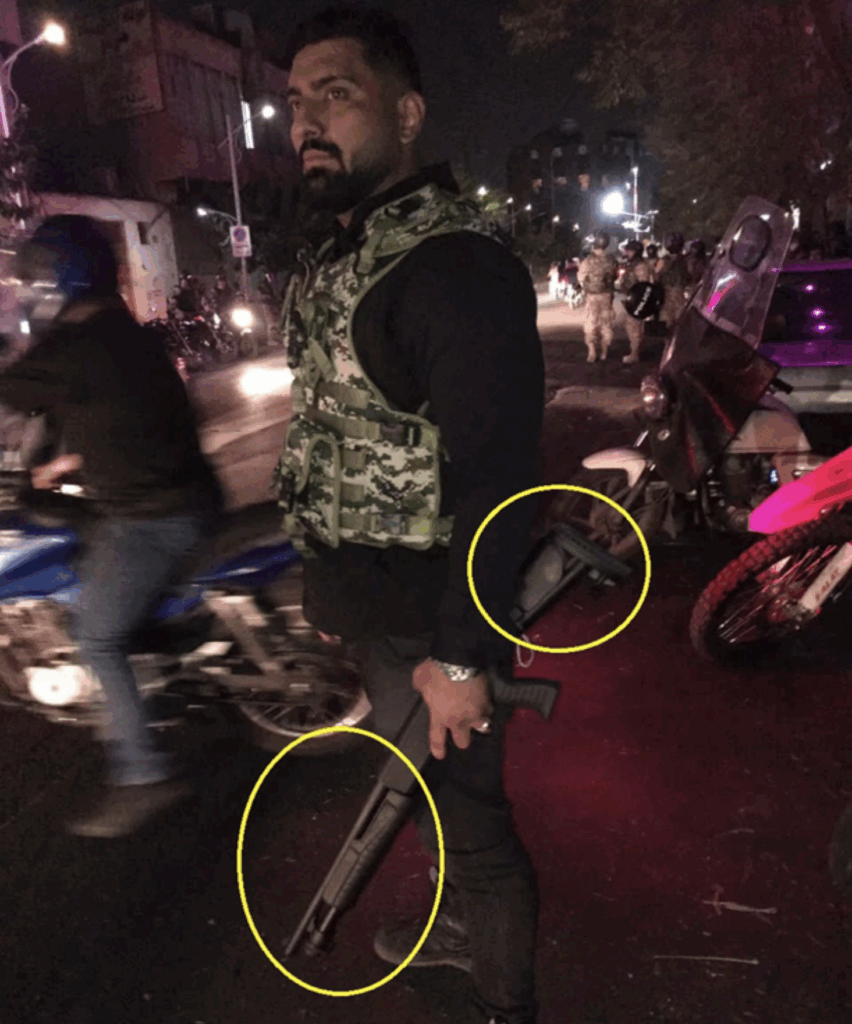

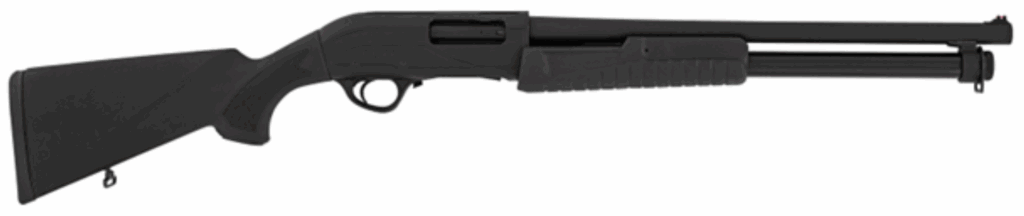

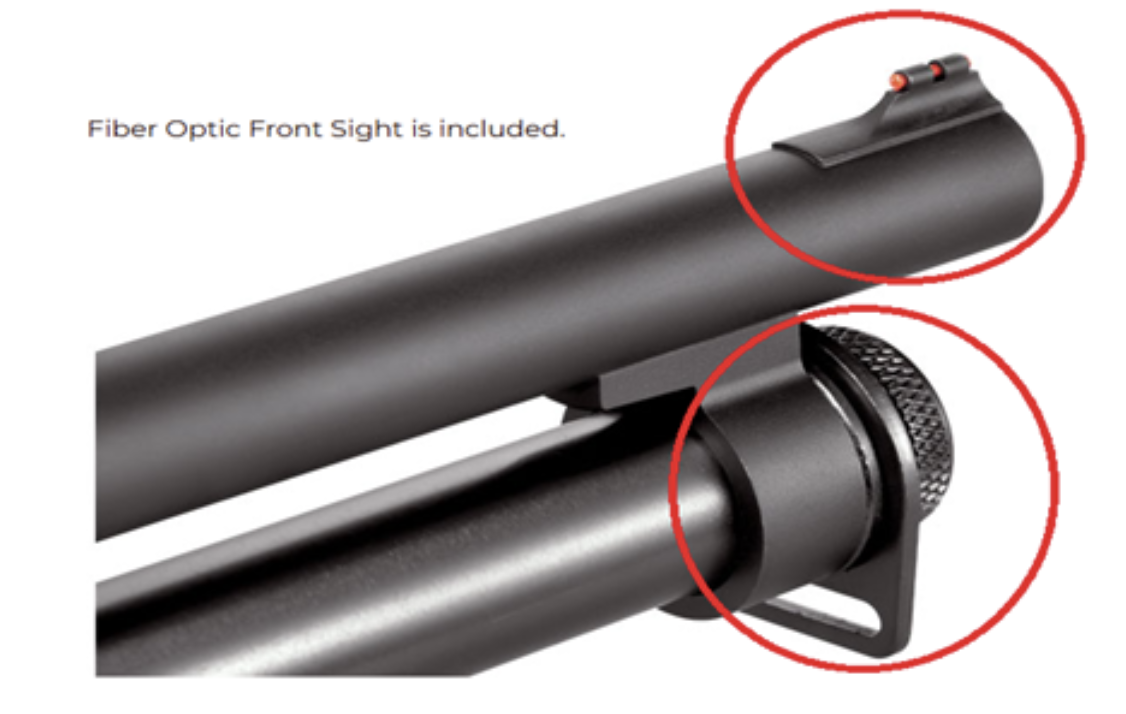

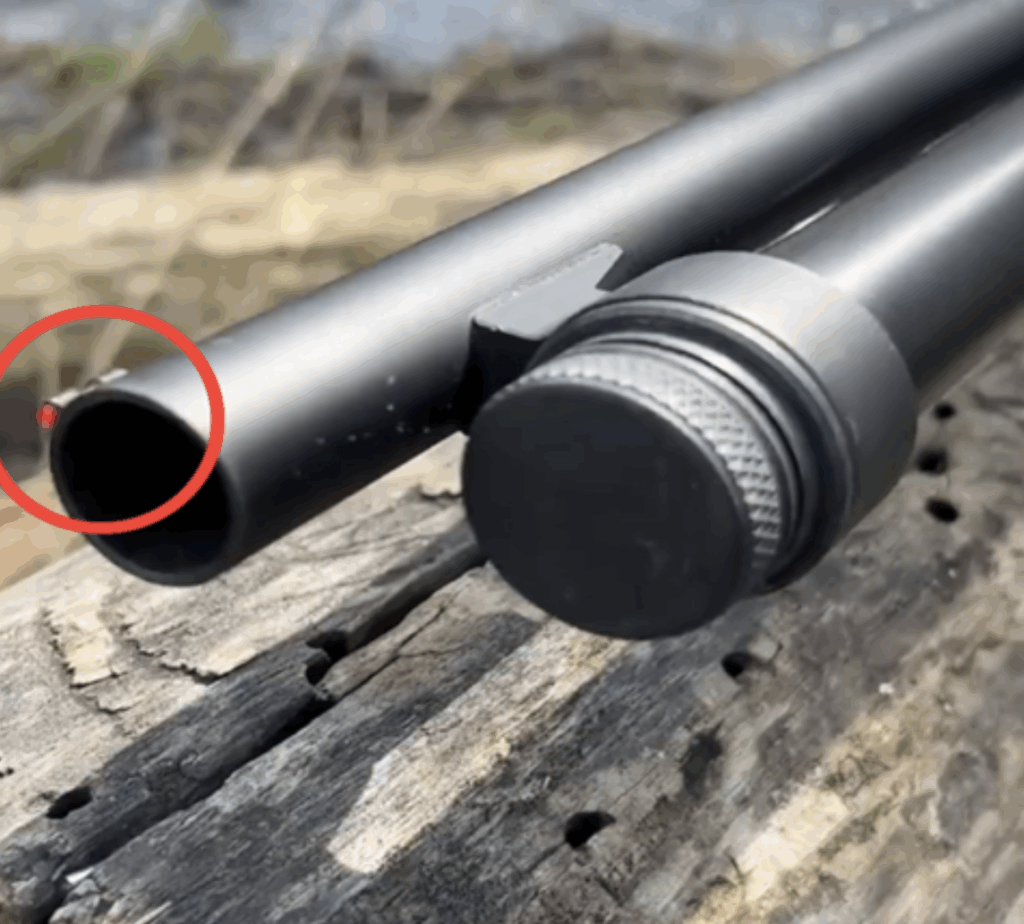

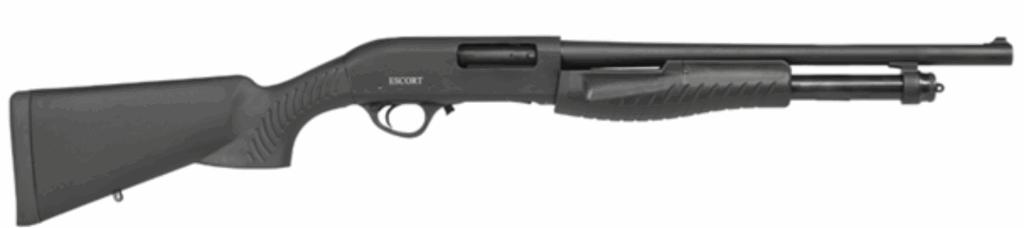
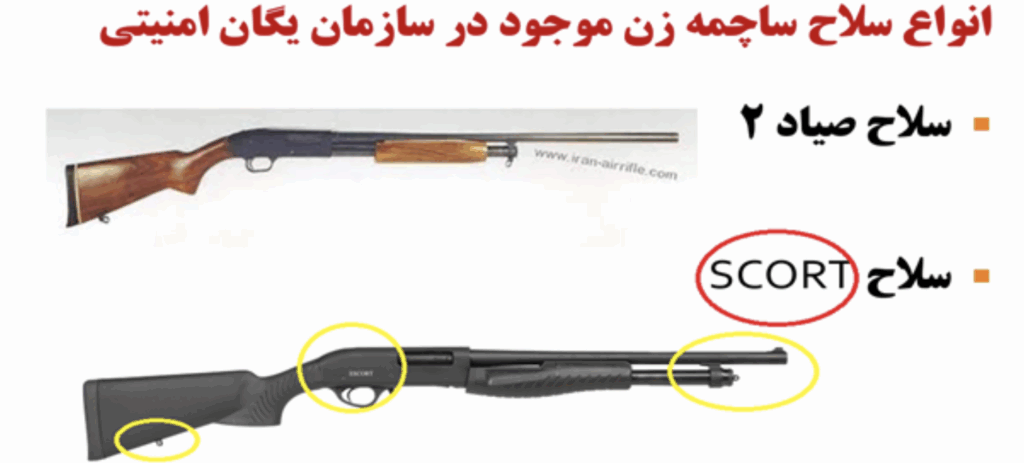


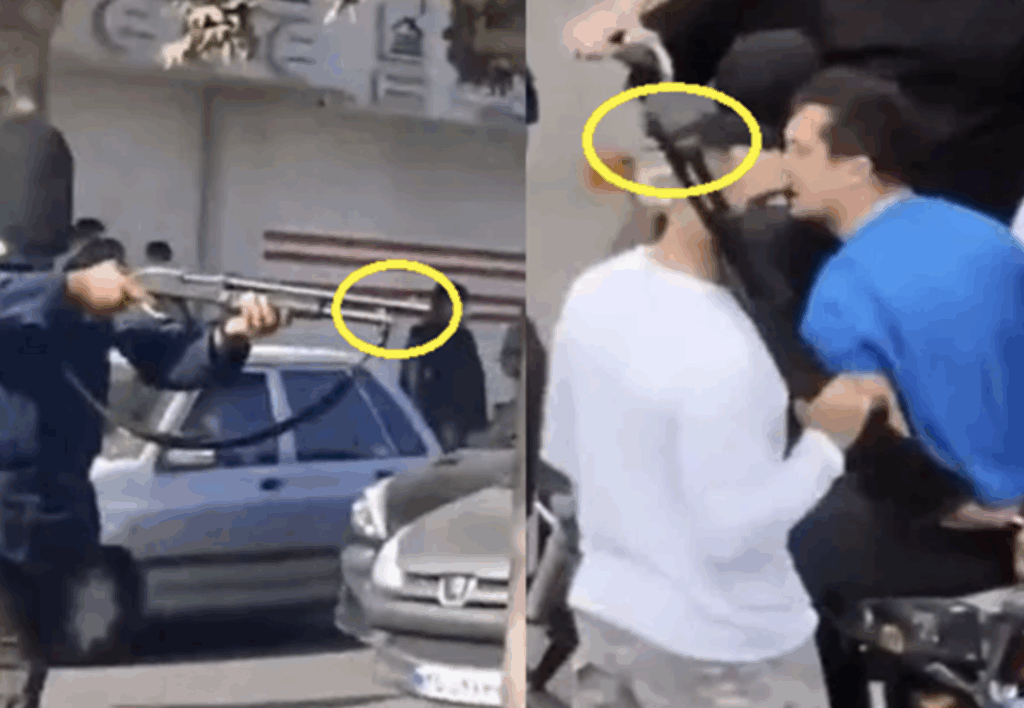

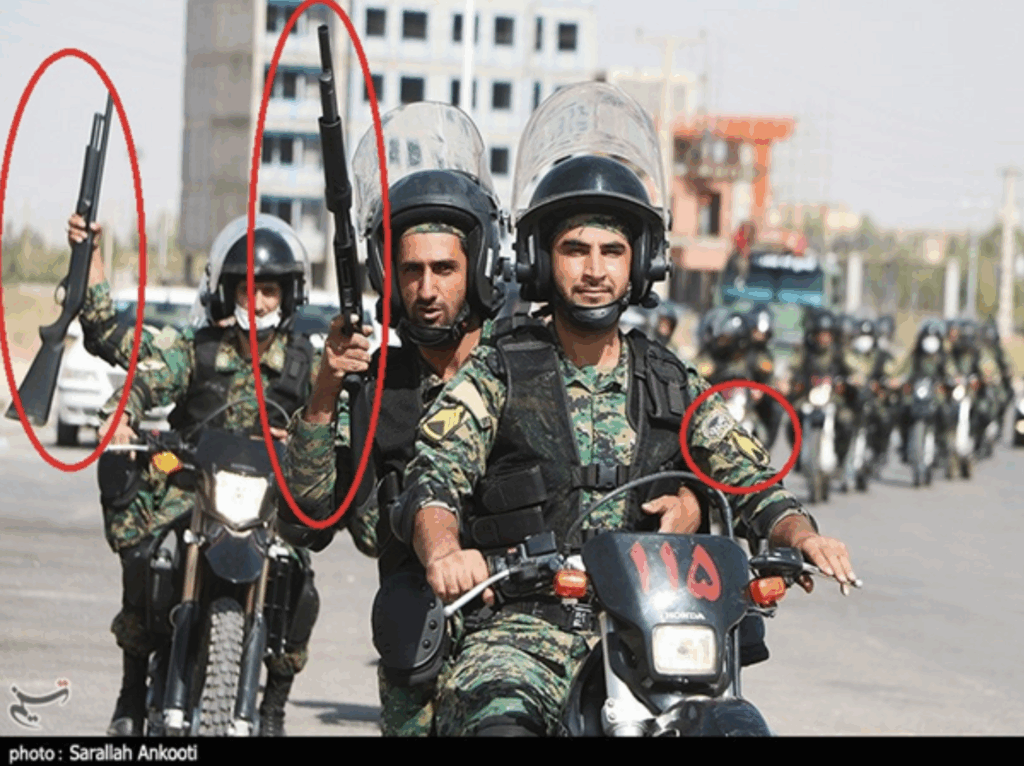

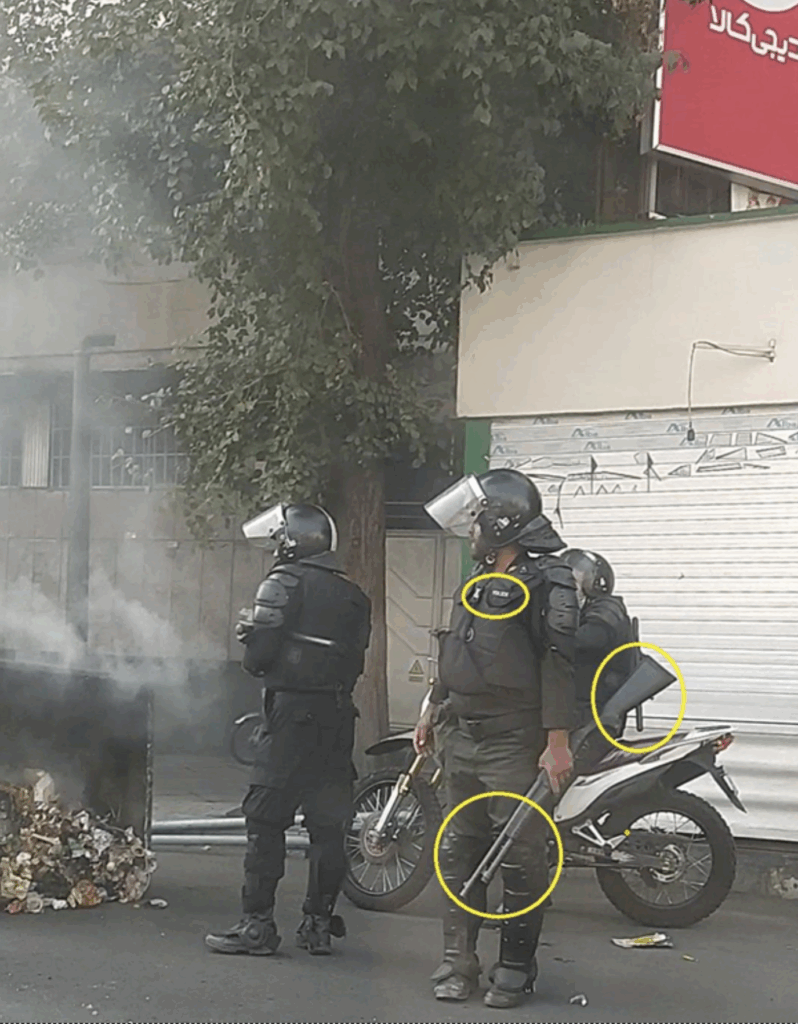

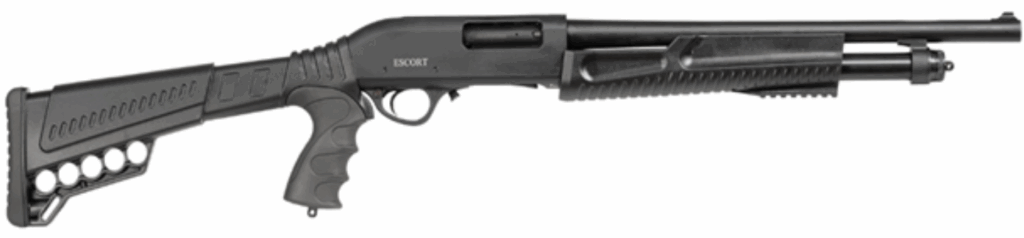

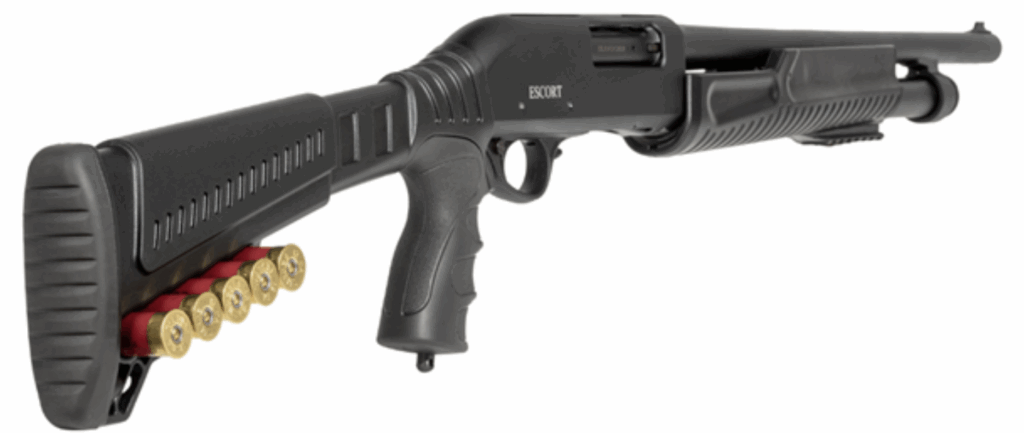

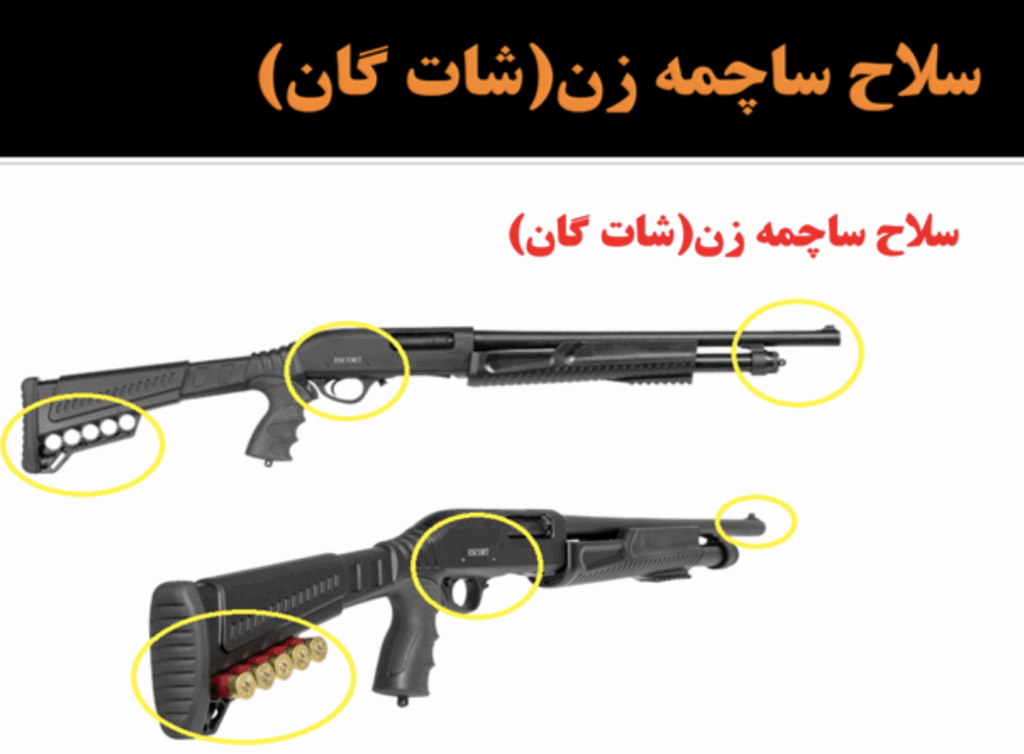

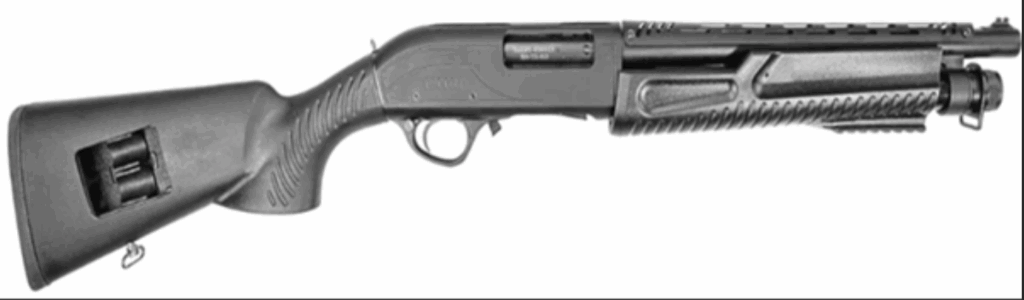

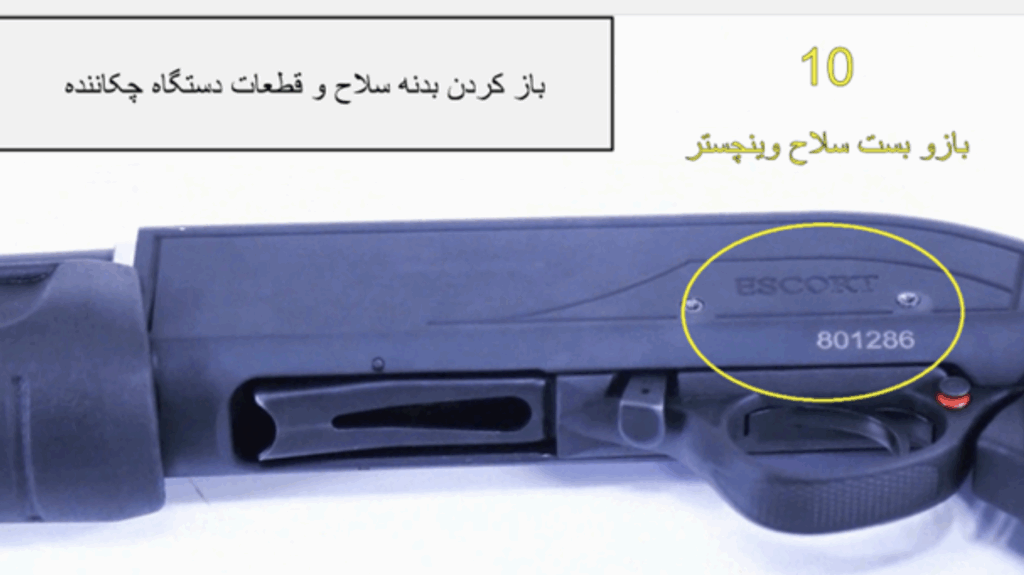

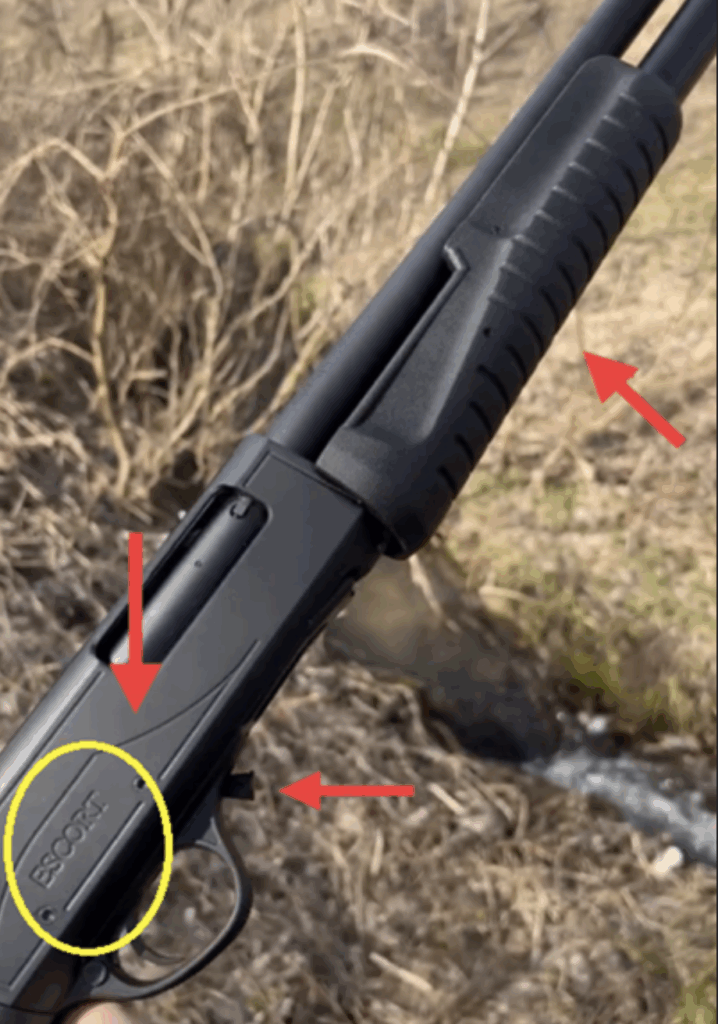

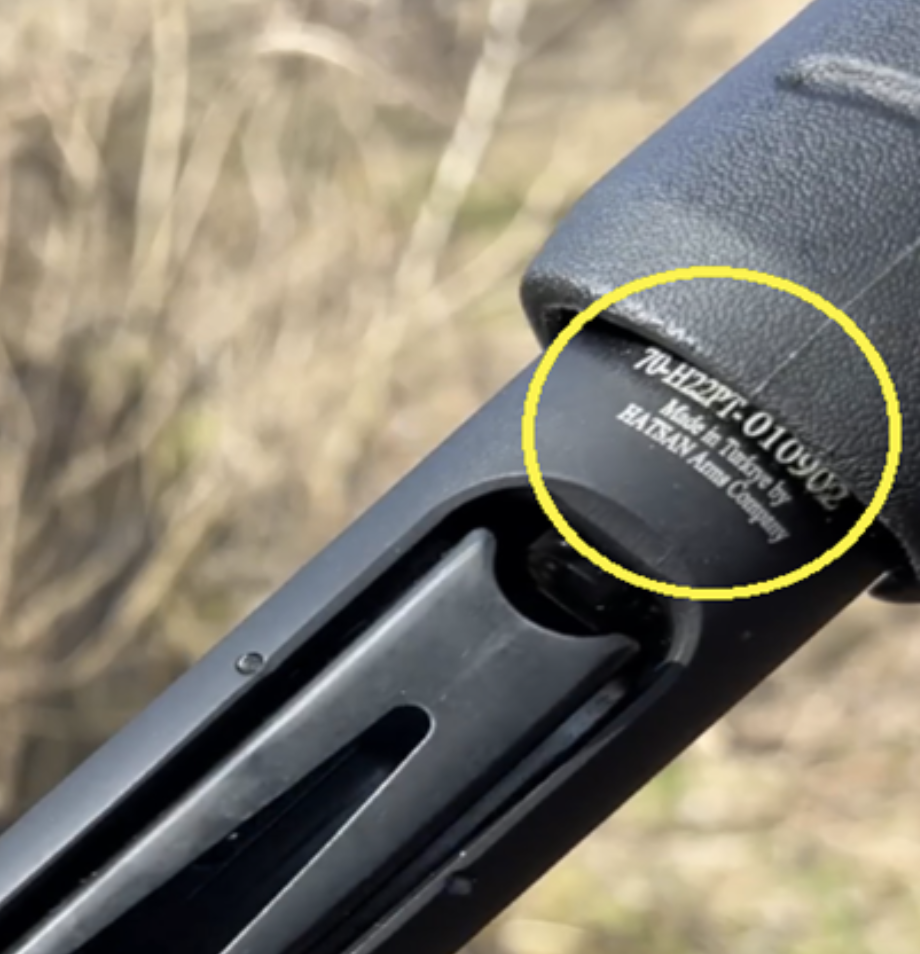
Court documents related to the killing of an Iranian citizen during the 2022 protests by a Basij member explicitly identify the weapon used as an Escort shotgun. To protect the source’s security, the full document and other identifying details have not been included in this report.
5.1.2. Akkar Co., Türkiye
Founded in 1985 in Istanbul, Akkar Arms Industries Co., Ltd. began as a manufacturer of components for various hunting firearms. Over the years, the company has evolved into a full-scale shotgun manufacturer, offering models such as Karatay, Altay, Poseidon, Apache, and Komanchi.[117] In 2021, Akkar, employing approximately 170 staff, reported a 33% increase in profits and a 40% growth in assets.[118] The company is currently owned and managed by Mehmet Akdal.[119]
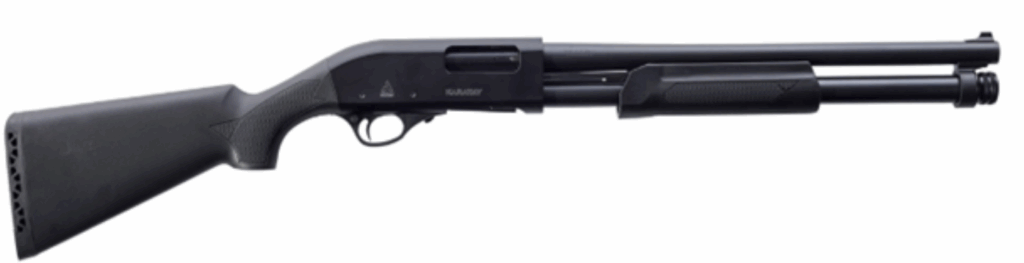
Based on the documents and evidence reviewed for this report, multiple Akkar Karatay shotgun models are reportedly in the possession of the Islamic Republic of Iran’s security forces.[120] Research conducted by IranWire and IHRDC indicates notable visual similarities between these shotgun models and weapons displayed at the IPAS Expo in Tehran, as well as those used by police forces and Basij Fatehin Units.[121]

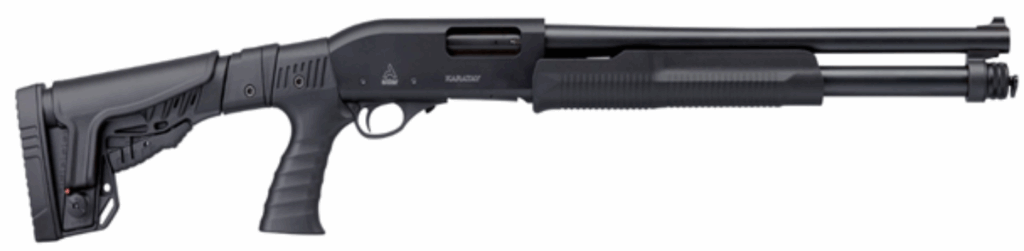

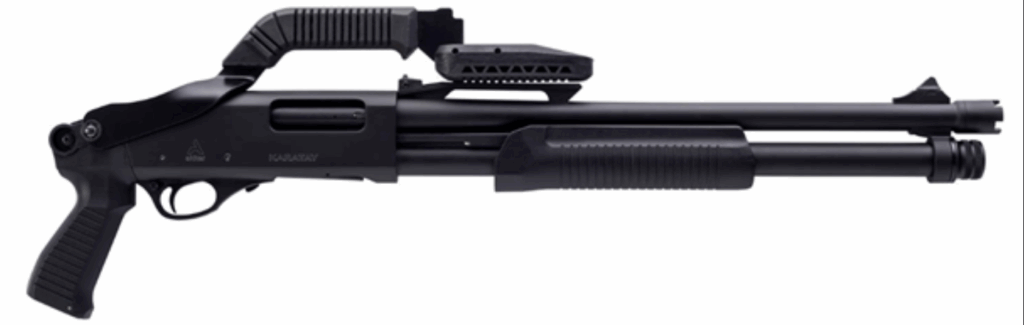

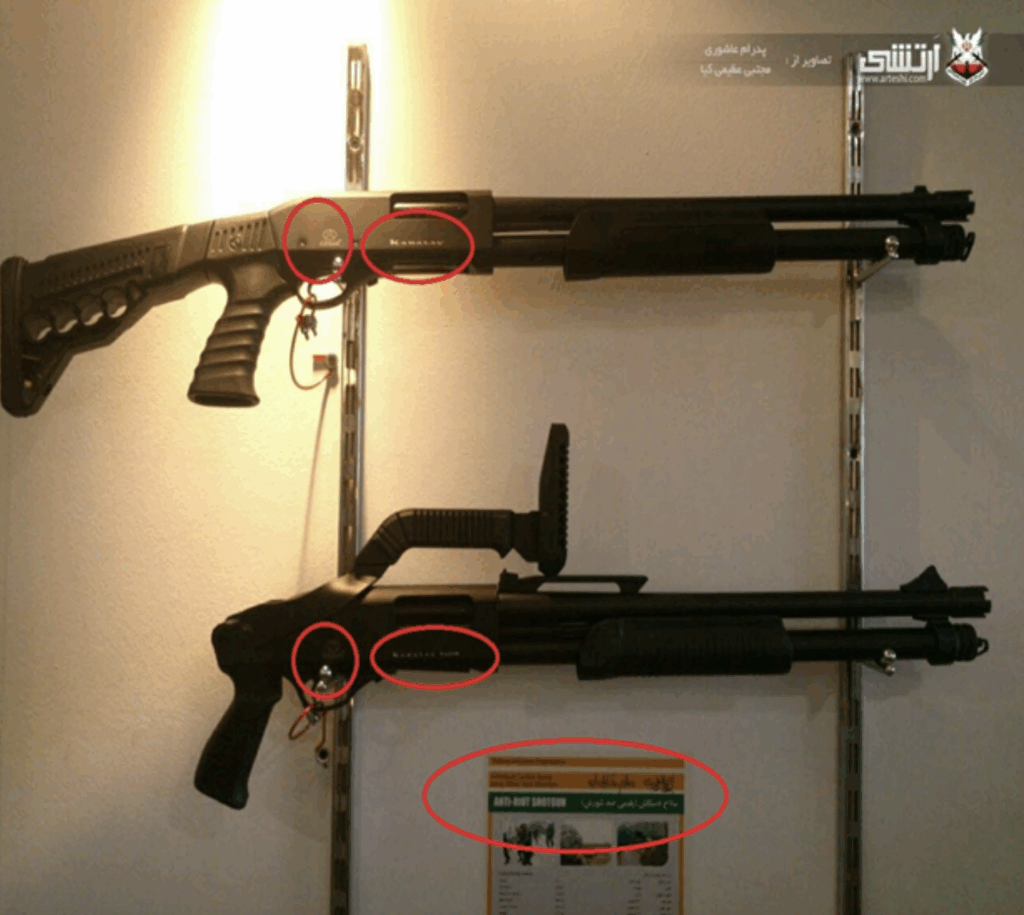

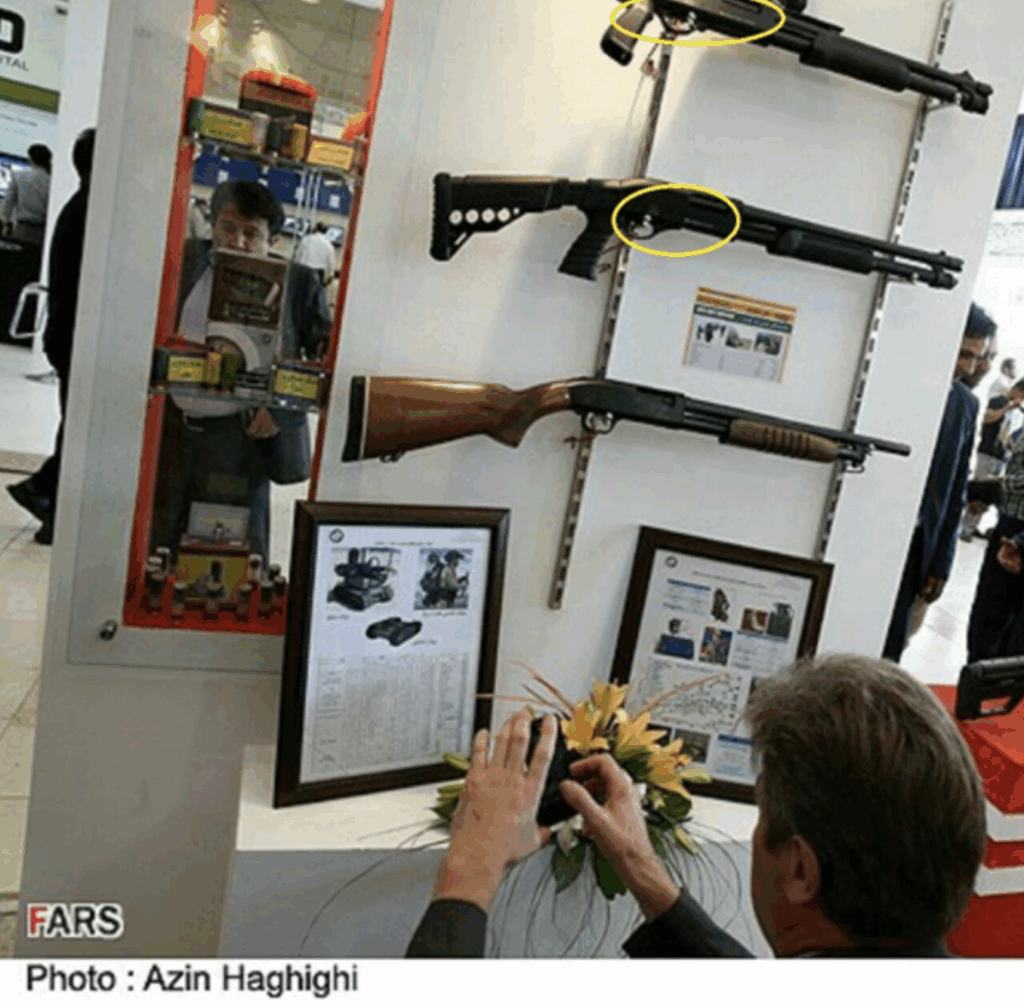
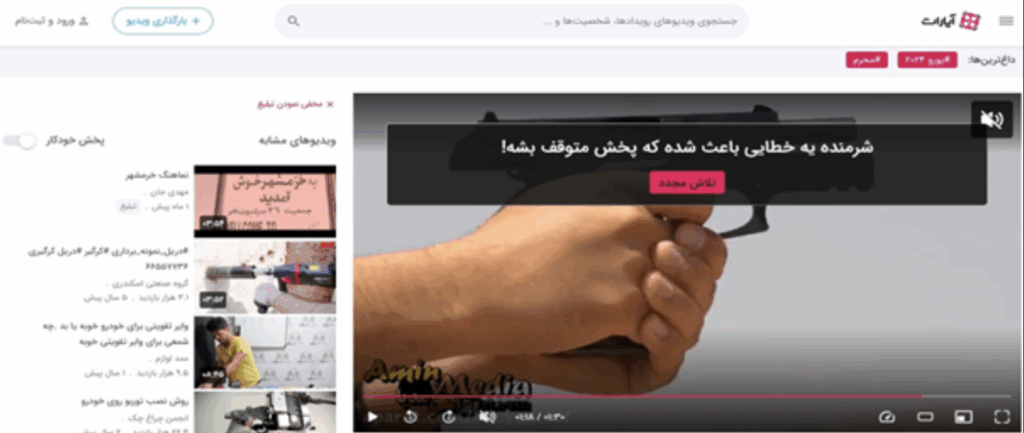
In June 2022, a short propaganda video showcasing the FARAJA Special Units was posted on Aparat.[122] Aparat is Iranian video-sharing platform akin to YouTube. The user account posting the video included hashtags supporting FARAJA forces.[123] At 1 minute and 20 seconds, a close-up clearly shows the name Karatay and the distinctive features of the Karatay 612 HD model with a fixed stock, manufactured by Akkar.[124]
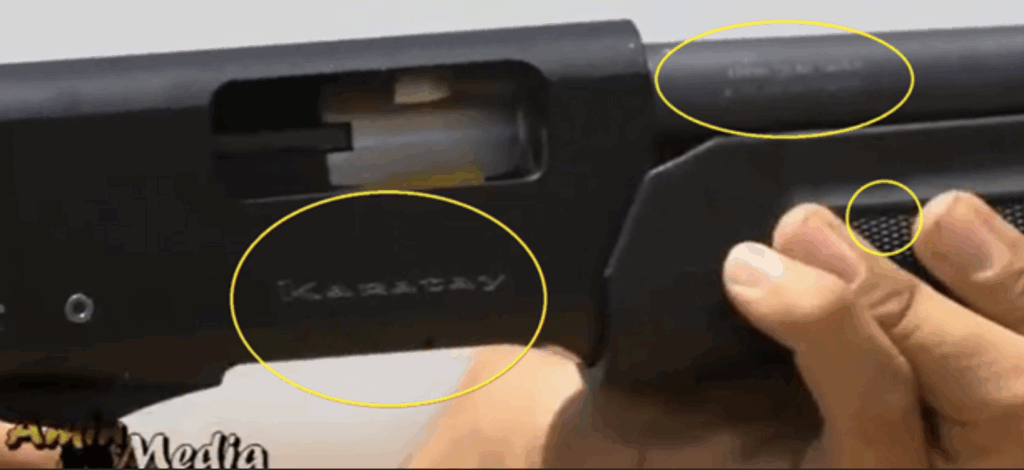


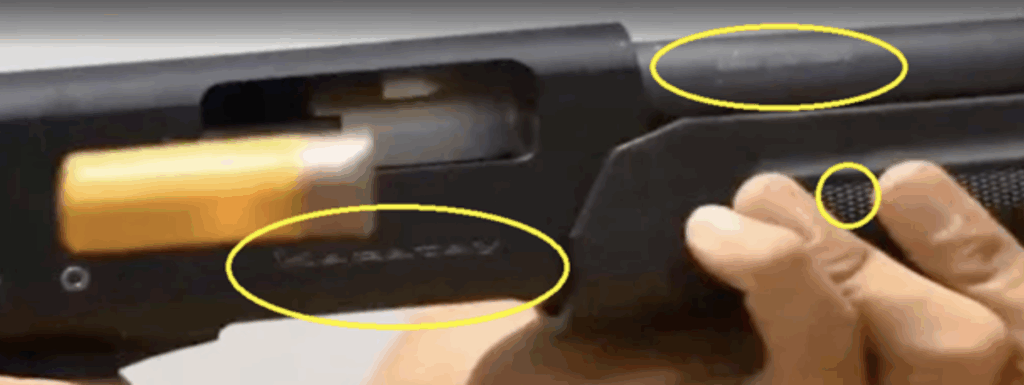

Notably, the scene depicting the firing of the Karatay shotgun was later removed from the video, possibly following the “Woman, Life, Freedom” protests in 2022.[125]

In response to inquiries from IranWire researchers, Akkar stated that, under a contract with “Jang Afzar” Company, it delivered a total of 20,000 double-barreled shotguns to the government of the Islamic Republic of Iran between 2010 and 2018. This transfer was carried out directly, without intermediaries.[126] A search of open-source materials did not identify an independent company officially or publicly named “Jang Afzar.” It appears that this name refers to the “Sanaye Jangafzarsazi” industrial complex, which is affiliated with the Defense Industries Organization (DIO) of the Islamic Republic of Iran, also known as SASAD.[127] SASAD is a government entity under the Ministry of Defense and Armed Forces Logistics, responsible for designing, producing, and supplying defense equipment and other requirements for Iran’s armed forces through its affiliated companies.[128]
Akar Company also confirmed that a limited number of Karatay 612 shotguns were exported to Iran, and that both parties signed a contract for the transfer of shotgun manufacturing technology, which led to the establishment of a shotgun production line within Iran. The company, however, asserted that Karatay 612 shotguns reached Iranian security forces through other distributors, and that, in principle, the sale and transfer of smoothbore shotguns—including models used by FARAJA forces—“do not require an export license from Turkey.” The company further stated that there are no general export restrictions on products of Turkish origin being exported to Iran.[129]
5.1.3. Sarsılmaz Co., Türkiye
Sarsılmaz Firearms Industry Inc. (Sarsılmaz Silah Sanayi A.Ş. or SAR) is Türkiye’s largest manufacturer of small arms. Established in 1880, the company is privately owned and produces a wide range of firearms, including semi-automatic and pump-action shotguns.[130] Headquartered in Düzce, Türkiye, Sarsılmaz employs over 1,600 personnel. The current CEO is Latif Aral Aliş.[131]
Sarsılmaz serves as the official supplier of small arms to both the Turkish National Police and the Turkish Armed Forces and exports its products to 78 countries worldwide.[132] More than half of its international sales are directed to the United States, where its firearms have gained significant recognition.[133] Notably, the National Rifle Association of America (NRA) has reviewed several Sarsılmaz products positively, and at least one Texas-based police department has adopted one of its pistol models as a duty weapon.[134] While the company does not disclose the full list of countries to which it exports, it confirms that its firearms are in use by the armed forces of its client nations.[135]
Sarsılmaz shotguns are also popular in Iran, where Persian-language media and social platforms frequently discuss their use and availability.[136] This report has identified M204 STD and M206W shotguns, produced by Sarsılmaz, in the possession of members of FARAJA Special Unit and IRGC security units.[137]

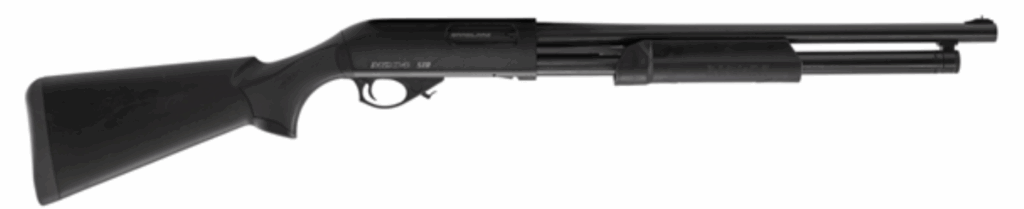




There is circumstantial evidence suggesting that Hatsan may have sold various models of its manufactured shotguns to Iran, although this has not been conclusively established. In the case of Akkar, the company has explicitly acknowledged its business dealings with government-backed companies in Iran. In contrast, for Sarsılmaz, the precise channels through which its manufactured shotguns have reached Iranian security forces and law enforcement remain unclear. Regardless of whether these transfers occurred directly or indirectly, they may constitute a breach of Türkiye’s obligations to supervise and regulate domestic companies to prevent money laundering and the financing of terrorism. These obligations encompass exercising rigorous due diligence with high-risk entities, appropriately monitoring financial transactions, verifying the end-users of sensitive goods, and reporting any suspicious activities to the competent authorities. Moreover, in light of Türkiye’s international export control commitments—designed to prevent destabilizing or illicit arms transfers—such transfers may also amount to violations of these obligations.
5.1.4. Cheddite Co., France and Italy
Founded in 1901, Cheddite is a prominent European ammunition manufacturer with a longstanding history in explosives production. Since the 1980s, the Franco-Italian company has produced shotgun shells, hunting rifle cartridges, and related components. In 2021, Cheddite reported revenues of €58.4 million.[138] The Italian branch of the company, Cheddite S.R.L, is headquartered in the port city of Livorno on the western coast of Tuscany. It has been managed by Andrea Andreani since 2009. In June 2025, Andreani was appointed President of the National Association of Italian Arms and Ammunition Manufacturers (ANPAM). He has also served as the managing director of the British company Eley Hawk Ltd since 2023, a subsidiary of the Spanish Maxam Group, which specializes in the production of shotgun cartridges.[139]
In France, the main production facility is located in Bourg-lès-Valence and is managed by Paolo Pederzoli.[140] Until late 2024, Cheddite France operated as a subsidiary of Sofisport SA, a French family-owned investment firm with deep roots in the ammunition and sporting goods sectors. In November 2024, Sofisport was fully acquired by the Belgian FN Browning Group, a major player in the European small arms industry.[141]
In 2021, Italian media reported that protesters in Myanmar—a country subject to international sanctions and an arms embargo—had recovered spent Cheddite shotgun shell casings from demonstrations against a military coup.[142] When Italian NGOs subsequently contacted Cheddite executives to inquire whether the company held the necessary export licenses for shipping ammunition to Myanmar through its Turkish partner, they received no response.
Alessandro De Pascale, a journalist who co-authored a report on these investigations for the Italian publication Il Manifesto, stated:
“We tried to contact Cheddite for a long time, but they did not answer any of our questions. Finally, after our article was published, police raided their office in Livorno to investigate the matter. So far, no fines or sanctions have been imposed on Cheddite. The case is now in the hands of the judiciary, and we do not know what will happen.”[143]
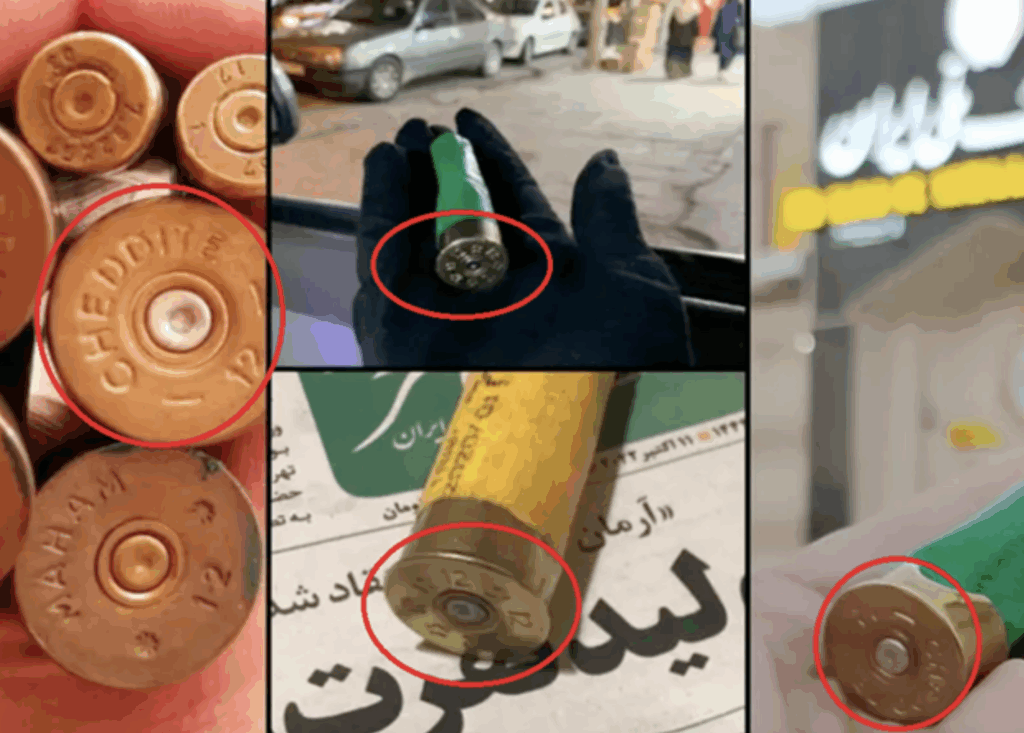
Following the publication of a report by France 24’s Observers team on the use of Cheddite products by Iranian security forces to suppress the 2022 protests, company officials reportedly adopted a strategy characterized by secrecy and a lack of transparency—mirroring the approach previously taken in the case of Myanmar. The report documented dozens of spent shell casings bearing the Cheddite trademark across multiple Iranian cities, representing a clear violation of EU sanctions. Since 2012, these sanctions have prohibited any direct or indirect export of ammunition—including shotgun shells and related components—to Iran, regardless of the intended use or method of transport.[144]
The France 24 report further identified the Turkish company Yavascalar YAF, which maintains close business ties with Cheddite, as a key intermediary in the transfer of ammunition to Iran. The company reportedly imports Cheddite-made shotshells and cartridges into Turkey, refills them, and then exports them to Iran. Most of these shells are plastic, with a metal base and a primer to ignite the gunpowder, and some are prepared for use by groups affiliated with SASAD after entering Iran.[145]
In response to the report, the French Ministry of Foreign Affairs announced that it had initiated an independent investigation into the matter.[146] To date, the results of this investigation have not been publicly disclosed.
Data from the UN Comtrade Database indicates that between 2012 and 2023, Iran imported over $3 million worth of ammunition and components classified under commodity code 930629 from Türkiye.[147] During the same period, more than $6 million worth of shotgun cartridges and other ammunition under code 9306 were exported from Türkiye to Iran.[148] Considering these figures alongside Iran’s domestic capacity to produce lead, metal, and rubber bullets, it appears likely that at least some of these shipments involve cartridge cases supplied by Cheddite and its Turkish partner.
The documented use of Cheddite-manufactured ammunition by Iranian security forces during the 2022 protest crackdown—potentially facilitated through Turkish intermediaries such as Yavascalar YAF—raises serious concerns under EU export control law, including Council Regulation (EU) No. 267/2012, which implements a comprehensive arms embargo against Iran; Council Common Position 2008/944/CFSP, requiring assessment of exports against human rights criteria; and regulations concerning dual-use items, mandating rigorous end-user checks. Even absent direct involvement in such transfers, Cheddite was obliged to exercise due diligence and implement monitoring mechanisms to ensure that its products were not diverted to unauthorized users. Failure to do so could constitute a breach of these binding legal obligations and expose the company to legal and reputational risk.


5.1.5. Corporate Responsibility and Complicity in Human Rights Violations
Under international law and human rights principles, there is a reasonable basis for asserting that certain Turkish and European companies involved in the transfer of shotguns, manufacturing technology, components, or related products to Iran may incur responsibility for their subsequent use in the violent suppression of the 2022 protests. While no single treaty expressly establishes corporate liability in this context, responsibility may arise from the interplay of international legal doctrines, national export control frameworks, and the evolving principle of corporate complicity in human rights abuses.
The principle of corporate complicity provides the most direct analytical framework. Though not codified in a comprehensive treaty, it has gained increasing recognition in jurisprudence and state practice as a basis for corporate accountability where businesses knowingly contribute to, or facilitate, state-perpetrated violations.[149] Liability may attach where companies provide substantial assistance to abuses with actual or constructive knowledge of the likely consequences. Supplying arms, ammunition, or production technology to the Iranian regime—given its history of violent suppression of protests, which has been widely documented—could therefore be regarded as a material contribution to subsequent violations. A key challenge, however, is the high evidentiary burden of proving this knowledge and establishing a direct link between a specific company’s products and the human rights abuses—a common counterargument raised by corporations.
Knowledge of end-use is a critical element in this analysis. The Islamic Republic’s systematic deployment of excessive and lethal force against demonstrators has been extensively documented over the past two decades, including during the November 2019 protests. Companies that continued to facilitate transfers under these circumstances may be considered to have had constructive knowledge that their products would likely be employed in further acts of repression.
The UN Guiding Principles on Business and Human Rights (UNGPs), though a soft law instrument, articulates the authoritative global standard for business conduct. They establish that companies have an independent responsibility to respect human rights, including obligations to avoid causing or contributing to abuses and to conduct human rights due diligence.[150] In sectors with heightened end-use risks—such as arms and dual-use technologies—enhanced due diligence is required. The value of this soft law framework lies in its role in creating a normative standard that is increasingly being codified into hard law through national legislation, such as new mandatory human rights due diligence laws in European countries.[151] A failure to conduct such due diligence in the Iranian context could amount to a breach of these responsibilities and expose companies to legal and reputational risk.
Export control regimes reinforce these obligations. Türkiye, as a member of the Wassenaar Arrangement, has undertaken commitments to exercise caution in authorizing transfers where there is a foreseeable risk of internal repression.[152] Likewise, the European Union’s Common Position on Arms Exports imposes binding obligations on member states to deny export licenses where there is a substantial risk of misuse for repression or violations of international humanitarian law. National licensing frameworks in both Türkiye and EU member states further require scrutiny of end-use and end-user risks. Transfer of less-lethal weapons and related equipment to Iran under these circumstances may therefore represent violations of both domestic export control laws and international commitments.
In more severe cases, complicity in international crimes may be alleged. While the International Criminal Court (ICC) does not have jurisdiction over corporations as legal entities, corporate officers—such as directors or senior managers—may be individually liable where their actions materially contributed to crimes against humanity. Moreover, national courts exercising universal jurisdiction increasingly provide avenues for accountability in cases of corporate involvement in egregious human rights violations.
Turkish and European companies that transferred shotguns, ammunition, or related production technology to Iran in recent years face potential exposure under the principle of corporate complicity, failures of human rights due diligence, and violations of export control regimes. While establishing direct legal liability remains complex, the convergence of international standards, domestic regulatory frameworks, and evolving jurisprudence underscores a clear normative trajectory: businesses cannot evade responsibility for the foreseeable misuse of their products. The systematic deployment of less-lethal weapons by Iranian authorities in the commission of grave human rights abuses significantly strengthens the case for accountability—both legal and reputational.
5.2. Domestic Manufacturers of Shotguns and Their Ammunition
Iran’s domestic arms industry includes key manufacturers that supply shotguns and ammunition to military, law enforcement, and civilian users. Shahid Kaveh Khorasan Industries, affiliated with SASAD, produces multiple shotgun models employed by security forces, while also offering sporting variants. The Ammunition and Metallurgy Industries Group (Maham) and its subsidiaries manufacture cartridges and shell cases used by these forces. This chapter examines these manufacturers, their products, and the operational characteristics of their firearms and ammunition, drawing on open-source information, exhibition records, and documented deployment in security operations.
5.2.1. Shahid Kaveh Khorasan Industries
Shahid Kaveh Khorasan Industries, affiliated with SASAD and managed by Seyyed Hadi Alavi-Gol, is a major manufacturer of small arms in Iran.[153] Open-source information indicates that the company’s Maher and Sayyad shotguns are deployed by the Islamic Republic’s military and security forces. The Yuz shotgun is produced in two variants: a law enforcement model—sometimes identified as the Sayyad 2—employed by military and security personnel, and a hunting model, which is a version of the Maher and Escort shotguns manufactured by the Turkish firm Hatsan. Additionally, Shahin and Nakhjir shotguns, also manufactured by Shahid Kaveh Khorasan Industries, are marketed for sporting and hunting purposes. The company’s products have been showcased at the IPAS Expo in Tehran in multiple years.[154]

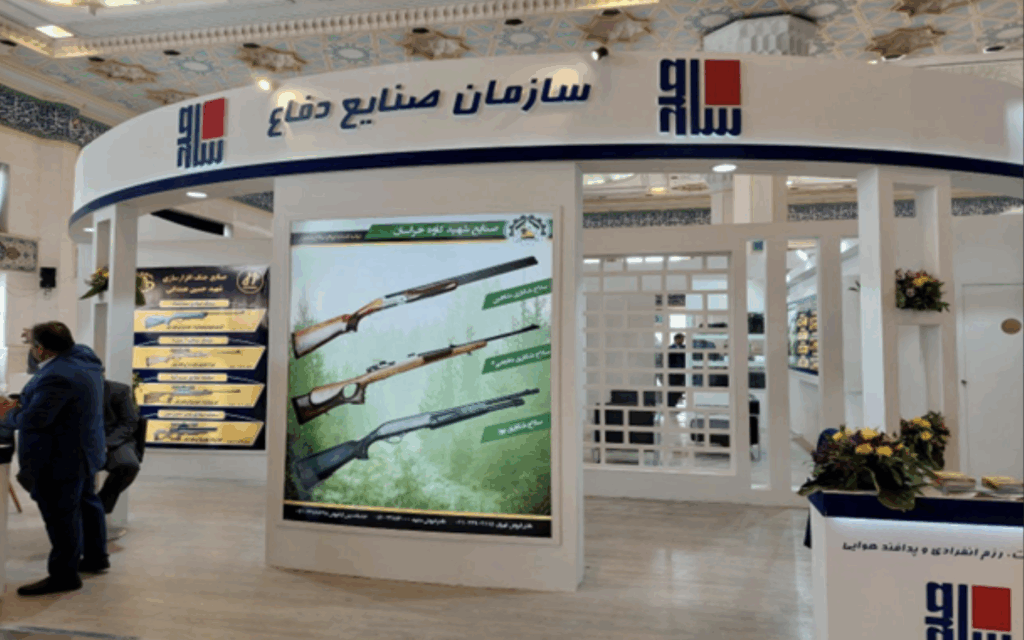
According to at least one source, the Maher shotgun is essentially a copy of the Turkish Hatsan Escort shotgun. It is primarily used by security forces within FARAJA and the IRGC.[155] The Maher shotgun appears to be available in three configurations: with a fixed stock, a pistol grip, or a top-folding stock.[156] The Iranian version can be distinguished from its Turkish counterpart by markings on the receiver: the Turkish model bears the word “Escort” on the right side, whereas the versions supplied to FARAJA carry the trademark of Shahid Kaveh Khorasan Industries.[157]

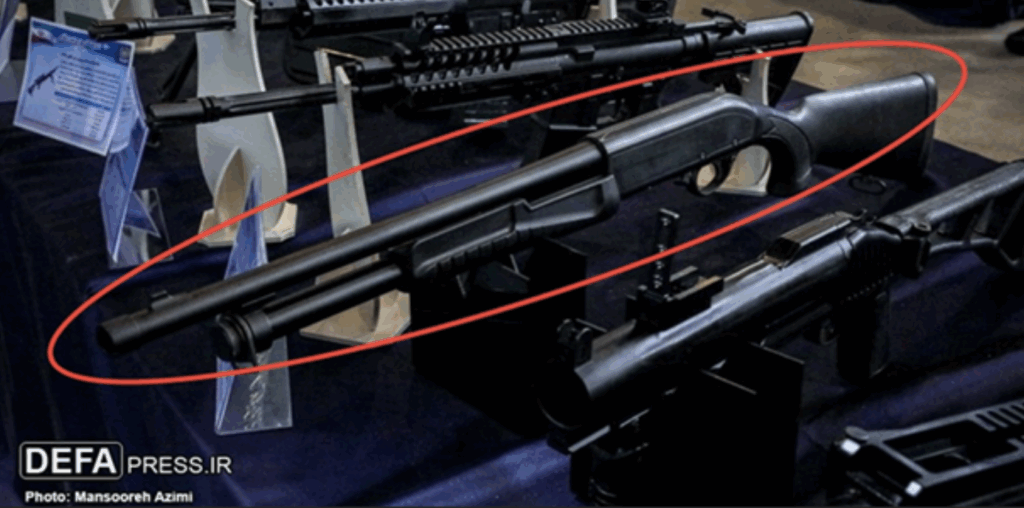

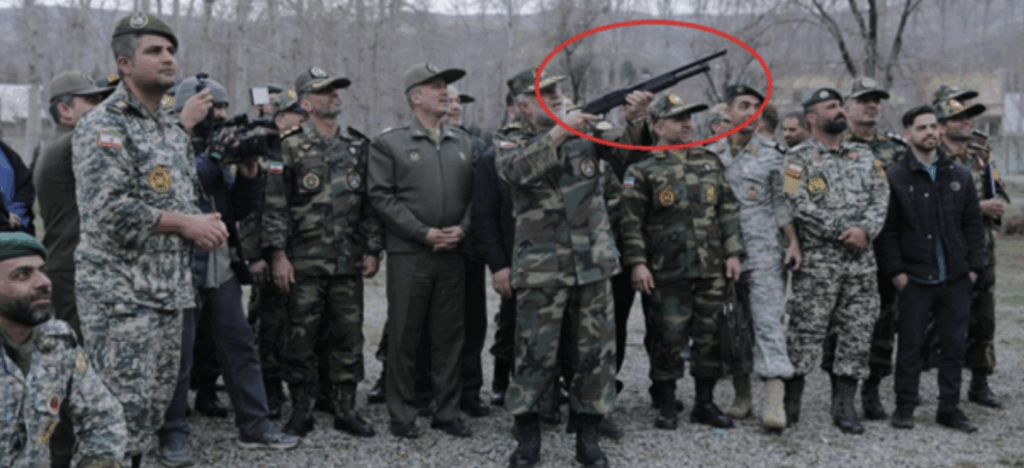

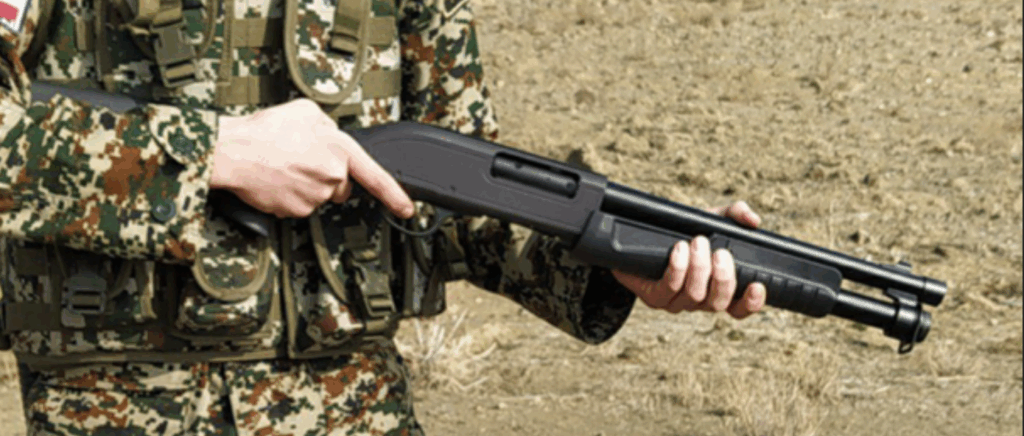

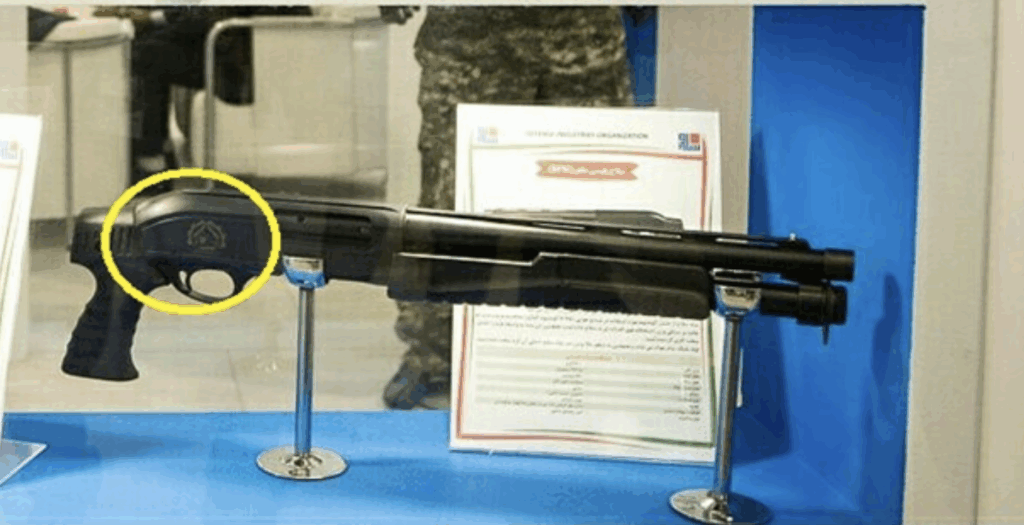

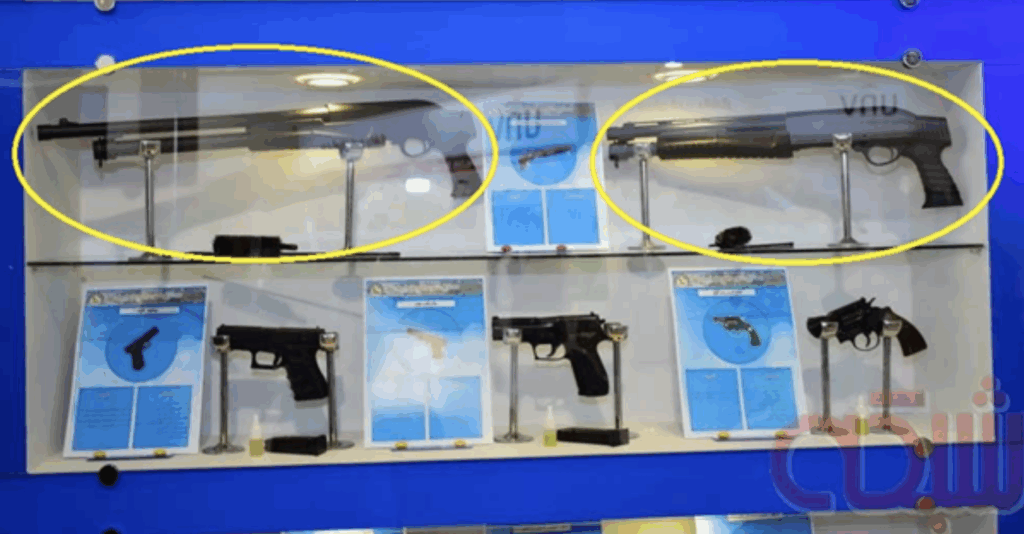
During the course of investigations for this report, a Maher shotgun was identified that appears to be a prototype previously displayed at an exhibition in Iran. In the background of a photograph showing an individual holding the firearm, the inscription “Shahid Kaveh Khorasan Industries” is visible. The body of the gun bears an Arabic prayer, translated as: “[p]raise be to God who has made us among those who adhere to the Guardianship of [Ali ibn Abi Talib, the first Shia Imam], the Commander of the Faithful, and the Immaculate Imams,” with the date “June 2015” inscribed below the prayer.[158]

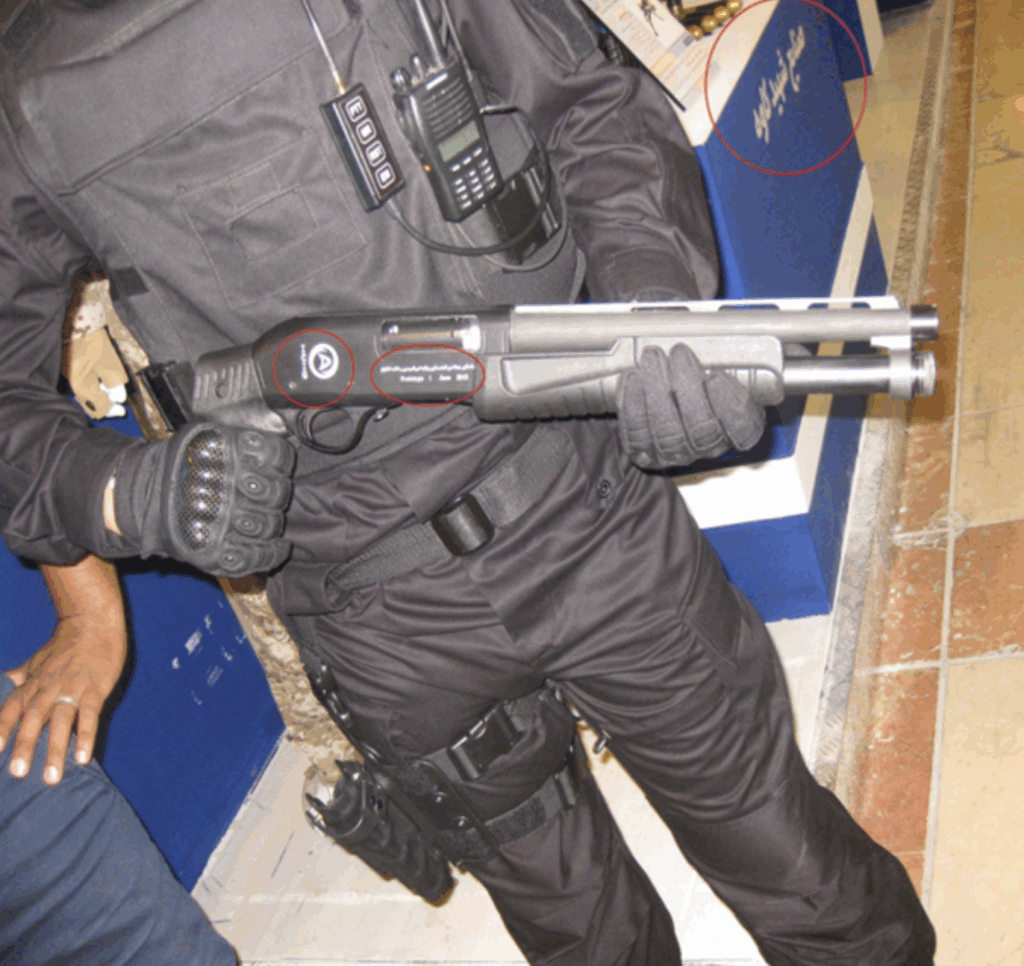
The source publishing the image identifies the firearm as a Maher shotgun; however, the logo on the gun’s stock resembles that of the Turkish manufacturer Akkar.

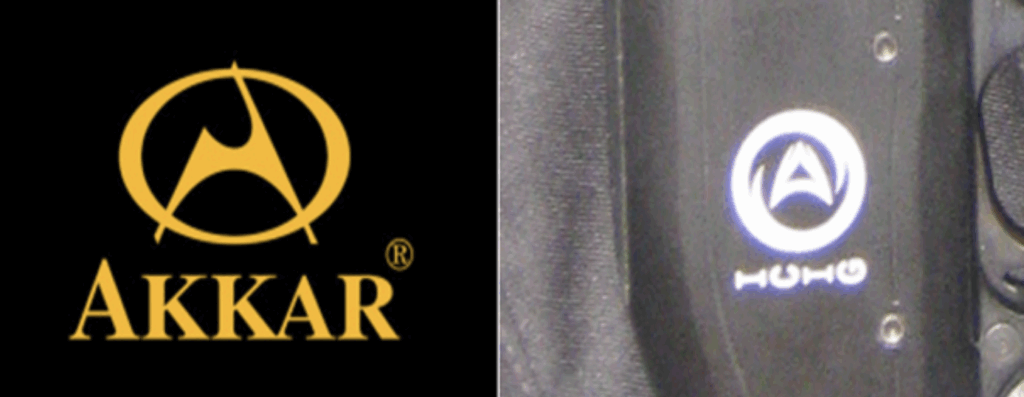
Although Akkar’s involvement with this specific weapon is not fully established, the company confirmed in correspondence with IranWire that, in addition to exporting its products to Iran, it entered into a contract to transfer shotgun manufacturing technology. This agreement facilitated the establishment of a domestic production line for the weapon in Iran.[159]
Shahid Kaveh Khorasan Industries is reported to have designed and produced the Sayyad and Sayyad-2 shotguns at the request of Iran’s Law Enforcement Command, offering two configurations: one with a fixed stock and one with a folding stock.[160] It should be noted that the designation “Sayyad” is not exclusive to Shahid Kaveh Khorasan Industries, as other Iranian-manufactured firearms also carry the same name.[161]
According to at least one source, the Sayyad 2 shotgun—the police variant of the Yuz shotgun—is an Iranian-produced copy of the American Mossberg 500 shotgun.[162] The Mossberg 500 has been in use by various FARAJA units for many years.[163] Certain models of Mossberg shotguns and Sayyad shotguns exhibit notable visual similarities.





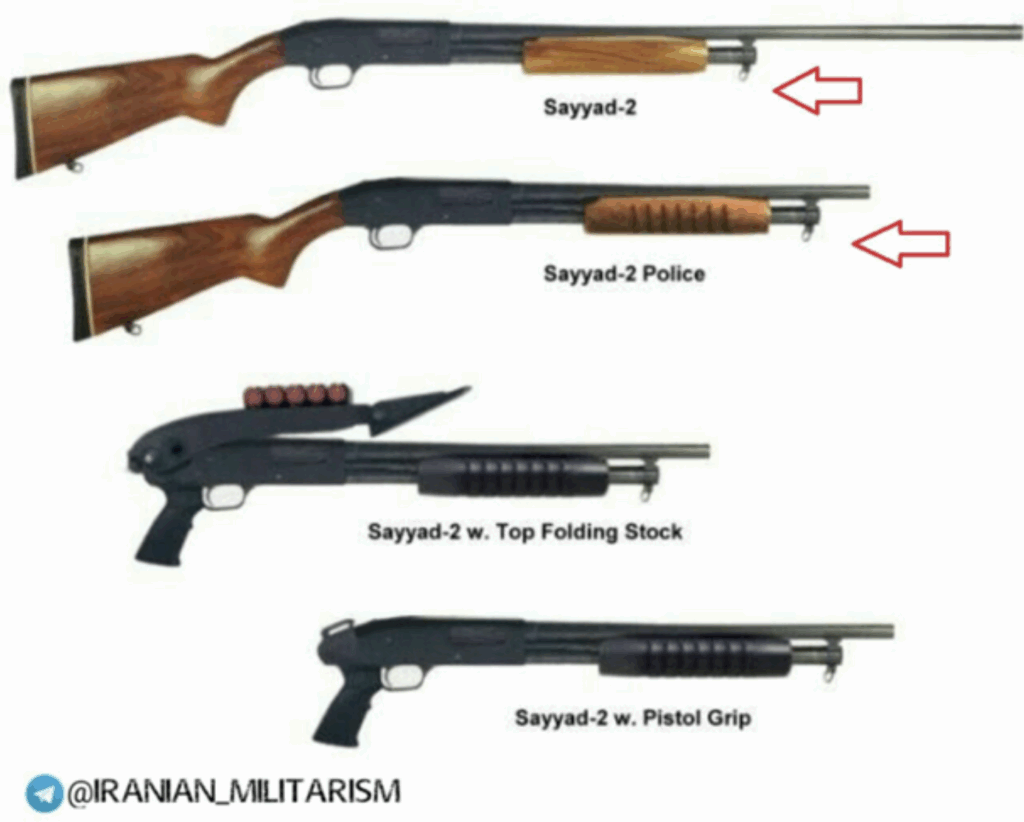

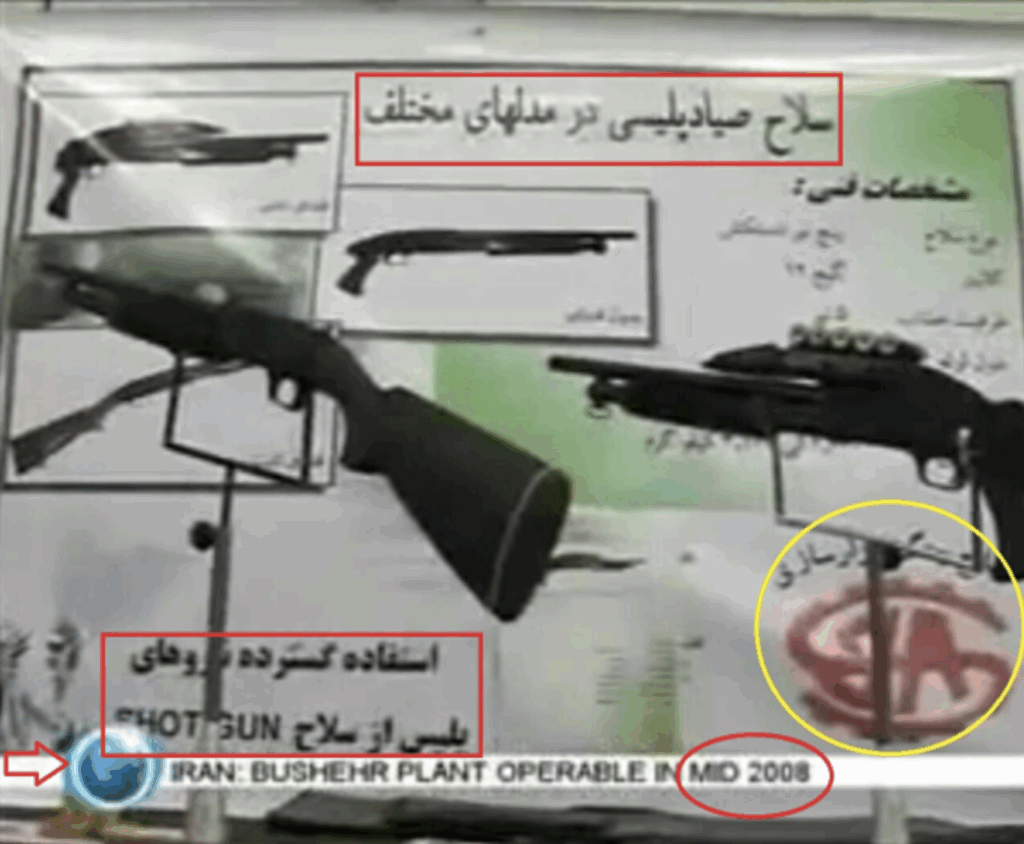

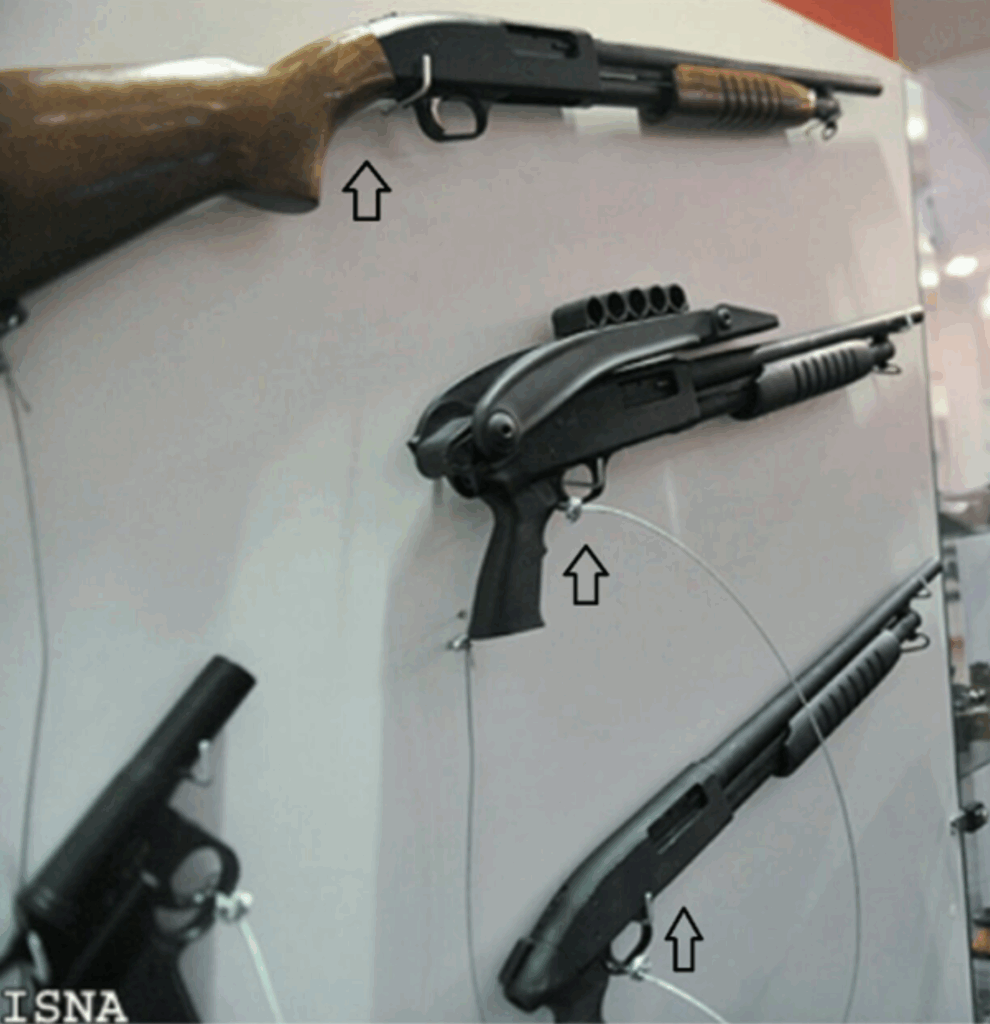

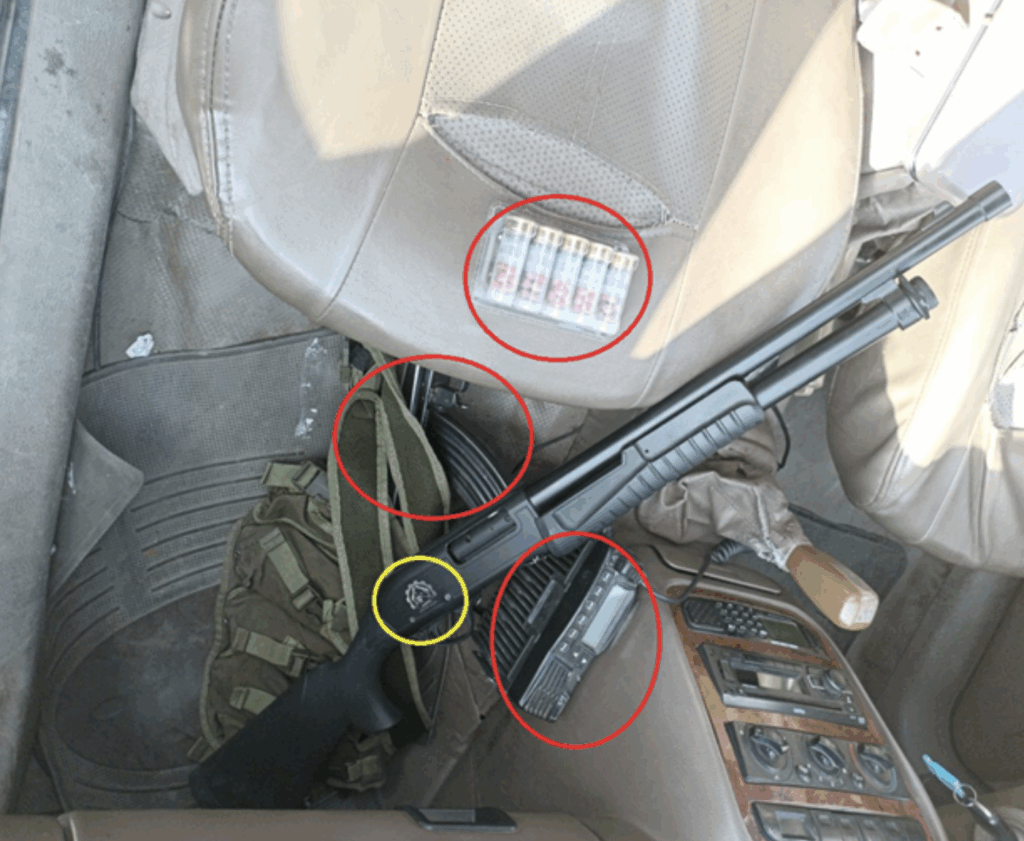

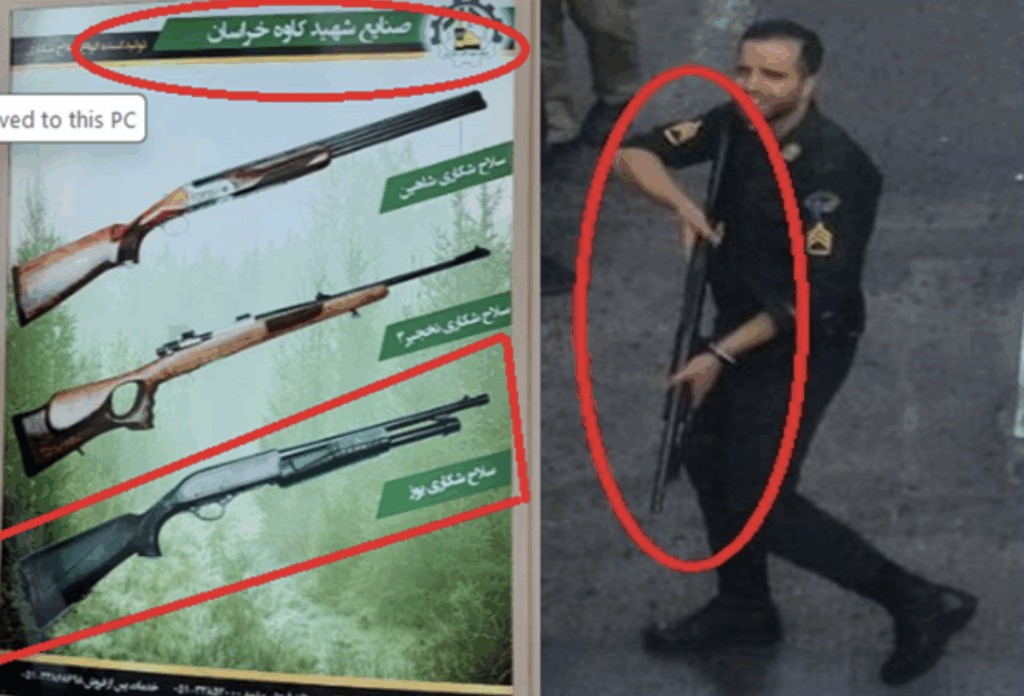
Based on the images available on social media, it appears that in addition to FARAJA forces, combat and security units of IRGC—including the Imam Ali security battalions—are also using Sayyad shotguns.[164]

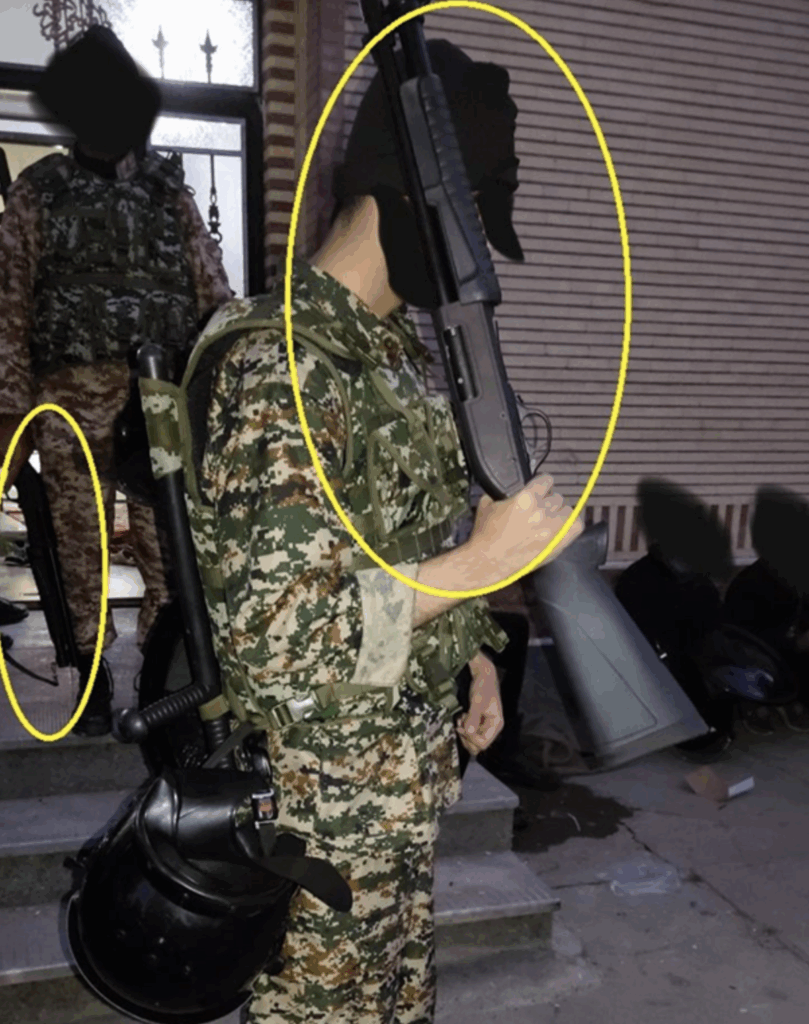

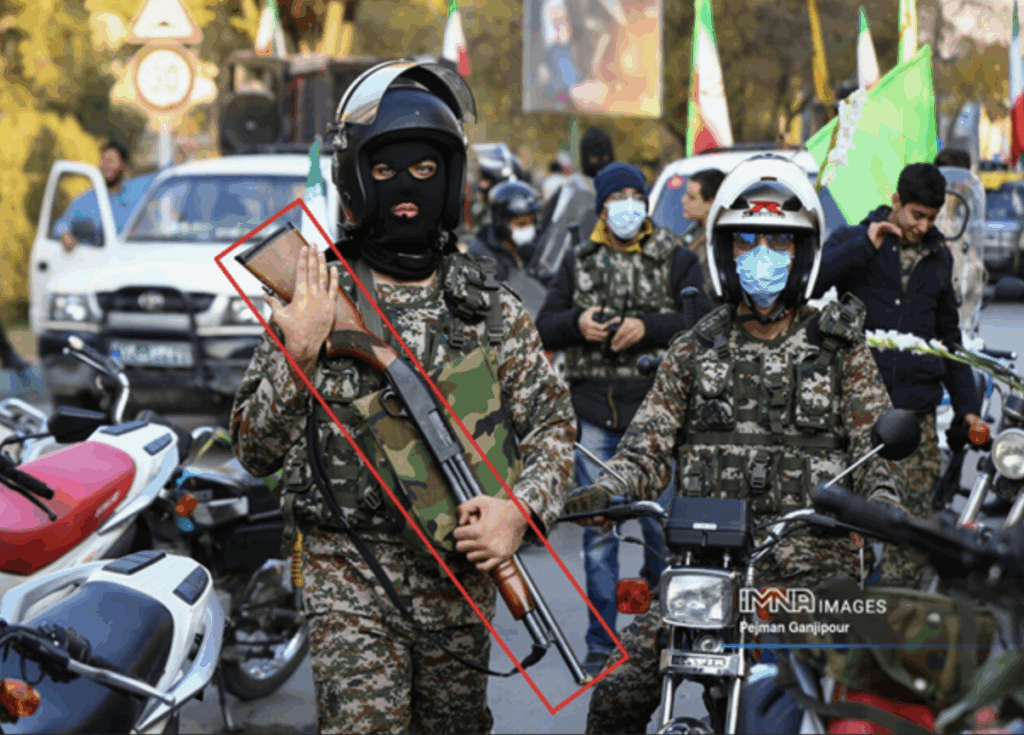
5.2.2. Ammunition and Metallurgy Industries Group and Shahid Shiroudi Ammunition Industries
The Defense Industries Organization of the Islamic Republic of Iran (SASAD) includes three manufacturing groups: ammunition, machine guns, and chemicals.[165] Despite limited access to reliable open-source information about Ammunition and Metallurgy Industries Group Corporation (Maham), certain indicators—such as the company’s headquarters address at Pasdaran Crossroads in Tehran—suggest that Maham is likely a subsidiary of SASAD’s munitions group. Maham also appears to encompass smaller production units, such as Shahid Shiroudi Munitions Industries, a company that shares the exact same address as Maham.[166] Shahid Shiroudi Munitions Industries produce various small-caliber cartridges for police and hunting use.[167]
A section of the biography of Mostafa Mohammad Najjar, an IRGC general and Minister of Defense during Mahmoud Ahmadinejad’s first presidential term (2005–2009), notes that from 2002 to 2005, he served as director and head of the executive board of SASAD Munitions Industries Group. This group encompassed multiple facilities, including the ammunition manufacturing plants at Pasdaran Crossroads, Parchin Ammunition Industries, Haft-e-Tir Industries in Isfahan, Isfahan Ammunition Industries, Khorasan Metallurgy Industries, Yazd Metallurgy Industries, and sites in Dezful and Susangerd (Khuzestan).[168] The Iranian government has deliberately limited public information regarding Maham’s activities. Notably, the most recent official report on this group dates back to 2001, referencing Engineer Seyyed Razi Shabiri as Maham’s CEO at that time.[169]

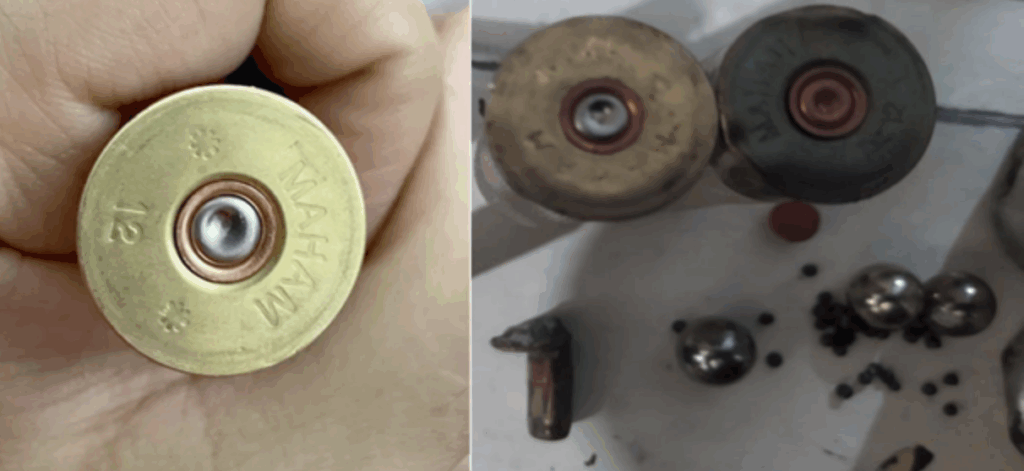
Based on the available information and the breadth of Maham’s operations, the company appears to supply a substantial portion of the Iranian government’s military and security forces with light and semi-heavy weapons and ammunition.[170] Pictorial evidence from the suppression of the 2022 protests indicates that the majority of cartridges and shells used by security forces were manufactured by Maham. As noted previously, the Turkish company Yavascalar, which maintains close business ties with the French-Italian firm Cheddite, played a key role in transferring ammunition to Iran. Some of the cartridges and shell cases produced by Cheddite, imported into Türkiye by Yavascalar, ultimately reached Iran. Certain shell cases were subsequently filled with gunpowder and pellets by Shahid Shiroudi Ammunition Industries and marketed under the trade name “Shahin.” It is important to note that both SASAD and Shahid Shiroudi Ammunition Industries have been subject to United States and European Union sanctions since 2007, as well as United Nations sanctions from 2006 to 2015.[171] Accordingly, any engagement with SASAD or its subsidiaries may constitute a violation of international sanctions law, exposing third-party suppliers who knowingly facilitated these transfers to potential civil or criminal liability.

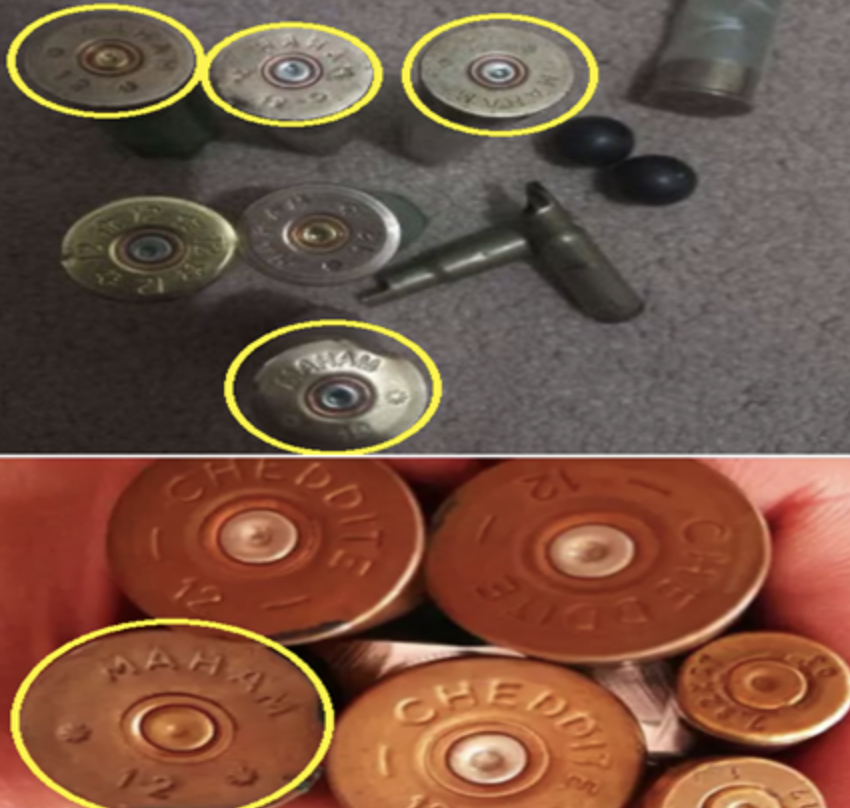
5.2.3. Limits of Corporate Responsibility in State-Controlled Arms Production
Under international law, state-owned arms manufacturers are considered extensions of the government. In Iran, where the state controls these companies and uses their products to commit human rights violations, legal responsibility rests with the government, not the companies. Independent corporations may be liable if they knowingly facilitate abuses, but for state-owned enterprises, accountability primarily falls on state officials and the government apparatus. Accordingly, legal and diplomatic actions are most effective when directed at the Iranian government and those responsible for ordering or executing violations, though third-party suppliers can still be held liable if they knowingly provided materials or technology used to commit abuses.
6. Paintball Guns
Marker guns, commonly referred to as paintball markers, are a category of air guns that utilize a compressed gas tank to propel paintball projectiles toward a target. While these devices are primarily designed for recreational and sporting purposes, evidence indicates that the security forces of the Islamic Republic have repurposed them for law enforcement operations, specifically to mark individuals for arrest during protest activities. During the 2022 nationwide protests, the deployment of these weapons escalated beyond identification purposes, with documented use in multiple cities demonstrating an intent to inflict serious bodily harm.

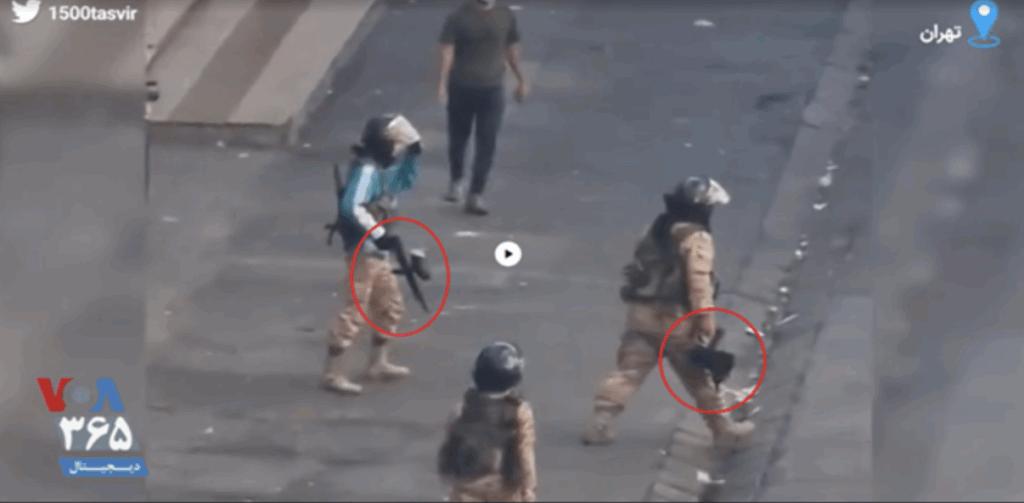
With minor technical modifications, paintball markers can be converted to discharge hard rubber or metal projectiles, significantly increasing their lethality. Security forces reportedly employed such modifications extensively during the suppression of the 2022 protests. Units involved include the Fatehin Special Unit (under the Basij Organization), local police forces, and the IRGC Navab Security Commando Battalion affiliated with the Saheb-e-Zaman Security Unit of the Greater Tehran Prophet Mohammad Corps.[172]

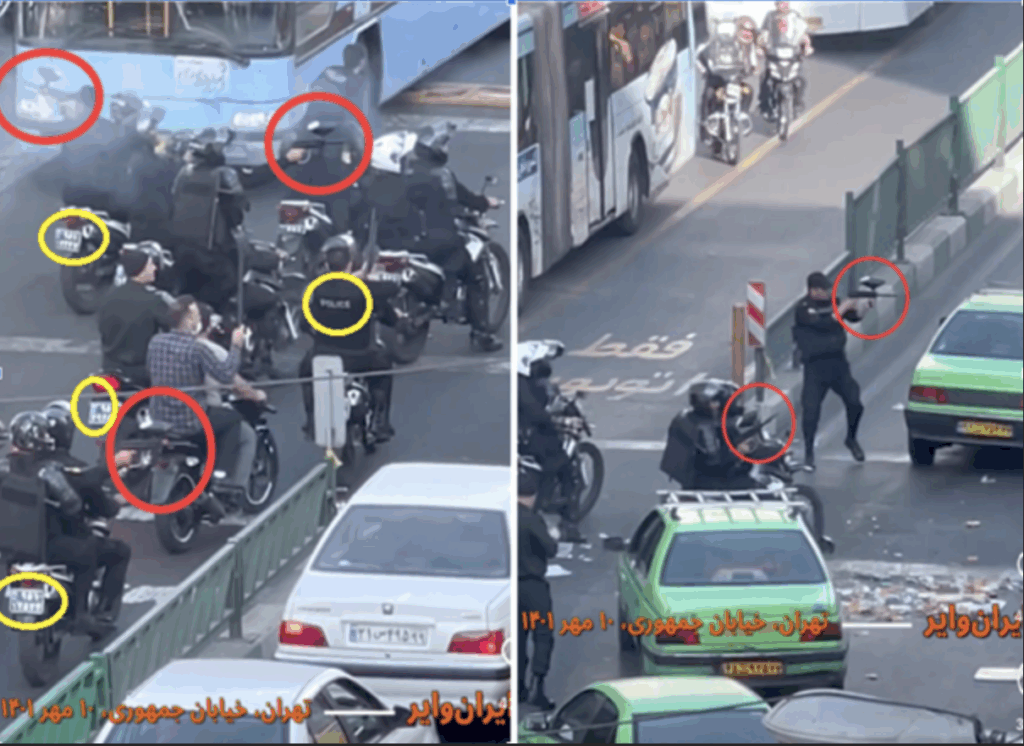
Victims interviewed during the course of this investigation reported experiencing ongoing harassment and threats following injuries to their eyes. These threats included verbal abuse and intimidation in both public and private spaces, primarily carried out by plainclothes security forces and Basiji members. The deliberate and permanent infliction of eye injuries appears to have been used as a systematic tool of social control. Through this method, authorities sought to identify potential protest participants and preemptively detain them. The permanent alteration of victims’ physical appearance effectively transforms them into visible markers in the society, which, in the view of the Iranian regime, conveys both a threatening and deterrent message to the broader public and serves to restrict civic participation.

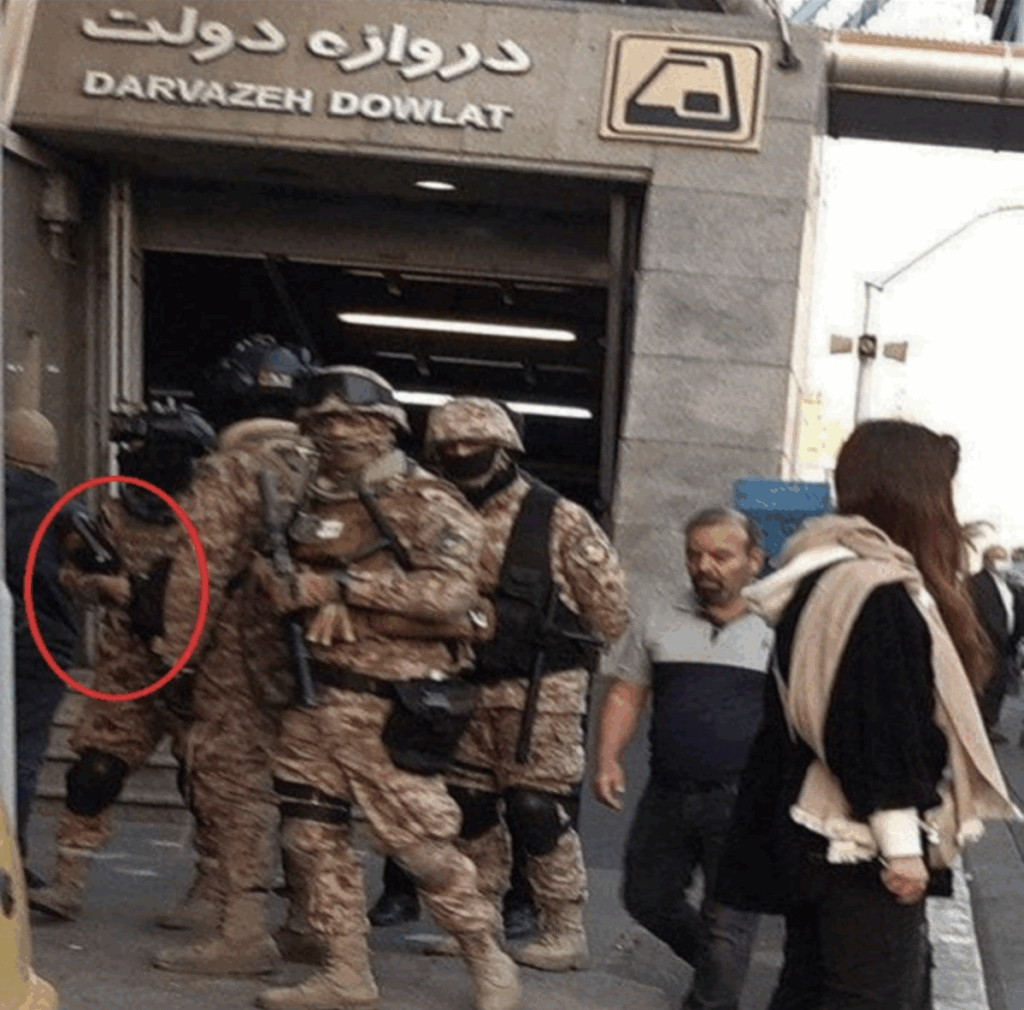

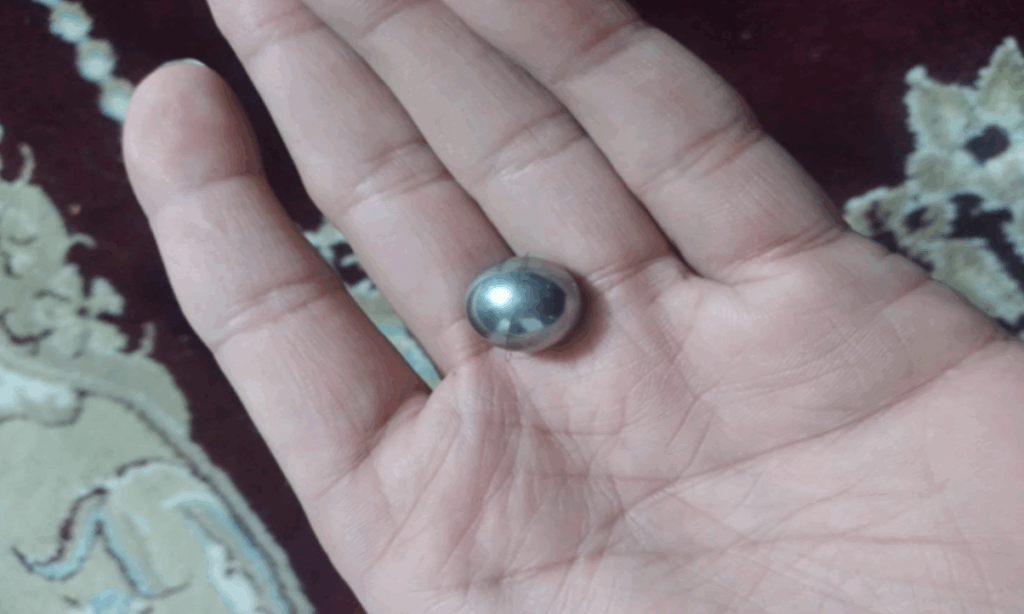

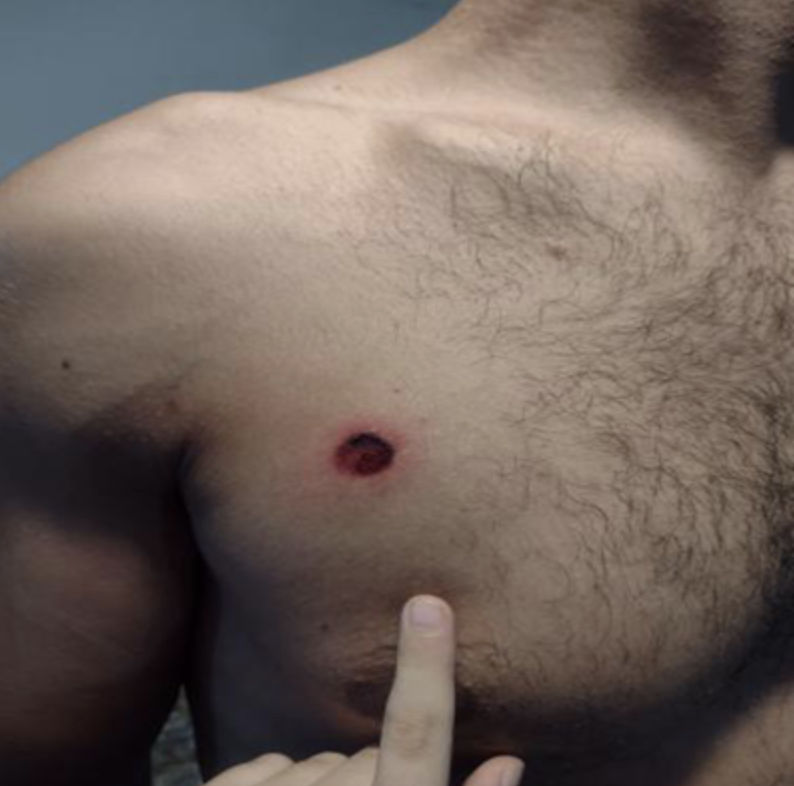
Among nine documented cases of ocular injuries caused by paintball projectiles, several individuals required enucleation. In the case of Kowsar Eftekhari, evidence indicates that the projectile was deliberately aimed at her eye. In an exclusive interview for this report, Eftekhari stated that a plainclothes security officer had explicitly threatened her prior to firing, warning that if she did not leave the area, he would shoot her in the eyes—a threat that was carried out within seconds. As a result of the shot, Eftekhari permanently lost vision in one eye.[173]

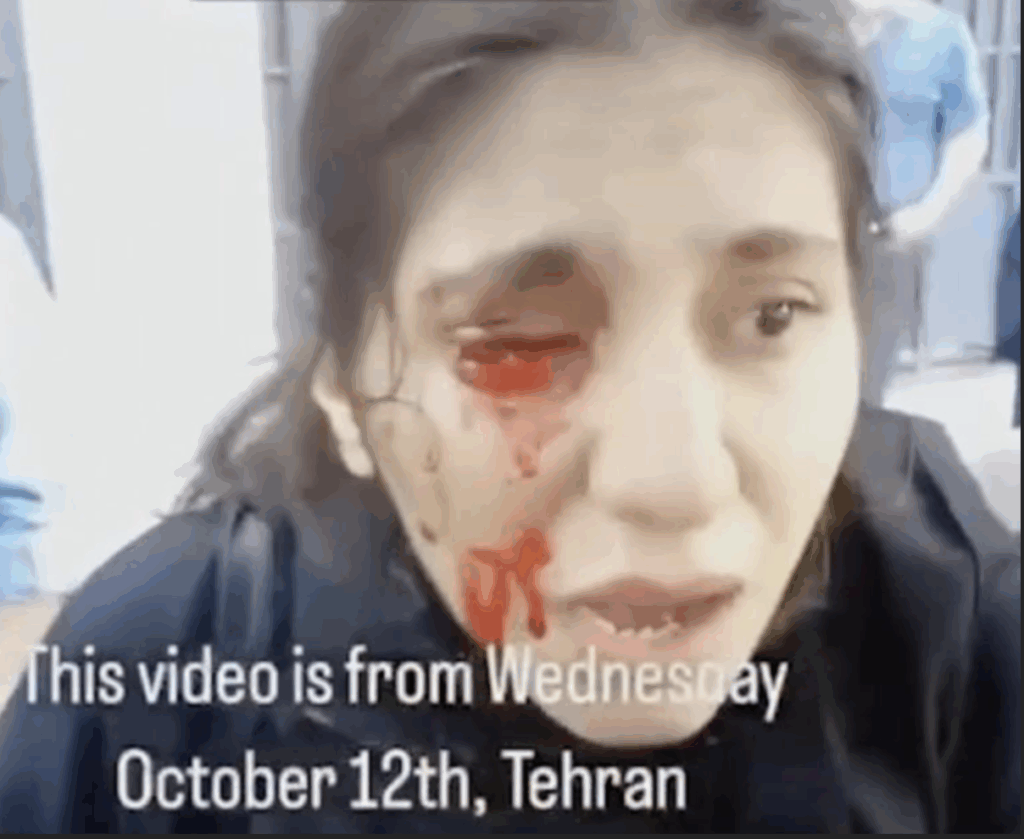

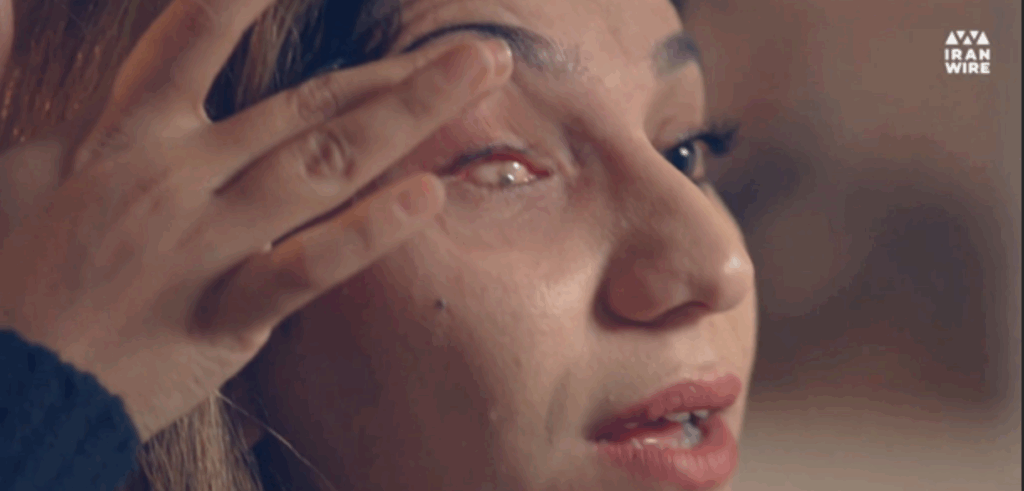
Such conduct represents a clear abuse of authority and a breach of international human rights obligations, including the prohibition on cruel, inhuman, or degrading treatment and the misuse of force in policing. The deliberate repurposing of ostensibly harmless recreational devices to cause lasting harm demonstrates a calculated strategy to intimidate and punish dissent.
7. Manufacturers of Paintball Guns
Despite the widespread deployment of paintball guns by various security units of the Islamic Republic, the range of models utilized is narrow and heavily concentrated among a limited number of North American manufacturers. Documented instances indicate that the vast majority of these weapons in use can be traced to two specific companies. This concentration raises potential questions regarding compliance with U.S. export control regulations and international human rights obligations.
7.1. Tippmann, USA and Canada
The U.S.-Canadian company Tippmann, founded in 1983 in Fort Wayne, Indiana, originally produced firearm replicas. Following changes in U.S. firearms regulations in 1986, Dennis Tippmann Sr., the company’s founder, shifted the business toward the production of paintball equipment. In 2004, the Tippmann family transferred approximately 80% of the company’s shares to venture capital firm Summit Partners, though Dennis Tippmann Jr. continued to serve on the board and contribute to product development. In 2014, Tippmann Sports merged with GI Sportz—owner of V-Force and Empire brands—and was subsequently acquired by Kore Outdoor Inc., bringing Tippmann under the Kore umbrella.[174]
Kore Outdoor, headquartered in Montreal, Québec, Canada, is a leading global manufacturer and distributor of paintball and air guns. In addition to its Canadian headquarters, the company maintains offices in the United States and operates extensive distribution networks across North America and Europe. Core Outdoor employs approximately 250 people and produces billions of paintballs annually. In 2022, Ironbridge Equity Partners & Management, a Toronto-based private equity firm, acquired a controlling interest in Kore Outdoor. The company is currently led by Chief Executive Officer Billy Ceranski.[175]

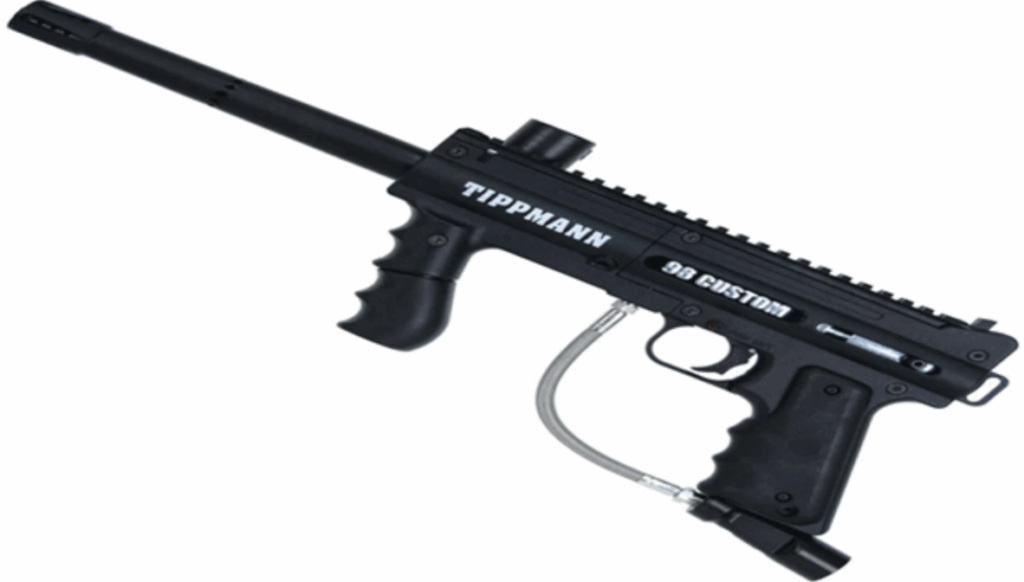
Photographic and video evidence indicates that Tippmann paintball guns are widely used by the training and operational units of the Islamic Republic, including the Imam Ali Security Battalions of the IRGC, the Special Units of FARAJA, and the Fatehin Special Unit of the Basij.[176] Although many images from the 2022 protests are either low-resolution or taken from a distance—making definitive identification of the firearm brands impossible—the visible characteristics of the weapons carried by security forces closely resemble Tippmann models, suggesting their likely use.[177]

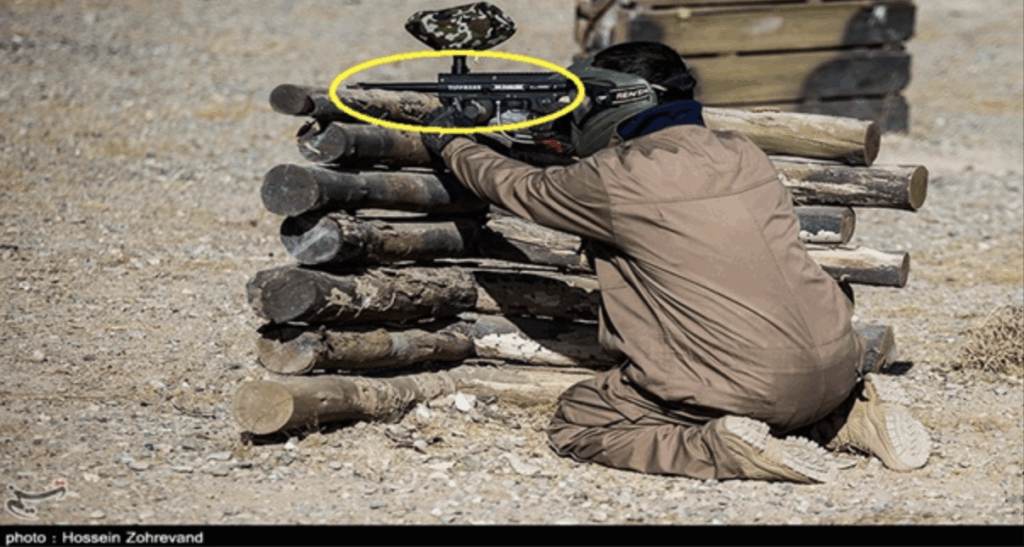

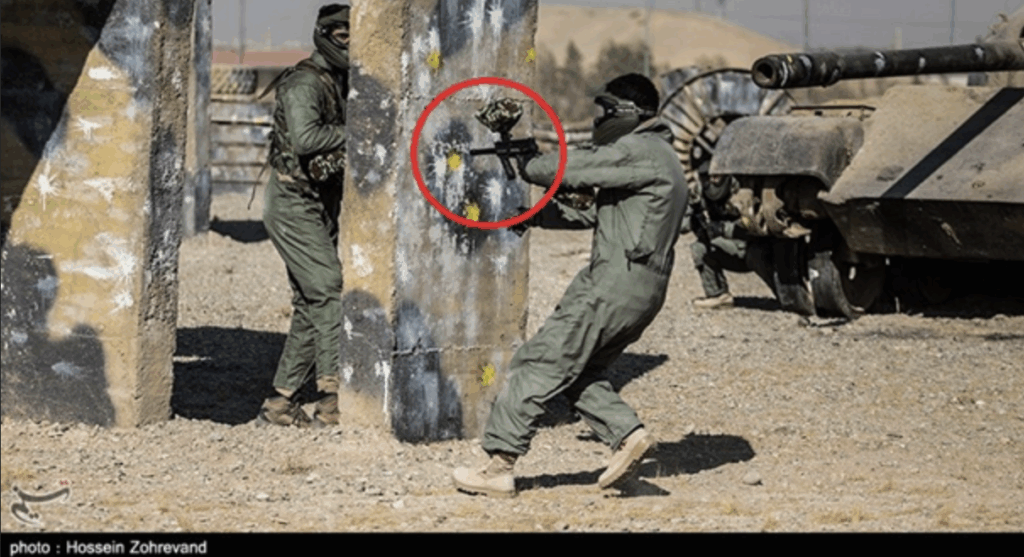
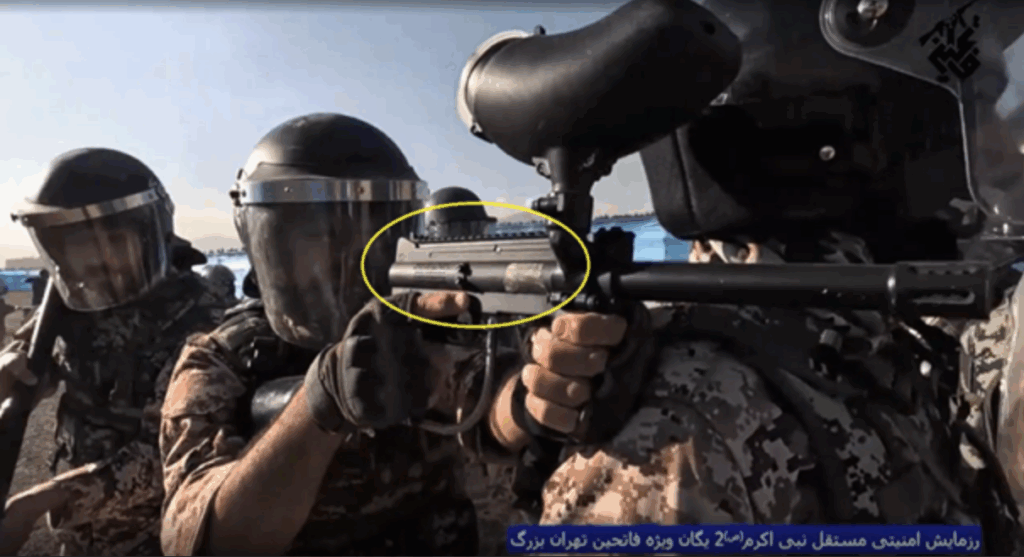
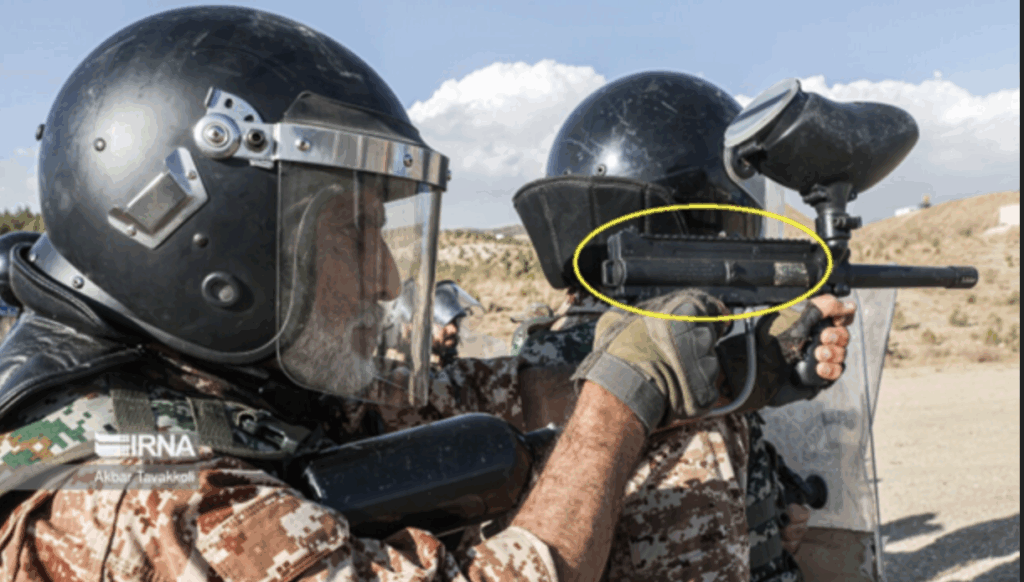

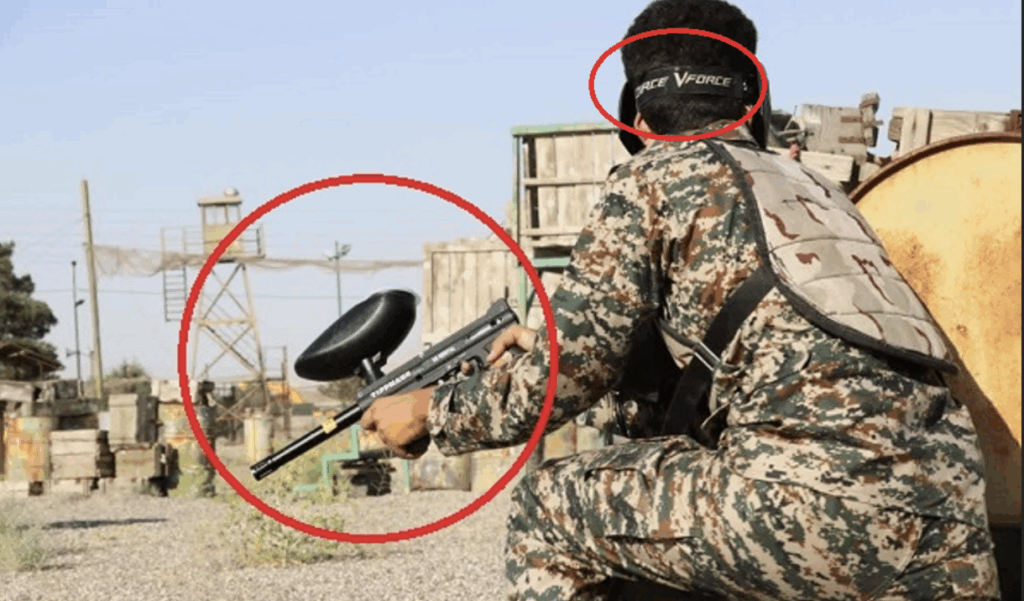

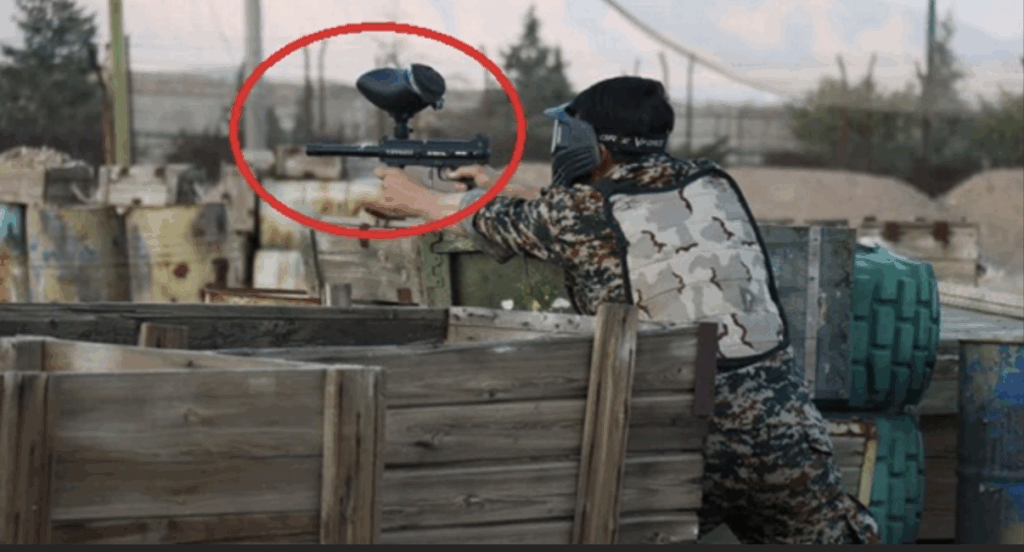

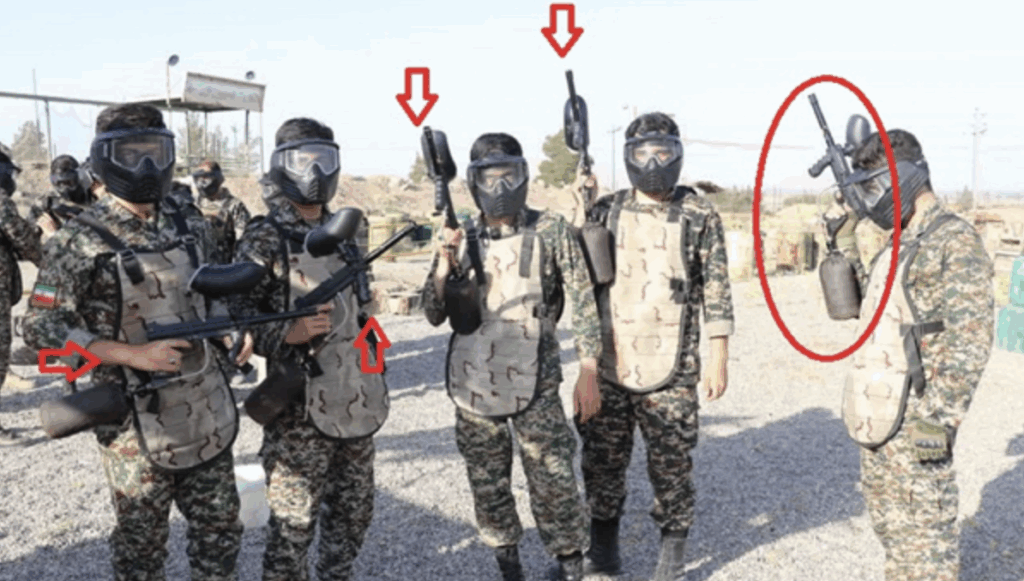

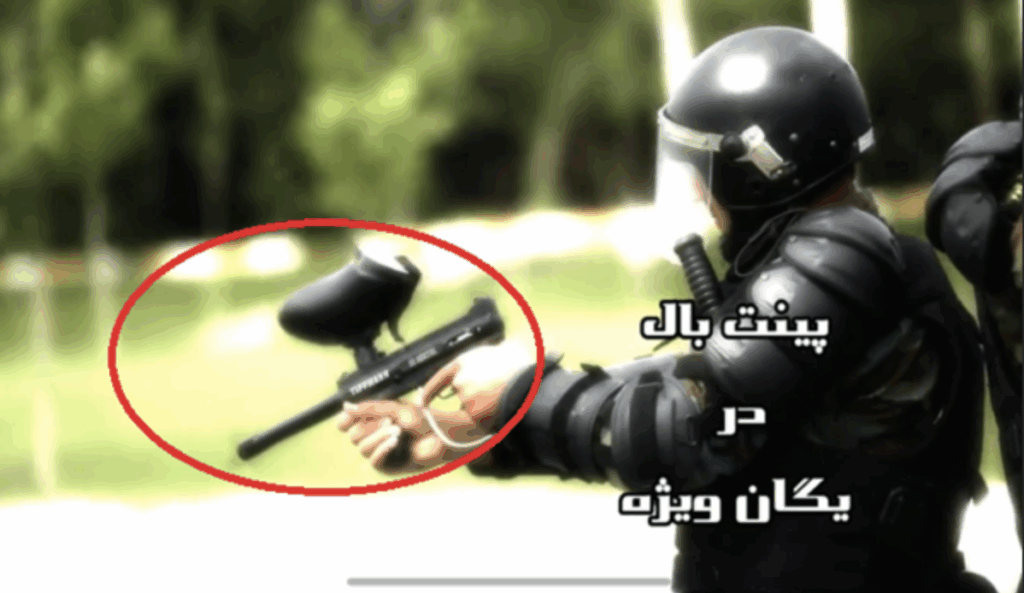
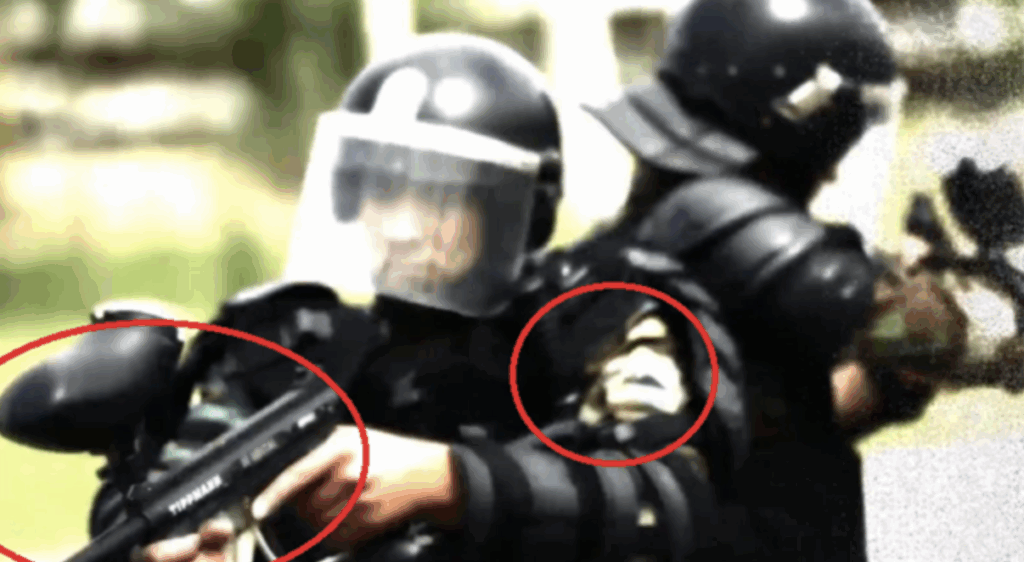

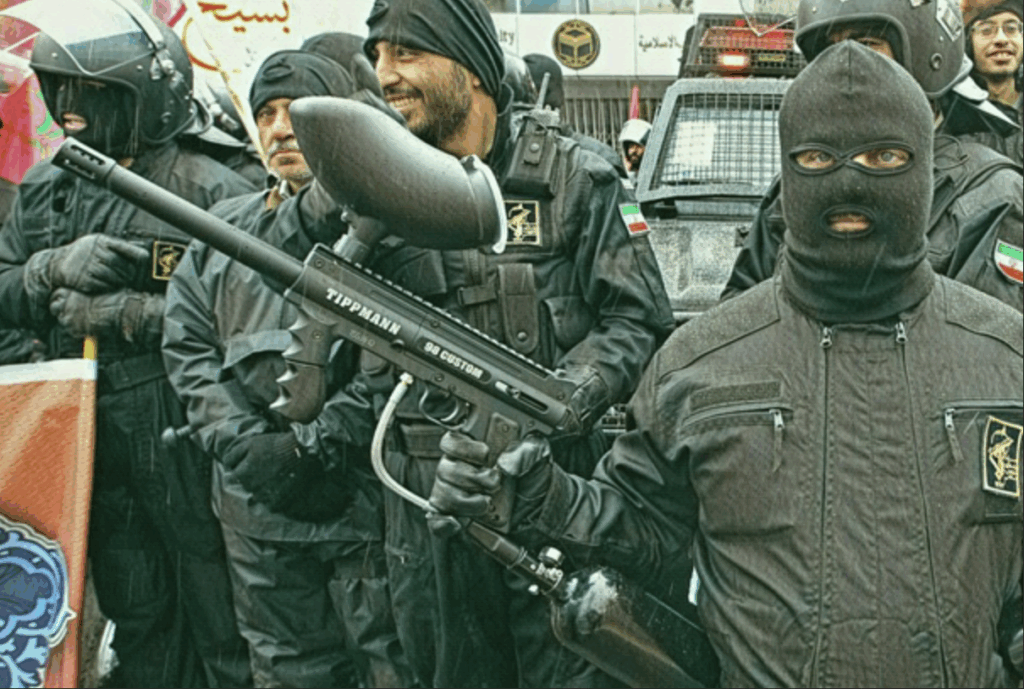
In at least one instance, NAKHSA members disseminated an image clearly featuring a Tippmann-branded paintball gun.[178] NAKHSA—formally the “Spontaneous Forces of the Islamic Lands”—is a paramilitary organization that describes its members as “devotees of Ali Khamenei and General Ghasem Soleimani.” The group is tied to the activities of IRGC in Syria and Iran. Available evidence suggests that NAKHSA played a role in suppressing the November 2019 and 2022 protests in Tehran, particularly in the districts of Sadeghieh, Nazi Abad, and Shahr-e Ray, functioning as part of the state’s broader repression apparatus.[179]

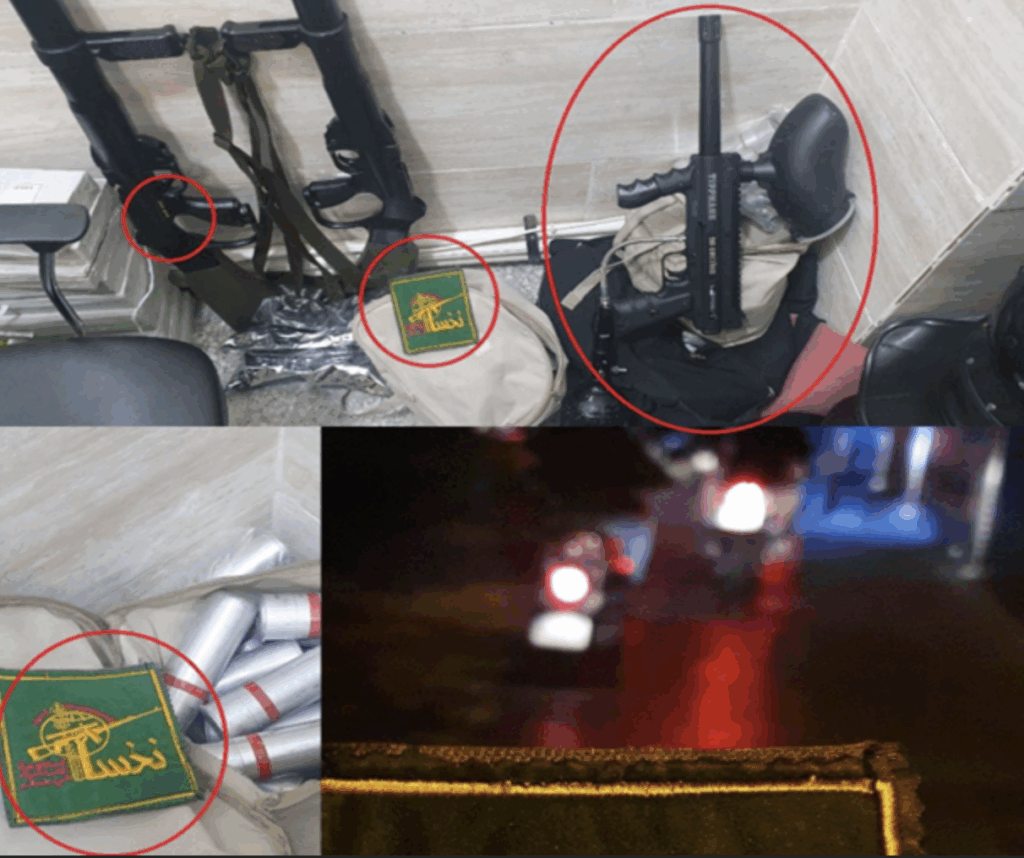
7.2. DYE Precision, USA
DYE Precision, commonly known as DYE, is a privately held company founded in 1994 by Dave DeHaan in San Diego, California. Employing more than 100 people, the company specializes in the design and manufacture of paintball equipment, with its Matrix series markers widely recognized in professional paintball circuits. In addition to this business, DYE operates an industrial division, DYE CNC, which provides precision machining services to the aerospace, medical, and defense industries.[180]
Open-source intelligence indicates that NAKHSA forces employed paintball guns during the violent suppression of the 2022 protests, resembling DYE’s M2 and M3 models in significant visual respects.[181]

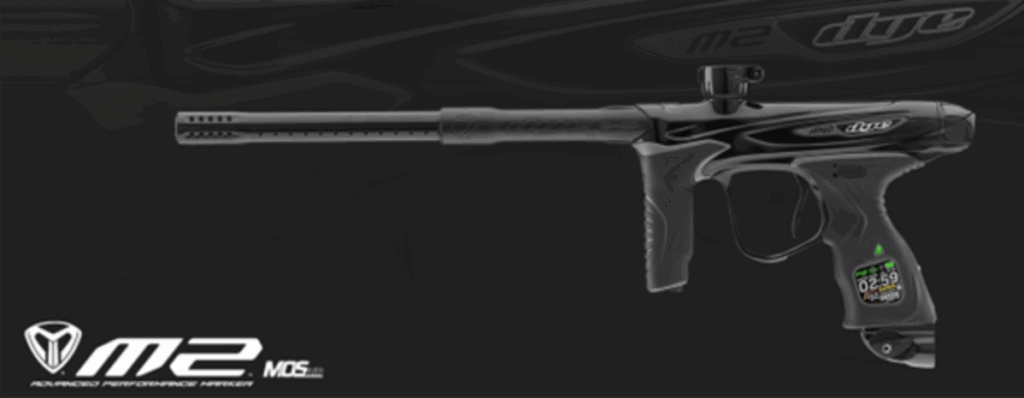

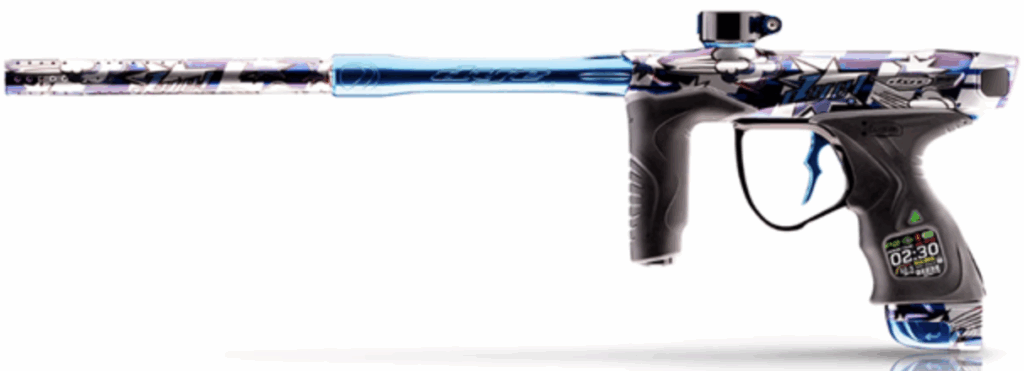

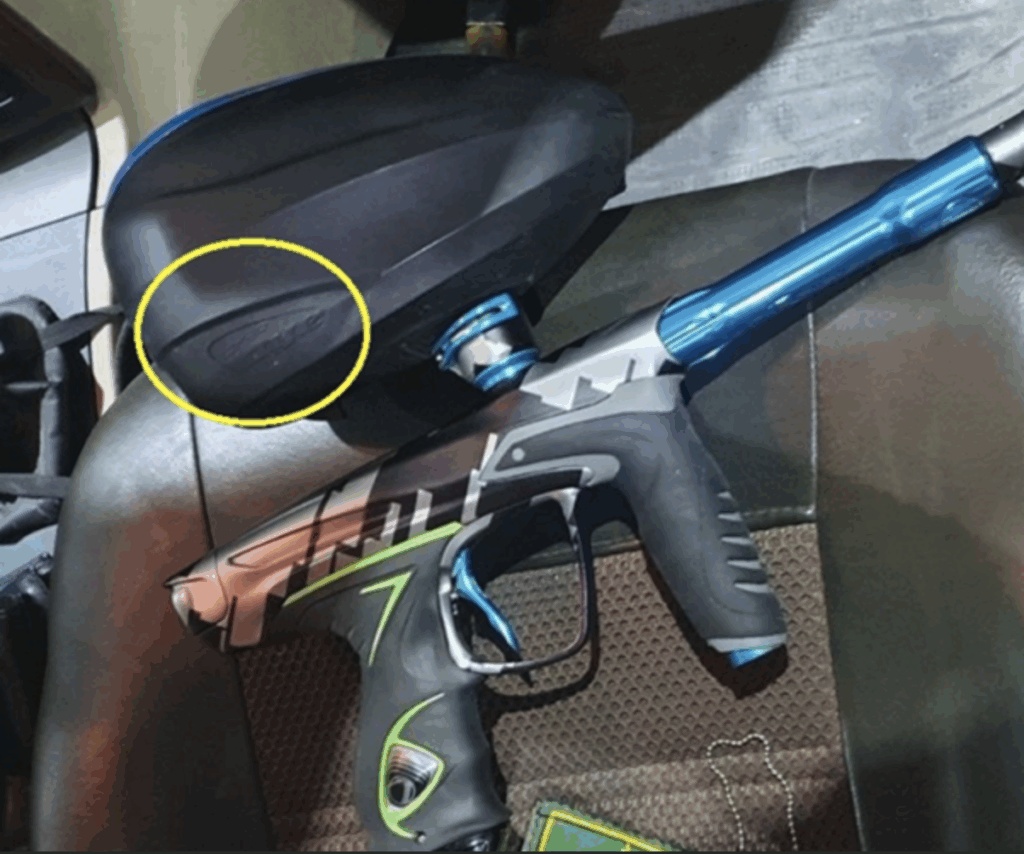
While most publicly available images of NAKHSA operations in 2022 do not show protesters, one exception depicts a bloodied individual lying on the ground, with another image showing a paintball marker resembling DYE’s M2 or M3 models next to him. The accompanying caption refers to the injured individual as a “sample work.” This setting suggests the possible use of the paintball gun in crowd-control operations; however, the time, location, and circumstances under which these images were taken are unclear.[182]

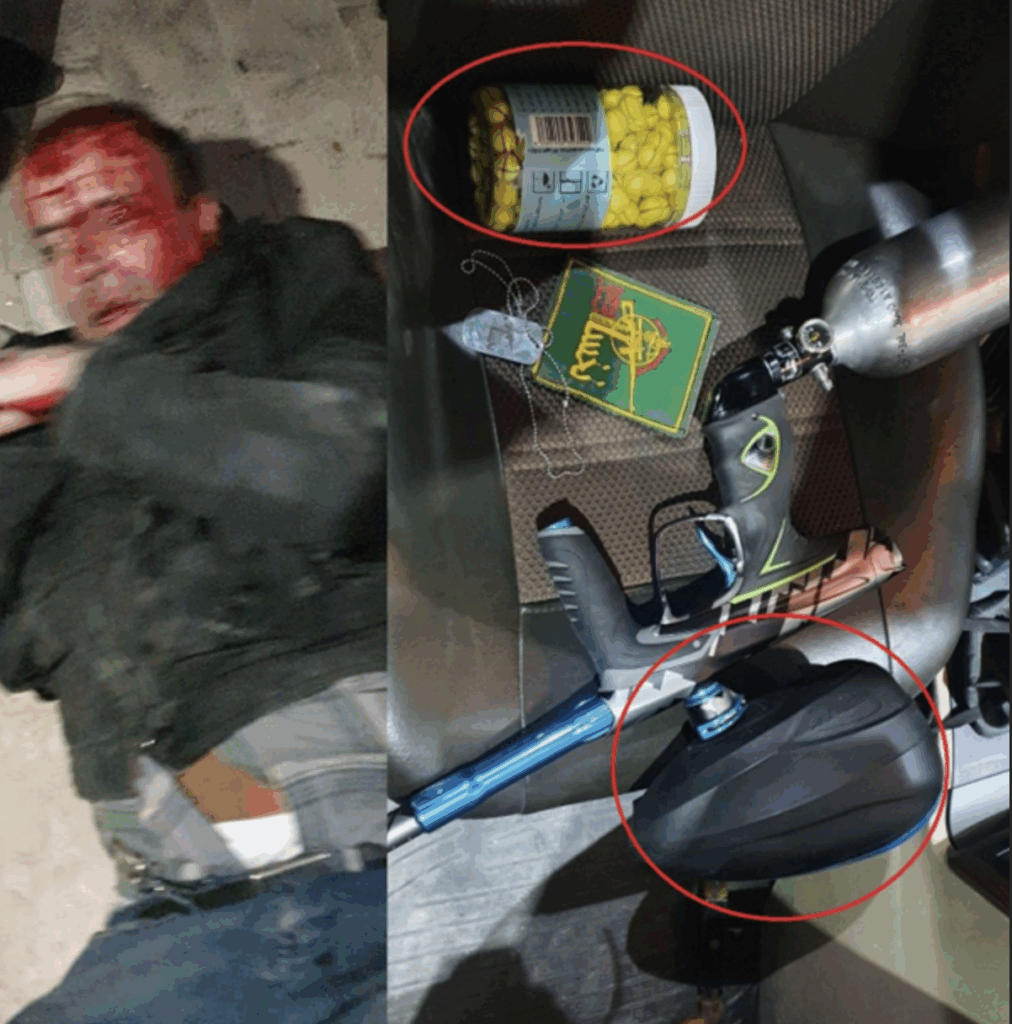
NAKHSA has also released a video on its Telegram channel depicting one of its members repeatedly and indiscriminately firing what appears to be a DYE M2 paintball gun in a residential area.[183]
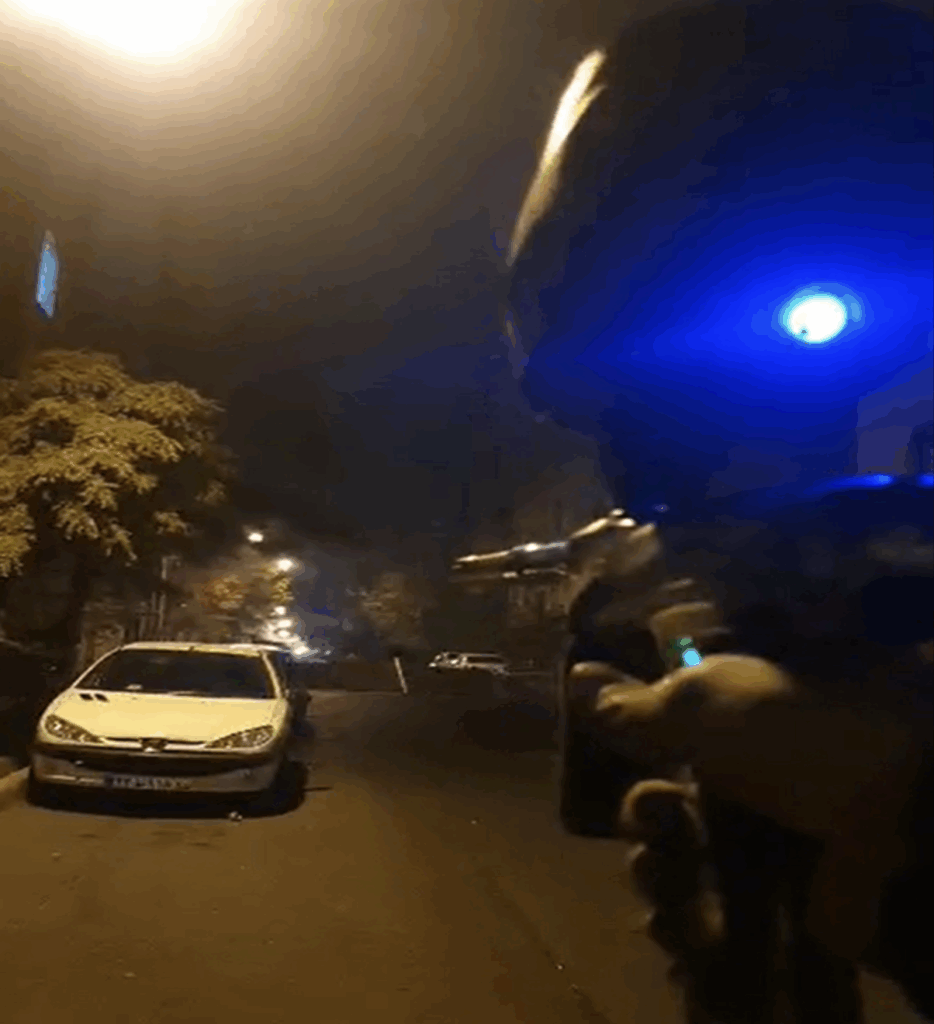
The sound of projectiles striking various surfaces in this video indicates that the shooter used metal pellets rather than standard paintball rounds.[184] In addition to this video, the group has released images documenting its actions during the suppression of the 2022 protests, in at least one of which the impact of hard projectiles on a parked vehicle is clearly visible.[185] Such actions appear to contravene regulations governing the use of less-lethal weapons in multiple respects.

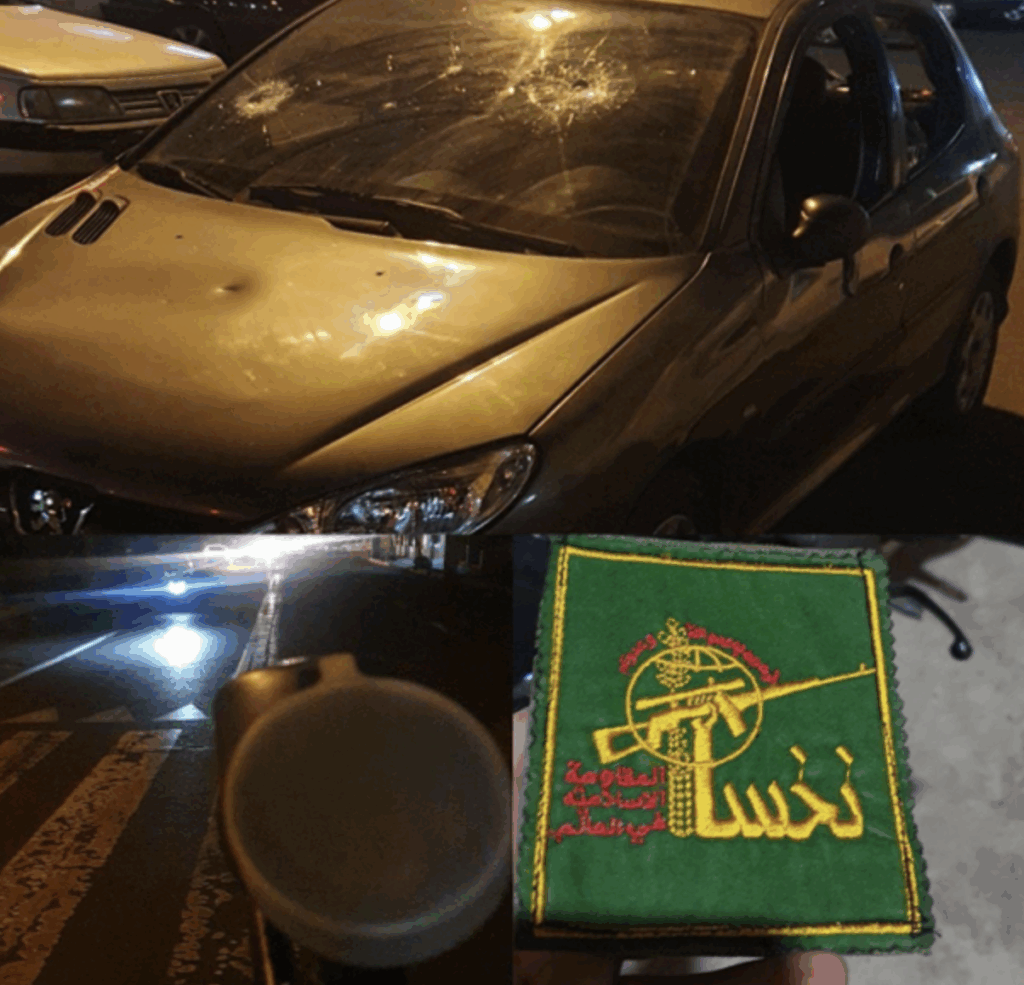

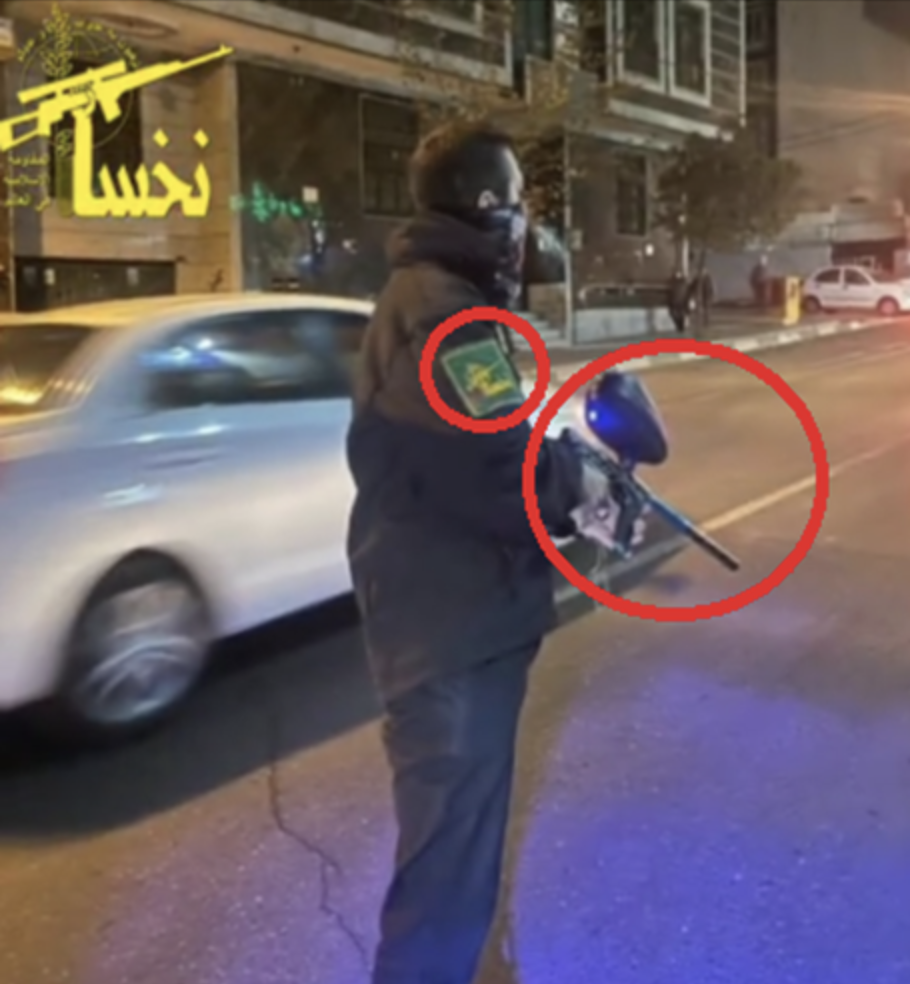
7.3. Manufacturer Liability for Misuse of Recreational Weapons
Paintball markers are designed as recreational, non-lethal devices. It is unclear whether the identified manufacturers of these markers—namely Tippmann and DYE Precision—had any direct control or involvement in the transfer of their products to Iran, particularly in light of U.S. sanctions law. What is clear, however, is that these companies did not control the Iranian regime’s repurposing of their products to intentionally inflict serious injuries, including permanent ocular damage—a violation of international human rights law, encompassing prohibitions on cruel, inhuman, or degrading treatment and obligations of necessity and proportionality in the use of force.
Under international standards, corporate liability may arise if a company knew or should have known that its products were being diverted for human rights abuses or if it facilitated modifications that increased lethality. Although establishing direct liability in this context may be challenging, the repeated use of Tippmann and DYE Precision products—particularly where the exercise of due diligence in their distribution chain is unclear—could potentially expose these companies to legal risks and reputational harm, whether under international law, U.S. export control regulations, or civil claims in the jurisdictions of other countries.
8. Regulations Governing the Use of Firearms by Security and Military Forces
While less-lethal weapons are employed by security and law enforcement forces globally, their use is regulated under both domestic law and international human rights standards. A foundational international framework is the United Nations Human Rights Guidance on Less-Lethal Weapons in Law Enforcement, developed by the Office of the High Commissioner for Human Rights.[186] This guidance articulates principles of necessity, proportionality, distinction, and precaution, which can serve as benchmarks for drafting or evaluating domestic legislation in countries committed to upholding human rights obligations. States bear both positive and negative obligations under international law: they must enact clear regulatory frameworks, ensure proper training and oversight, and hold violators accountable through effective, impartial investigations and deterrent sanctions.
The Islamic Republic of Iran has codified domestic legislation on firearm use by security and military forces; however, these laws exhibit notable gaps and inconsistencies relative to international standards. Even the existing statutory framework is frequently applied inconsistently or inadequately enforced, raising concerns under both domestic law and Iran’s international legal obligations.
The Law on the Use of Firearms by Armed Forces Personnel in Necessary Circumstances (January 1995) constitutes the principal statutory authority governing the deployment of lethal and less-lethal weapons in Iran.[187] Articles 1 and 11 authorize the carrying and use of firearms by armed personnel, including law enforcement, military, and intelligence agents.[188] Article 3 mandates the use of firearms exclusively in circumstances of necessity, including self-defense, defense of others, the apprehension of offenders, the prevention of detainee escape, the protection of installations, equipment, and personnel, and responses to threats or border violations. Importantly, the law prescribes adherence to the principles of minimum force, prior warning, and a hierarchical order of engagement—warning shots, lower body targeting, and, only as a last resort, upper body targeting.[189]
According to Article 4 of the aforementioned law, law enforcement officers and military personnel tasked with maintaining order during “illegal” disturbances or assemblies may resort to the use of firearms only upon the express order of the commanding officer. Such use is permissible solely after all other lawful means and methods of restoring order have been employed and proven ineffective, and provided that prior warning has been clearly given to those present regarding the potential use of firearms.[190]
While the determination of what constitutes a “disturbance” falls within the authority of the Provincial or County Security Council, it must be noted that, pursuant to Article 27 of the Constitution of the Islamic Republic of Iran, the right to assemble and to hold demonstrations—on the condition that no arms are carried and the principles of Islam are observed—constitutes a recognized civil right.[191] This constitutional safeguard creates a legal tension with operational interpretations of disturbances and highlights the risk of unlawful suppression of legitimate civic activity.
Article 6 also limits the use of firearms against vehicles, allowing such action only when the vehicle is stolen, transporting contraband, fugitives, narcotics, illegal weapons or ammunition, engaged in attacks against individuals, or otherwise presenting an imminent threat. Officers are legally required to issue a warning and exhaust all alternative measures before resorting to lethal force.[192]
In preparing this report, several internal directives of the security forces were obtained and analyzed. These directives—including those issued to the Special Units of FARAJA and the Imam Ali Security Battalions—set forth rules on the use of shotguns, as well as restrictions on their deployment. The directive governing the use of shotguns by the Special Units of FARAJA provides:
“[…] only in situations where the level of unrest is severe or when rioters intend to attack facilities, equipment, or vehicles, may shotguns be used—and only upon the order of the commander, within a distance of 50 meters, and with pellet rounds of size No. 6 or higher, aimed at the legs. It must be noted that the round must be fired in such a manner that it strikes the ground approximately two meters in front of the rioters’ feet.”[193]

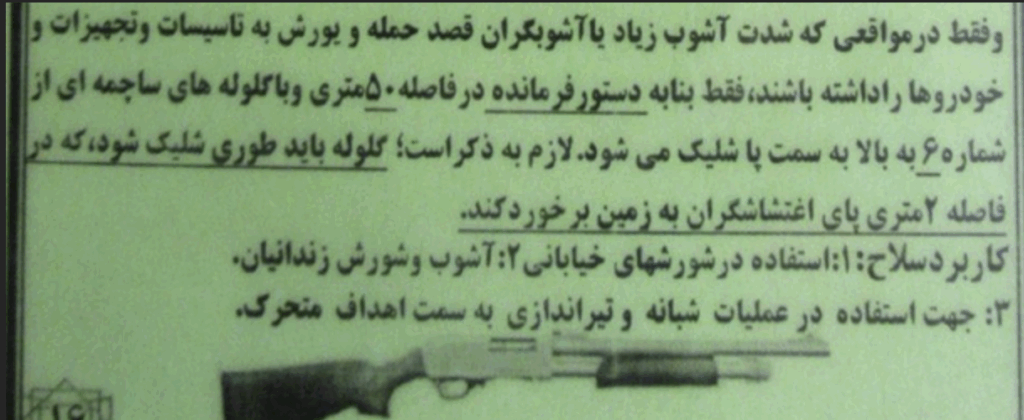
The training manual of the 1st Security Battalion “Shaheed Motavaselian,” affiliated with the Imam Ali Battalions in Alborz County, similarly provides detailed guidelines on the use of shotguns. According to the manual, when employing this weapon at distances under 50 meters, shots must be aimed exclusively at the lower body or below the target’s feet to minimize the risk of serious injury. At distances beyond 50 meters, the waist is the only permissible target area, and firing at the head or other sensitive regions is strictly prohibited.[194]
The manual further specifies that when using hard plastic projectiles, aiming at the head at distances shorter than 25 meters is strictly forbidden to prevent irreparable or potentially fatal harm. Regarding the use of lead pellet ammunition, the manual emphasizes that firing at individuals at distances under 50 meters is prohibited, and at greater distances, extreme caution must be exercised to avoid striking sensitive areas, particularly the face.[195]

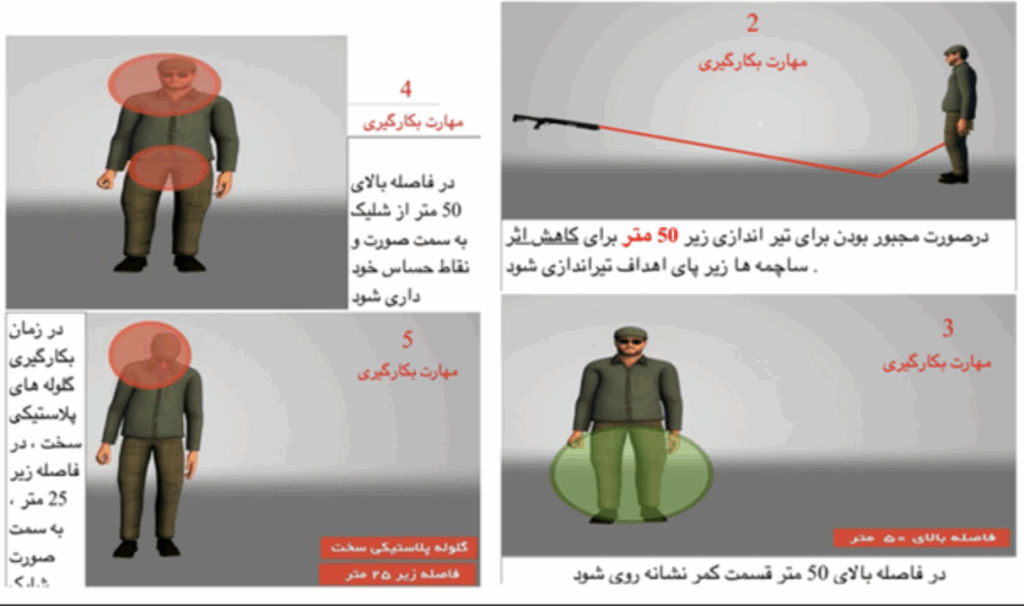
Field evidence and documented accounts from the 2022 protests indicate that law enforcement and security forces systematically disregarded directives governing shotguns and other less-lethal weapons. Although internal rules restrict their use to situations of severe unrest or direct threats—specifying engagement distances, permissible pellet size, and aiming at the ground or lower body only when necessary—personnel frequently fired at upper bodies or heads, engaged targets beyond authorized ranges, and used large-caliber projectiles capable of causing serious injury or death. Such conduct violated both domestic regulations and international standards, including United Nations protocols on the use of kinetic impact projectiles (KIPs), as reflected in the scope and severity of the resulting injuries.[196]
Numerous individuals described as “plainclothes” forces—whose formal affiliation with security or law enforcement institutions, including the Imam Ali Security Battalions and Fatehin Basij Units, has not been verified—were widely equipped with and deployed shotguns. Even if all such individuals were legitimate personnel, their use of firearms frequently violated statutory and internal regulations. They routinely fired beyond authorized ranges and targeted upper bodies, heads, faces, and other sensitive areas, in clear contravention of guidelines requiring adherence to necessity, proportionality, prior warning, and minimum use of force. In many instances, the use of force appeared intended to punish, inflict severe pain, or cause serious injury or death.
Members of FARAJA special units and security forces also discharged large-caliber metal pellet rounds, including 9- and 12-piece buckshot cartridges, contrary to prohibitions against projectiles capable of causing severe or fatal injury. These rounds were fired indiscriminately at close range toward protesters and bystanders, in stark breach of UN KIP protocols. UN guidance on less-lethal weapons explicitly prohibits targeting the head, face, or neck and forbids the use of metal projectiles coated with rubber due to their severe hazards. Such conduct constitutes a clear instance of unlawful use of force under international law.[197]
Iran’s legal framework on firearms falls short of international standards, and even these minimal rules were widely ignored during the 2022 protests. The use of shotguns and less-lethal ammunition caused widespread unlawful injuries and fatalities. Under international human rights law, these actions constitute unlawful use of force, violating necessity, proportionality, and precaution, and may amount to arbitrary deprivation of life or bodily harm. Firearms deployed to punish or injure rather than restore order reflect systematic violations, reveal a stark gap between law and practice, and expose Iran to state responsibility under international law.
9. Case Studies of Lethal Use of Less-Lethal Weapons
The 2022 crackdown on protests in Iran revealed a systematic campaign of violence targeting unarmed civilians. Security forces targeted protesters and bystanders with firearms, shotguns, paintball guns, and tear gas, causing death, blindness, and permanent injuries. The following case studies illustrate this calculated brutality and the state mechanisms enabling widespread human rights violations and crimes against humanity.
9.1. Targeted Blinding
During the protests on Wednesday, September 21, 2022, in the city of Esfarayen in North Khorasan Province, law enforcement officers opened fire without complying with the legal requirements governing the use of firearms. In a video recorded moments before Tavakolian was injured, the crowd of protesters is seen peacefully chanting anti-government slogans. In the same video, a young man is shown climbing a scaffolding and attempting to tear down a banner of Supreme Leader Ali Khamenei.[198] In another video, recorded from a different angle, a law enforcement officer, directed by a superior officer, can be seen firing at least twice directly—and without any prior warning—at the individual attempting to remove the poster.[199]

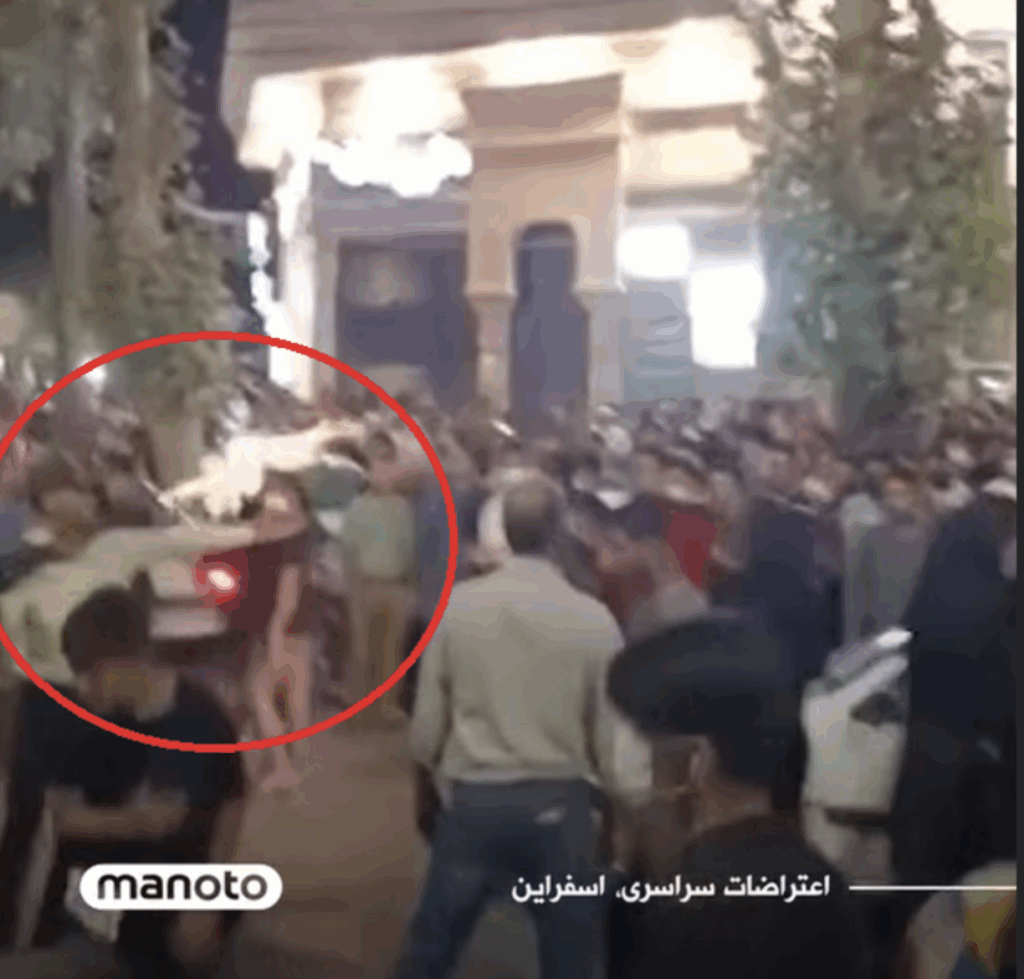

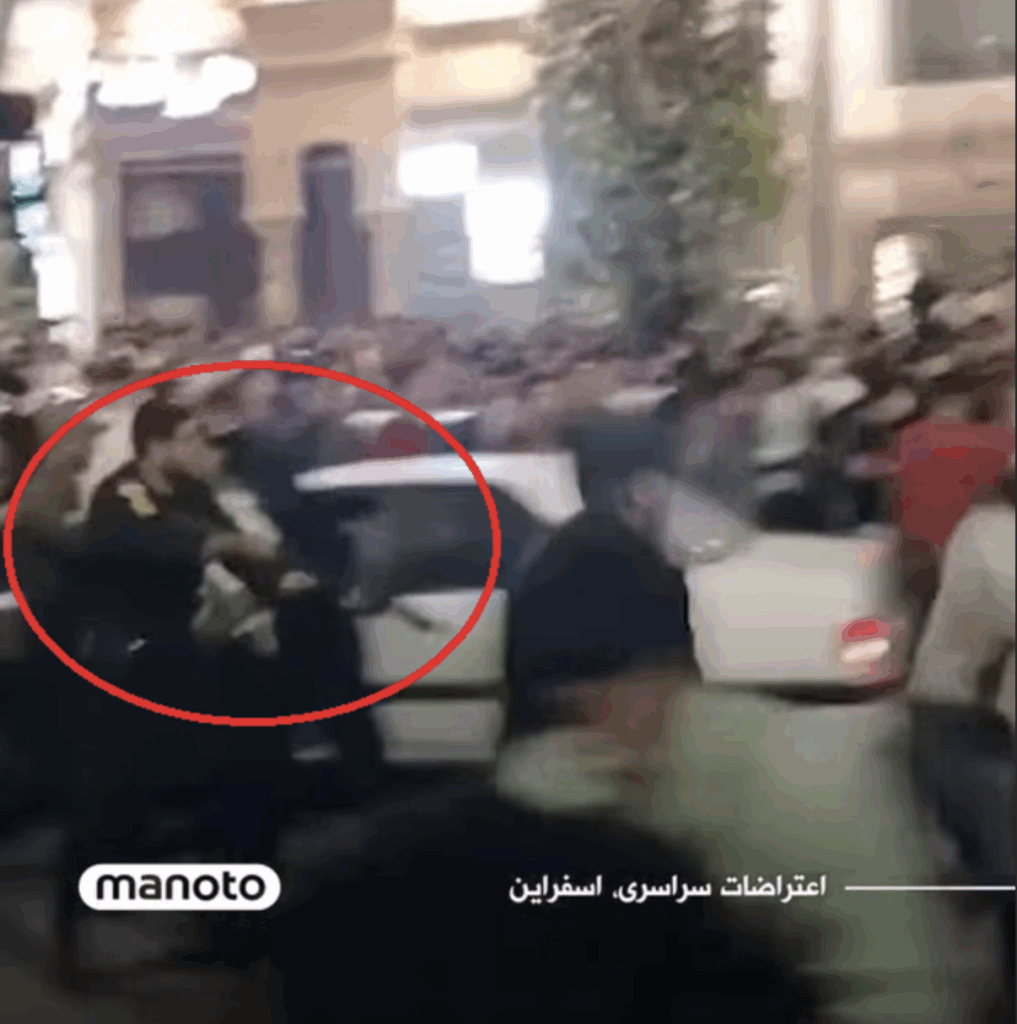
It appears that the young man on the top of scaffolding fell to the ground after being shot and was subsequently arrested. In another video depicting the same protests, a police officer holding a shotgun is seen in the street amid the crowd, while the protesters remain nonviolent, merely shouting anti-government slogans and expletives.[200]

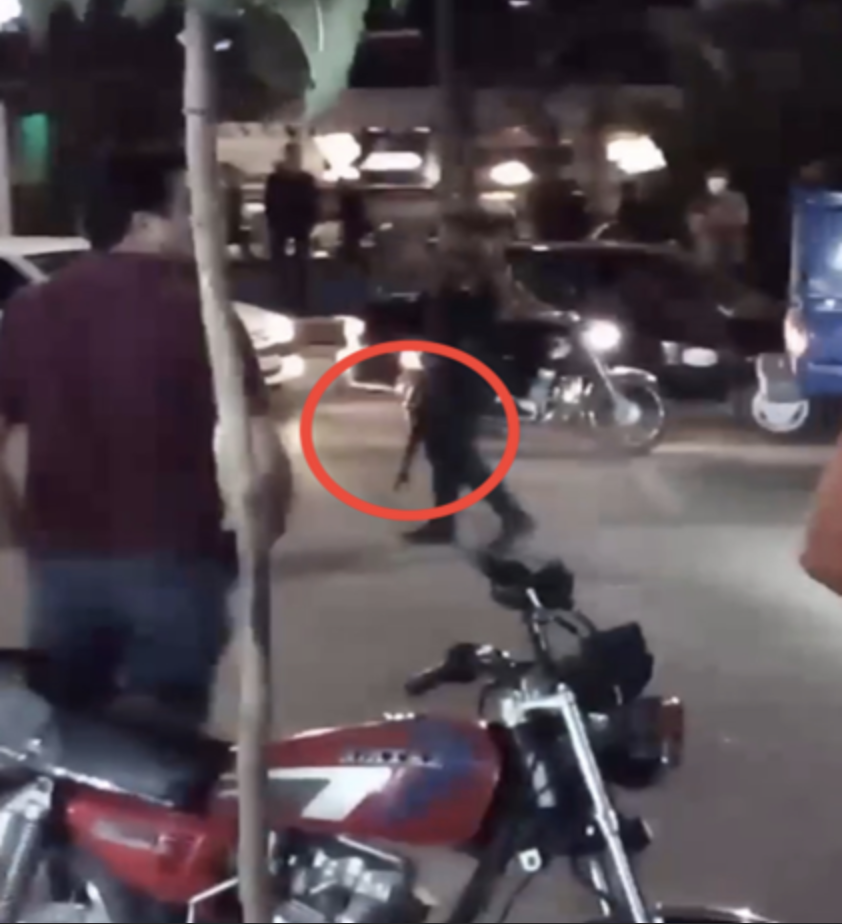
Moments later, the same armed police officer returns toward a group including Elaheh Tavakolian and shoots without any warning. The camera then pans toward the group and shows bystanders attempting to wash her bloodied face with water. According to Tavakolian, the police officer had shot at her from a distance of less than 50 meters, a shot that resulted in her blindness.[201]

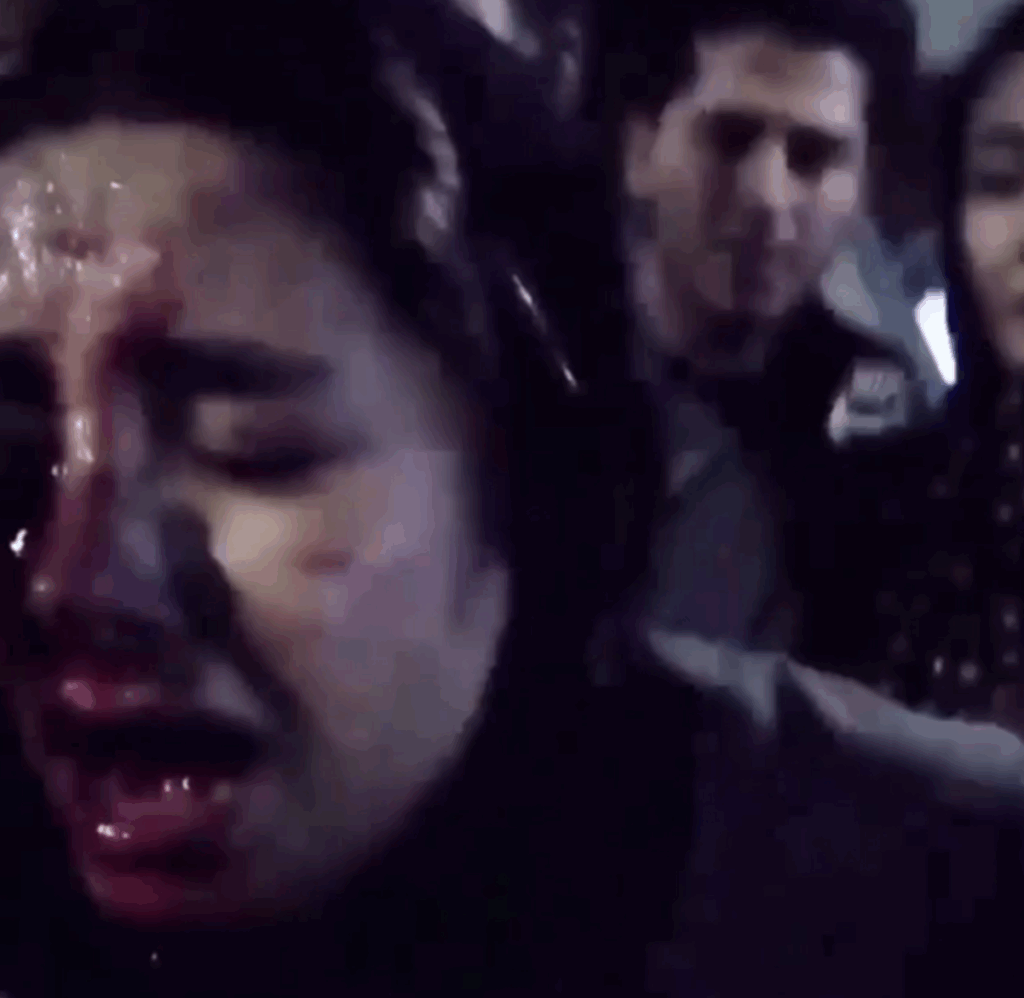
These acts constitute clear violations of Article 6 (right to life) and Article 7 (prohibition of torture and cruel, inhuman, or degrading treatment) of the International Covenant on Civil and Political Rights (ICCPR). Furthermore, the systematic targeting of unarmed civilians, combined with the widespread and deliberate nature of the shootings, meets the elements of crimes against humanity under Article 7 of the Rome Statute, specifically attempted murder, torture, and other inhumane acts.[202] Domestically, these actions violated Iran’s Law on the Use of Firearms by Armed Forces Personnel in Necessary Circumstances and the FARAJA Special Unit Guidelines, which stipulate the principles of necessity, proportionality, warning, and aiming below the waist. The deployment of shotguns and pellet ammunition in these cases was facilitated through state-controlled supply channels, underscoring the direct link between weapon provision and the commission of human rights violations.
9.2. Paintball Gun Assault
A video recorded on December 7, 2022, in the Ekbatan neighborhood of Tehran shows the arrest of an individual by plainclothes forces. In this video, the individual being detained is sitting calmly on a bench, without any resistance or threatening behavior. One of the plainclothes agents suddenly approaches, aims a paintball gun directly at his face from a distance of less than half a meter, and fires. The sound of the shot is clearly audible in the video. Following this, the individual is taken to an unknown location.[203]

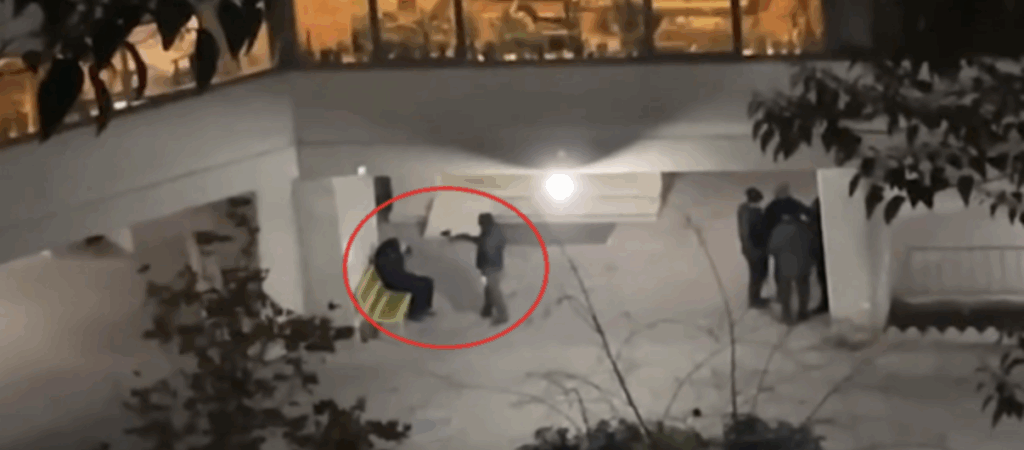

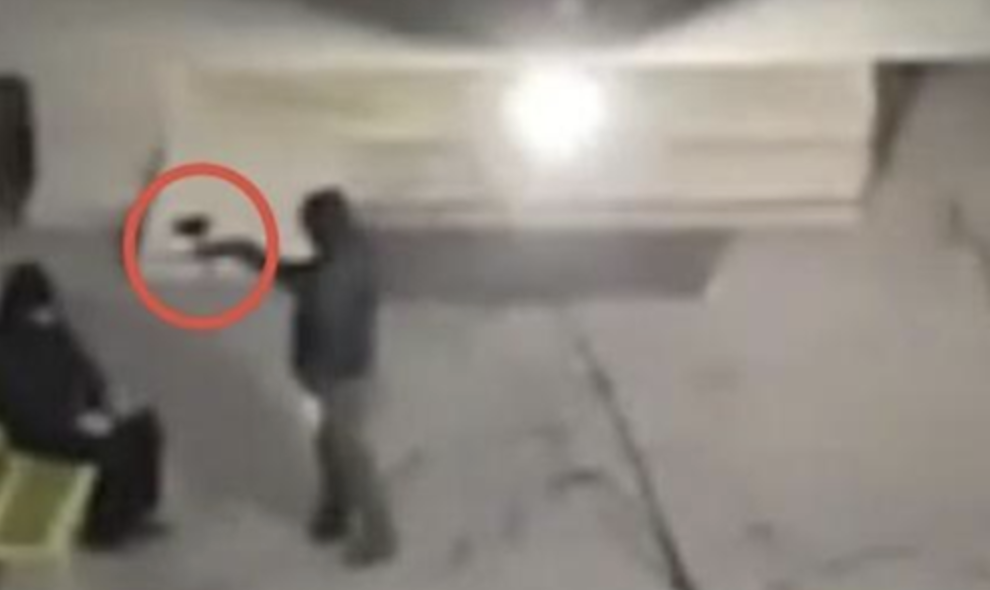
The use of a paintball gun in these circumstances represents a deliberate attempt to inflict severe bodily harm for purposes of punishment, humiliation, and intimidation, constituting a violation of ICCPR Article 7, as well as a crime against humanity under the Rome Statute due to the systematic nature of these actions. The paintball gun was potentially supplied through the Iran Paintball Association and the Iran Sports for All Federation, which, although nominally civilian organizations, operate under IRGC oversight, demonstrating how civilian sporting supply chains were exploited to facilitate repression.
9.3. Vehicle Attacks
In 2022, multiple reports indicate that officers of Iran’s law enforcement and security forces fired at passing vehicles from close range, causing both fatalities and permanent injuries. Evidence shows that these actions were carried out deliberately to punish or inflict severe harm on protesters and bystanders, thereby violating domestic regulations on the use of weapons as well as ICCPR Articles 6 and 7 and the UN guidelines on the use of less-lethal weapons.
At least four citizens across three provinces were killed in such attacks. In all four cases, documented evidence—including images and eyewitness testimony from the scene—confirms that law enforcement and security forces fired their weapons without justifiable cause. In only one case was the offending officer convicted, while in the remaining instances, no legal accountability was achieved.[204] These acts meet the criteria for murder and other inhumane acts under the Rome Statute, forming part of a structural pattern of repression.
The continuation of such actions indicates that these behaviors have, in practice, become a structural pattern among law enforcement and security forces. One video depicts masked, motorcycle-riding security agents near Sharif University of Technology in Tehran firing paintball rounds from a distance of only a few meters at civilians filming the arrest of a protester. The shattering of the car window upon impact suggests the use of ammunition with a hard metal core.[205]

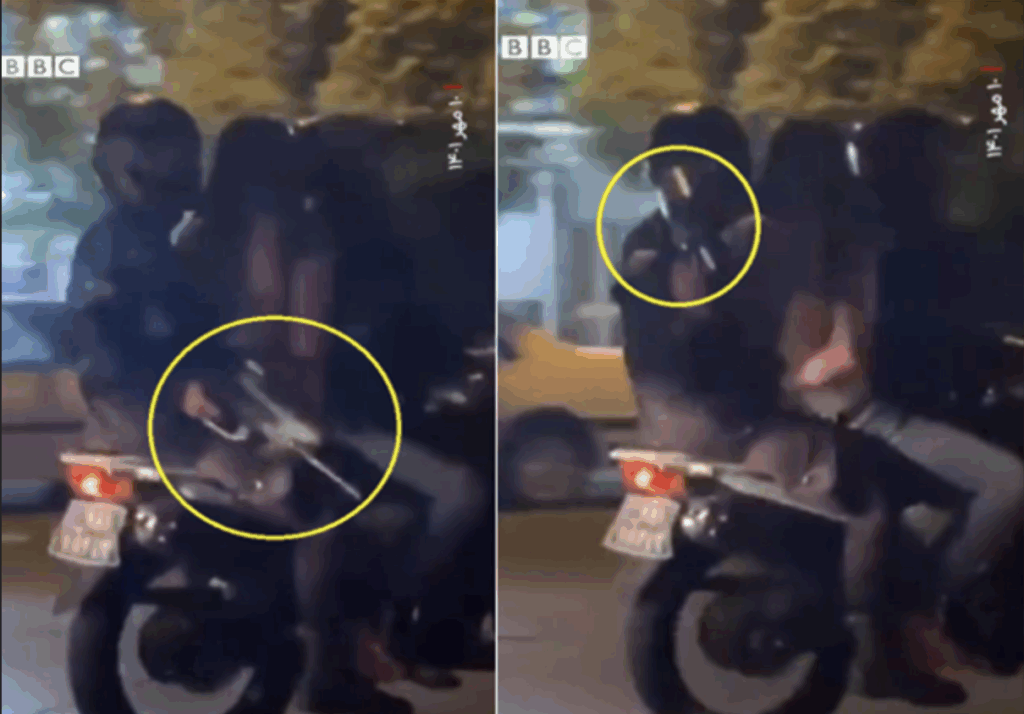
In a similar incident on the night of November 15, 2022, Ali Delpasand, accompanied by his wife Bahareh and their young daughter, was driving in their personal vehicle along one of the boulevards in Rasht, Gilan Province. When Bahareh extended her hand out of the car window and made a victory sign, an armed officer fired a shotgun at their vehicle. As a result of the shooting, Ali Delpasand suffered severe injury to one of his eyes, resulting in permanent loss of vision in that eye. Additionally, several pellets struck Bahareh’s face, and the shattering of the car windows caused injuries to their young daughter’s hand.[206]

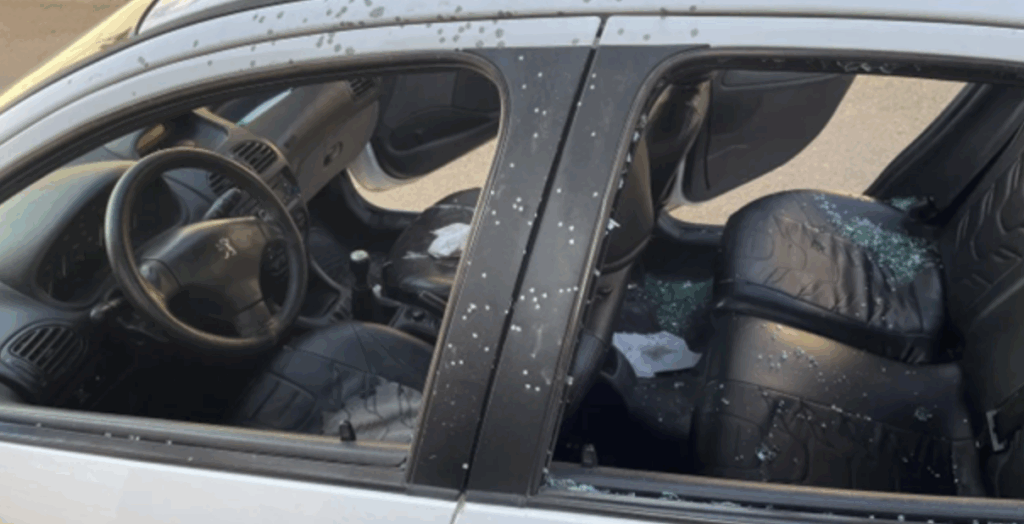

The deliberate targeting of vehicles and their occupants constitutes arbitrary deprivation of life and torture in violation of Articles 6 and 7 of the ICCPR and qualifies as persecution and other inhumane acts under the principles of crimes against humanity. The deployment of shotguns and so-called less-lethal ammunition in these attacks highlights the role of state procurement systems in directly enabling the commission of such human rights violations.
9.4. Indiscriminate Use of Metal-Core Pellets and Tear Gas Projectiles
Hundreds of videos and medical records from the 2022 protests demonstrate that law enforcement personnel and security forces indiscriminately targeted protesters and bystanders, frequently aiming at the head, face, and eyes. The impact of pellets and tear gas projectiles caused severe injuries, permanent blindness, skull fractures, and, in some cases, death. These findings are extensively documented and corroborated by medical records and other contemporaneous evidence.
One circulated video from September 2022, recorded in Mehrshahr, Karaj, Alborz Province, shows a group of armed plainclothes individuals positioned beside a law enforcement vehicle. In the footage, two individuals take up firing positions next to the vehicle and repeatedly and indiscriminately discharge their weapons toward the opposite side of the street, while others advance toward what appears to be the center of a fire or disturbance and open fire in that direction.[207]

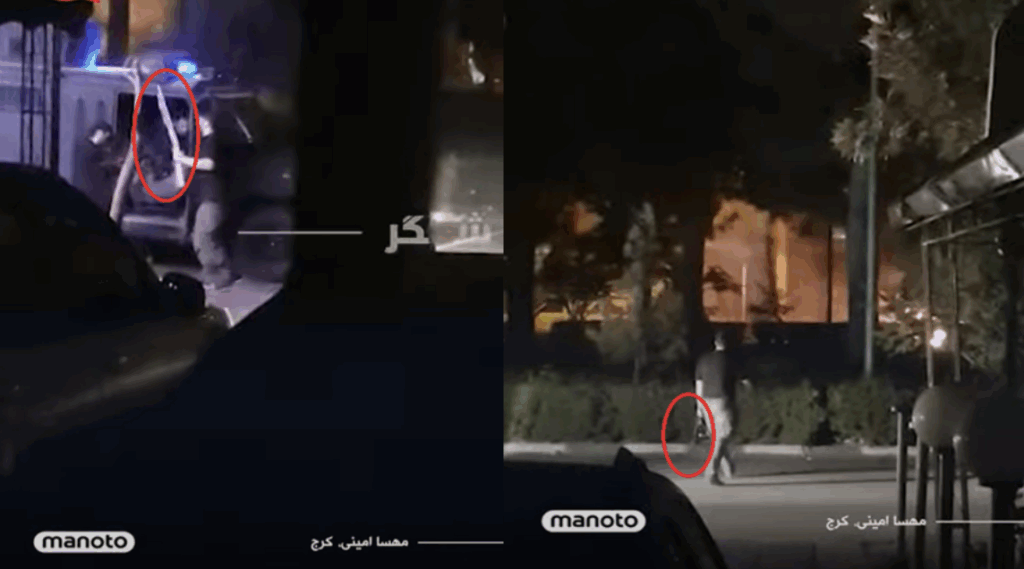
Another video, filmed on October 2, 2022, on Tehran’s Jomhouri Avenue, depicts a large group of FARAJA Special Unit officers on motorcycles moving through a crowd amid heavy traffic. The officers are seen repeatedly and indiscriminately firing at protesters, bystanders, and passing vehicles.[208]
Additional footage from October 8, 2022, near Sharif University of Technology in Tehran, shows a group of plainclothes security forces firing directly and continuously at a crowd of protesters from close range. Although some of these individuals did not bear the typical appearance of government forces, all were visibly armed. The gunfire endangered both protesters and bystanders, who were caught in the crossfire. At no point does the footage provide evidence that protesters were threatening or engaging in violent behavior toward the security forces. At least one operative is also seen launching tear gas canisters directly at protesters, a practice that contravenes international standards on crowd control.[209]

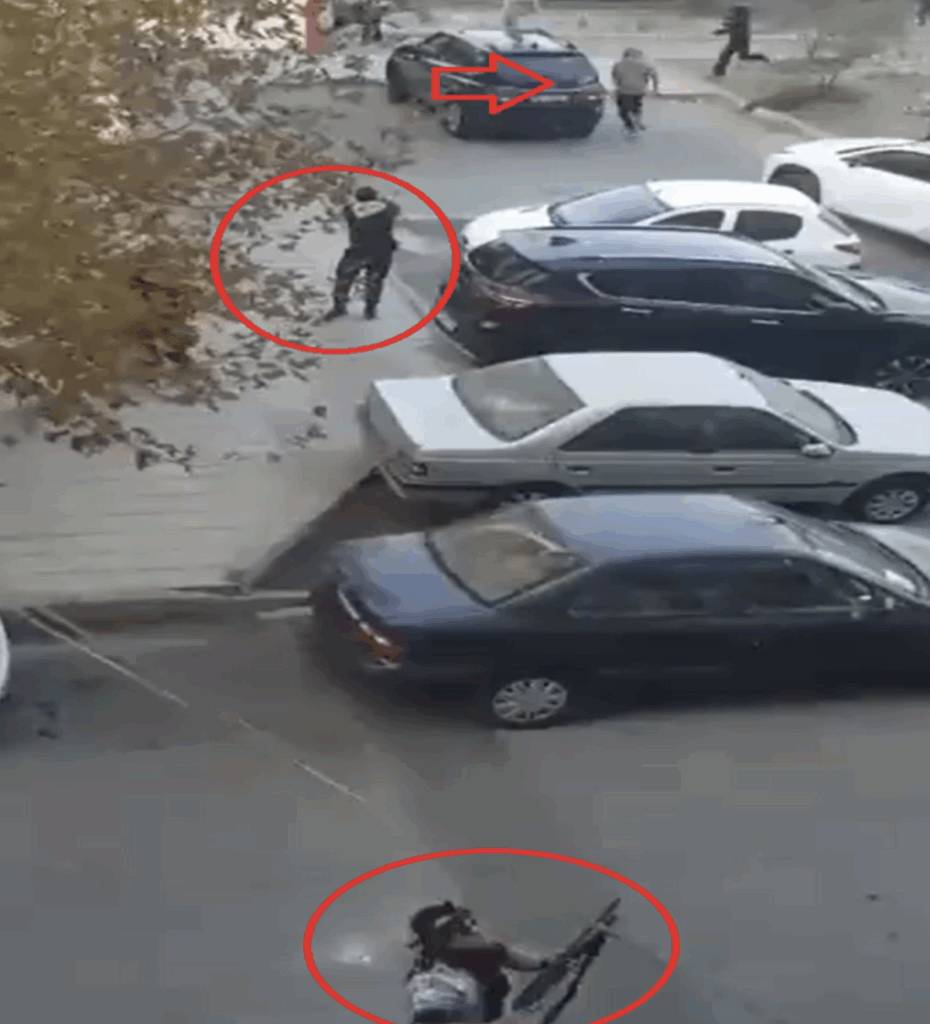
Such conduct was not confined to open spaces but also occurred in closed environments, where the risks to life and safety were even greater. Footage from Tehran’s City Theater metro station on October 12, 2022, shows law enforcement officers positioned among the crowd as anti-government chants echoed through the station. In one sequence, officers fire tear gas down an escalator, causing widespread panic as people flee in distress.[210] Another video from the same station, dated November 16, 2022, depicts law enforcement officers accompanied by plainclothes agents armed with paintball guns. In the footage, one plainclothes agent—appearing to fire paintball rounds with metal cores—repeatedly shoots into a train compartment.[211]
The direct and indiscriminate use of less-lethal weapons at close range, particularly in confined or crowded spaces, poses a grave risk to life and health, violates international standards on the use of force, and constitutes torture under ICCPR Article 7. The United Nations’ Guidance on Less-Lethal Weapons in Law Enforcement further emphasizes that indiscriminate or successive firing, as well as the simultaneous discharge of multiple projectiles, undermines accuracy and contravenes the principles of necessity and proportionality. The use of metal projectiles, including those fired from shotguns, is impermissible under all circumstances.[212]

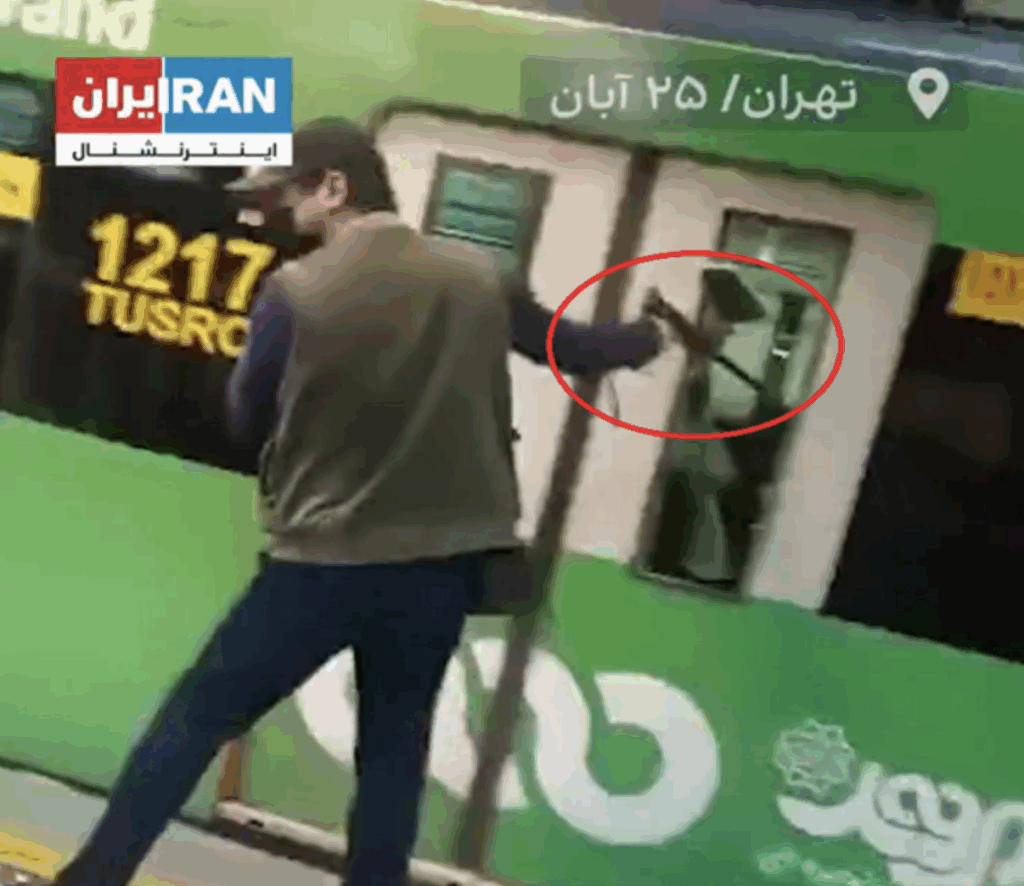
These incidents illustrate a recurring pattern of gross indifference by security forces toward the lives and safety of civilians, resulting in hundreds of deaths and serious injuries. For instance, on the evening of November 16, 2022, during protests in Bandar Abbas, Hormozgan Province, Farid Rashidi was struck at close range by direct pellet fire from security forces. Medical examinations revealed twelve pellets lodged in his head, four in his eye, and several others embedded in his abdomen, chest, and legs. He ultimately lost vision in one eye. Rashidi has stated that the officer deliberately and intentionally aimed at his head.[213]

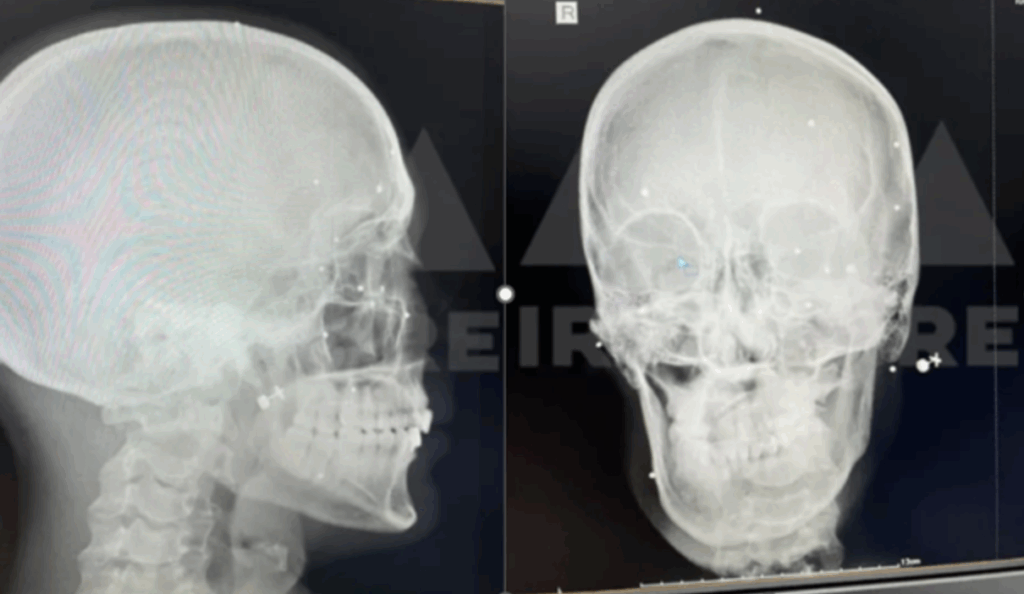
Throughout the 2022 protests, at least nine individuals sustained severe injuries from direct impacts of tear gas projectiles. These injuries extended beyond blindness and, in multiple cases, resulted in skull fractures and cranial deformation. Some victims suffered visible depressions in the skull due to the force of projectiles fired at close range.
One video circulated on social media shows law enforcement officers standing in the middle of a busy street in the Madain neighborhood of Tehran, firing tear gas toward the opposite side. The positioning of their hands at roughly a 90-degree angle and the trajectory of the discharge indicate that the canisters were being fired directly forward. Based on the apparent dimensions of the scene, the street does not appear to be wider than 15 meters, placing the officers less than 30 meters from the opposite sidewalk.[214]

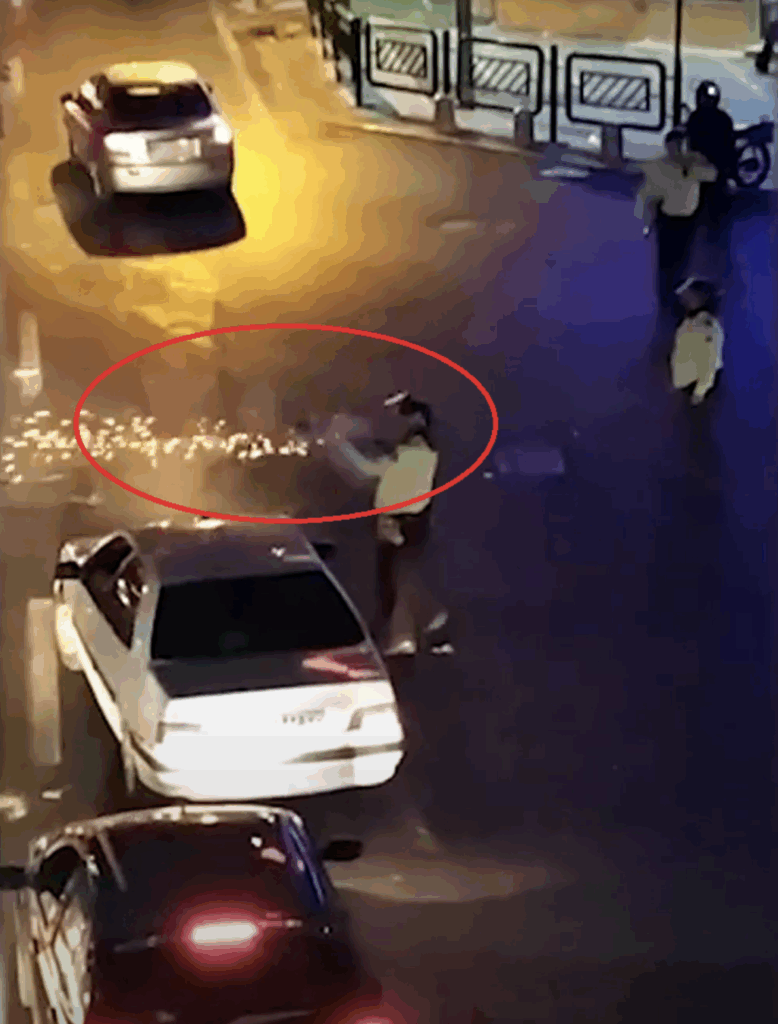
The consequences of such tactics are evident in several documented cases. Farzad Moradinia, a labor activist from Sanandaj in Kurdistan Province, permanently lost vision in one eye after being struck at close range by a tear gas canister, which also caused lasting damage to the structure of his skull.[215]

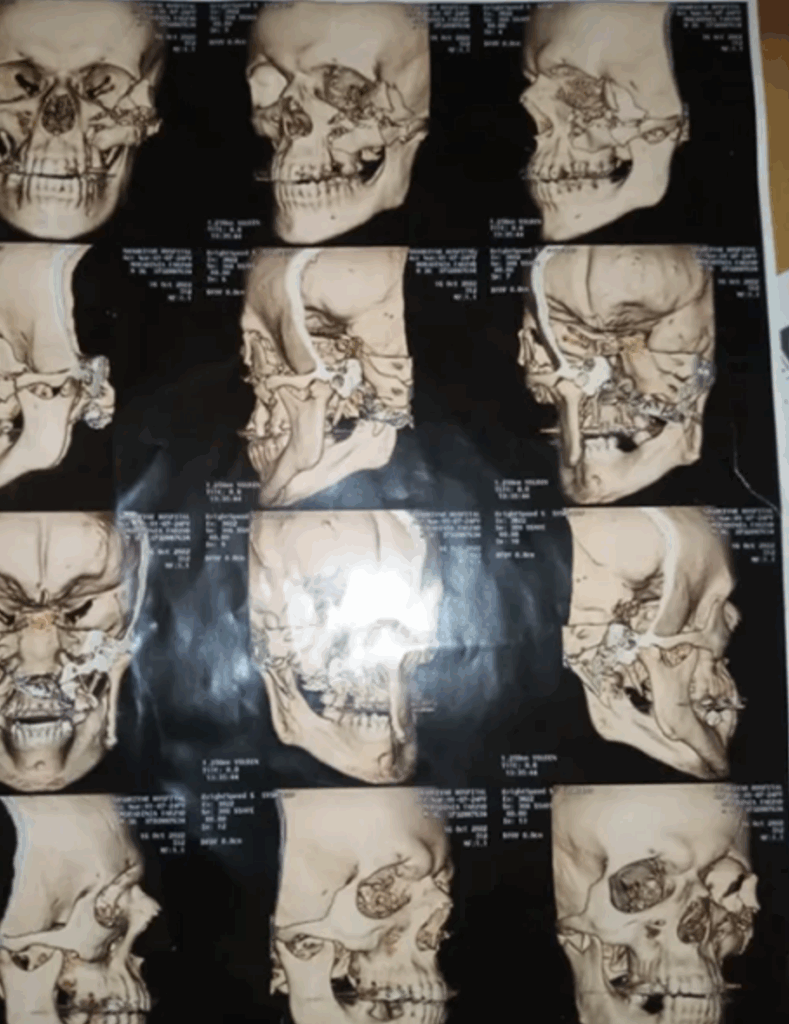
Similarly, on November 15, 2022, in western Tehran, Sepehr Khaleghi was directly targeted by motorcyclists firing tear gas canisters at close range. The attack caused the loss of vision in one eye and severe cranial injuries. Despite undergoing several surgical procedures, including cranial reconstruction and the placement of an ocular prosthesis, he continues to experience significant physical complications and social consequences.[216]
The firing of tear gas canisters at protesters also led to fatalities. One confirmed case is that of Abolfazl Amir-Ataei, a 16-year-old boy who was struck directly in the head by a tear gas canister. After spending several months in a coma, he died from his injuries.[217]

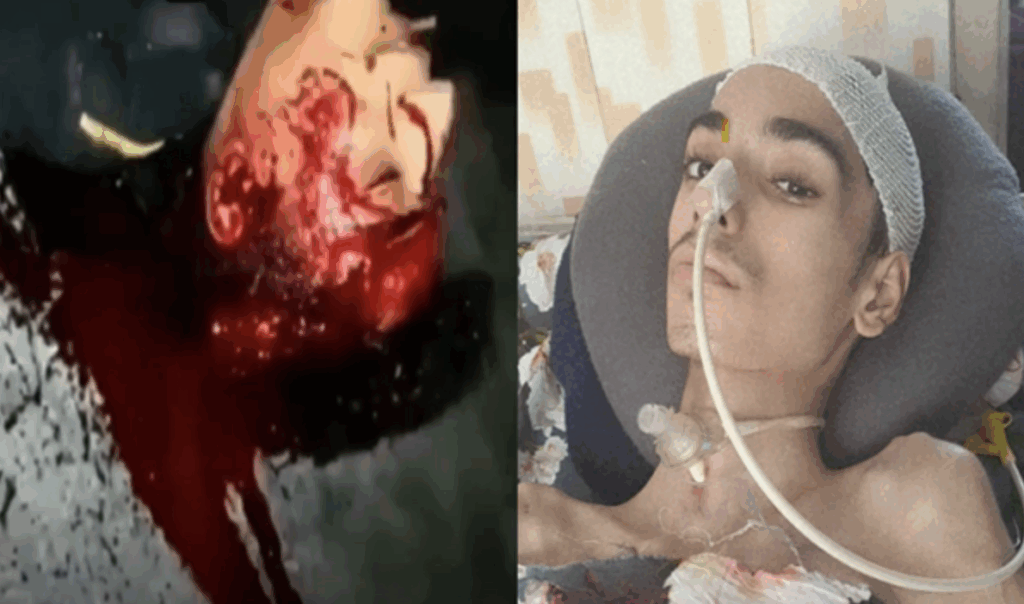
9.5. Execution-Style Shooting
One of the clearest pieces of video evidence indicating the deliberate shooting of protesters by security forces from a lethal distance is the footage capturing the assault and shooting of Pouria Alipour. This video, which runs for over two minutes and contains distressing scenes, was recorded by a citizen from the upper floors of a building opposite the site of the incident. In the footage, dozens of law enforcement officers, on at least two separate occasions, attack Alipour and subject him to severe beatings. In one segment, an officer on a motorcycle repeatedly rides over Alipour’s body as he lies on the ground at the entrance of a residential building’s courtyard.[218]

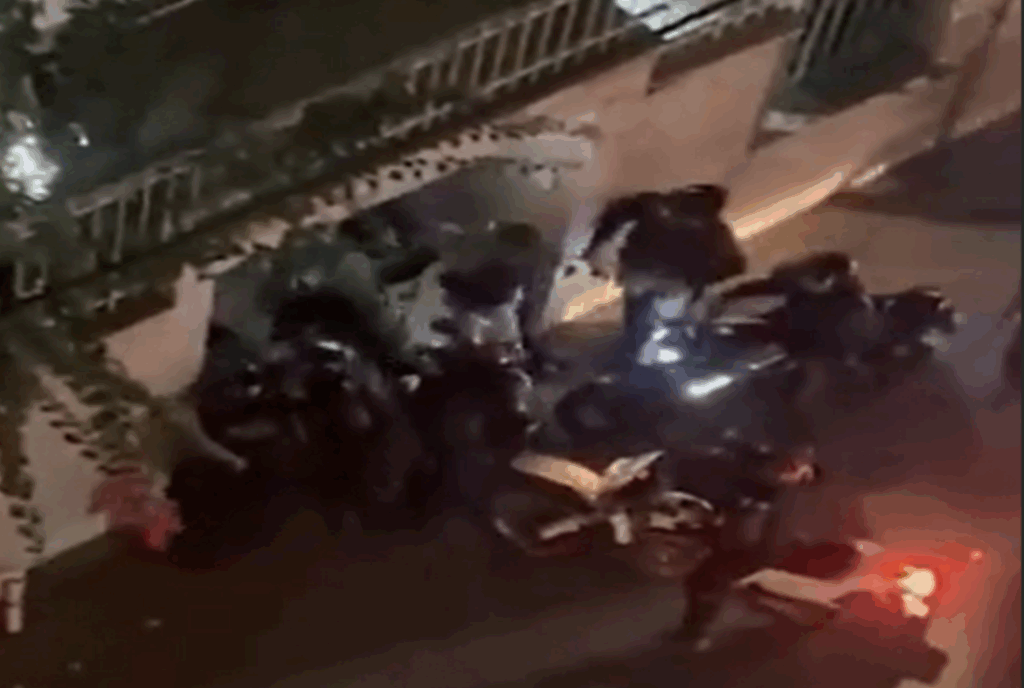
A few moments after the law enforcement officers leave the scene, two plainclothes security agents approach Pouria Alipour, who remains motionless on the ground, and begin striking him repeatedly with force. Shortly thereafter, one of the officers pushes the others aside and fires a shotgun directly at Alipour’s face from a distance of less than one meter.[219]

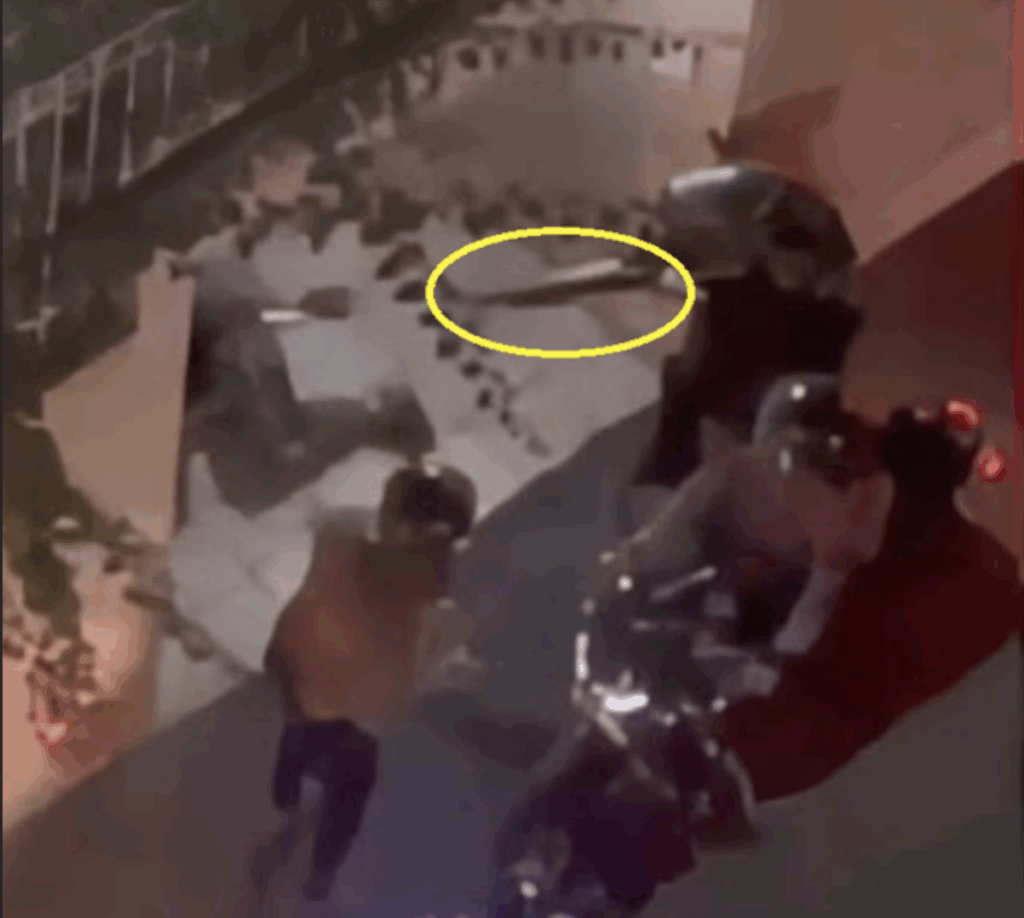
10. Severe Suffering and Irreparable Harm from Less-Lethal Weapons
Among the 134 identified victims of the 2022 protests in Iran, 23 were women and 111 were men, sustaining injuries across 24 provinces and 47 cities. The average age of victims was 29 years. Of these, at least 114 were injured by shotgun pellets, nine by paintball projectiles, and nine suffered injuries or permanent impairments from direct hits by tear gas canisters. While a few cases involved disabilities to the hands or feet caused by close-range lead pellets, the majority of injuries targeted the head, face, and eyes.
Beyond those documented in this report, physician and healthcare statistics indicate that hundreds more across Iran sustained similar injuries. In November 2022, an open letter by a group of doctors reported at least 500 serious eye injuries in three hospitals in Tehran and a minimum of 80 cases in Kurdistan Province.[220] Nationwide protests continued for at least three months thereafter, with additional documented cases occurring afterward, confirming the persistence of head and eye targeting.
Except for a few high-profile incidents, none of these violations have been investigated, and perpetrators have neither been identified nor prosecuted. Where proceedings were initiated, no meaningful punishment has resulted.
In many cases, the persistent presence of security forces at medical facilities deterred victims from seeking treatment due to fear of arrest, directly contributing to irreversible injuries, including permanent blindness and loss of eyes. A striking example is Mohammad Hossein Erfan, who was shot in the eye during the 2019 protests; interruptions in treatment, combined with chronic psychological trauma, led to complications that ultimately caused his death.[221] This case illustrates the compounded effects of physical injury, systemic intimidation, and deliberate obstruction of medical care as part of a calculated strategy of harm.
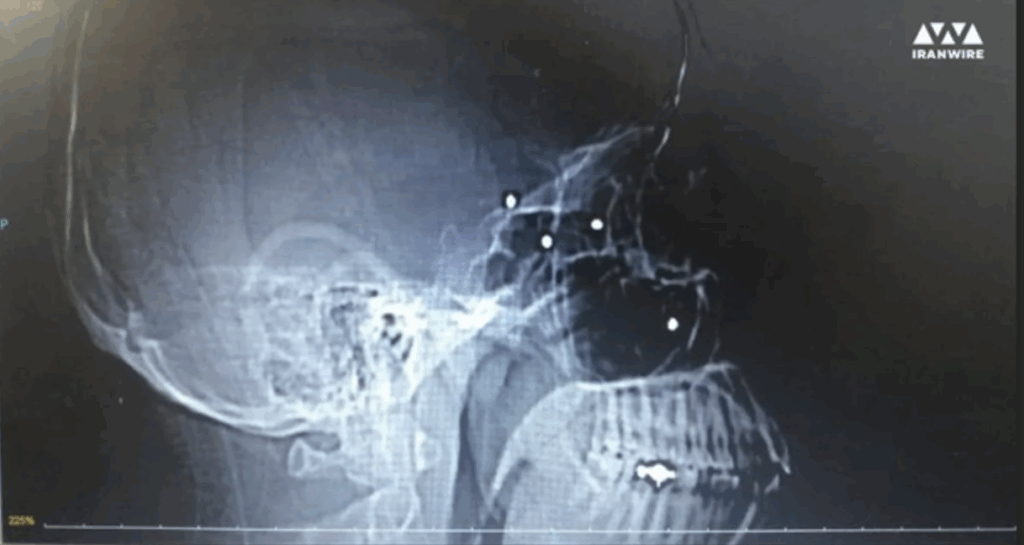
Gunshot injuries to the eyes inflict intense, excruciating pain. Medical reports indicate that many victims endured extreme suffering, with some requesting enucleation to escape unbearable discomfort—demonstrating deliberate physical harm.[222]
The psychological consequences are equally severe: victims report chronic anxiety, depression, social isolation, and ongoing fear of arrest, medical neglect, and repeated exposure to violence. This multi-layered suffering reinforces the intended terror and underscores the systematic nature of these acts.

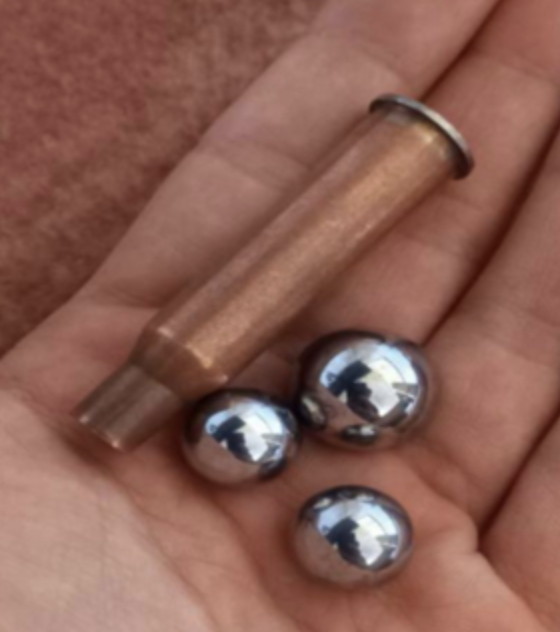
Shooting protesters in the eyes is a deliberate form of torture meant to instill fear. Hundreds of cases involving teenagers and adults reveal a state-sanctioned pattern, with weapons supplied and repurposed through state-linked channels. Targeting eyes and faces reflects a calculated effort to incapacitate protesters and create cautionary examples. These acts violate ICCPR Article 7, constitute crimes against humanity under the Rome Statute, and breach domestic firearms laws. By enforcing prolonged treatment, multiple surgeries, and extended recovery, authorities ensure victims remain physically impaired, socially marginalized, and psychologically traumatized. Blinding protesters is thus both immediate harm and a tool of social control, fear, and terror, sometimes resulting in death.
Conclusion
The findings of this investigation show that, during the suppression of the 2022 protests, Iranian security forces systematically and widely deployed so-called less-lethal weapons, causing severe and often irreversible harm to civilians. The geographic spread of victims across multiple provinces highlights the organized and coordinated nature of these operations.
Analysis of hundreds of videos, images, OSINT investigations, and interviews with victims and witnesses documents repeated use of projectiles fired deliberately at heads, eyes, and other vital organs at close range. Such conduct violates Iranian law, internal security protocols, and international standards, including the UN Basic Principles on the Use of Force and Firearms and the UN Guidance on Less-Lethal Weapons in Law Enforcement.
Medical reviews by specialist physicians, particularly of ocular injuries, confirm that many wounds are consistent with intentional targeting of sensitive areas. Numerous cases resulted in total blindness, causing permanent physical suffering and psychological trauma. This evidence demonstrates that less-lethal weapons were used as instruments of mutilation, prolonged suffering, and, in some cases, extrajudicial killing.
The recurrence and scale of these injuries indicate a deliberate and coordinated pattern of conduct that may constitute crimes under international law, including violations of the rights to life, freedom from torture or cruel treatment, and freedom of assembly and association.
The investigation also identifies specific manufacturers whose products were used by Iranian security forces. Turkish companies Hatsan, Akkar, and Sarsılmaz supplied shotguns or its technology, while the European company Cheddite and North American companies Tippmann and DYE Precision produced ammunition components and paintball guns, respectively, which were used to suppress peaceful protests in Iran. Evidence—including images, training videos, and corroborating documentation—confirms the deployment of these products by Iranian forces.
Visual and technical similarities between the weapons observed and models produced by these companies—including body design, components, and trademarks—provide reasonable grounds for attribution, even without formal sales records. The role of manufacturers and intermediaries in supplying these weapons raises potential liability under international arms control, export regulations, and human rights law. Companies may be held responsible for failing to conduct due diligence, for enabling the use of their products in abuses, or for violating restrictions on dual-use or defense-related exports.
Recommendations
- Classifying Shotguns and Paintball Guns as Dual-Use Products
The legal landscape for shotguns and paintball guns is shifting with the rise of less-lethal launchers, which fire projectiles such as hard rubber or metal balls. Though not traditional firearms, their capacity to cause serious injury or death and their documented misuse in human rights violations support a strong case for reclassification. Under frameworks like the Wassenaar Arrangement and the EU Dual-Use Regulation, these devices should be classified as dual-use products. This would subject them to stricter export controls, requiring thorough evaluation of both end-users and end-uses, especially where human rights risks are present. Such reclassification establishes the legal basis to regulate their international trade and reduce the potential for abuse.
- Requiring Due Diligence from the Manufacturing Companies
Manufacturers of dual-use devices have a legal and ethical obligation to prevent their products from being used to commit human rights violations. In line with the UN Guiding Principles on Business and Human Rights, this responsibility requires comprehensive due diligence across the entire supply chain. While upstream due diligence—such as scrutinizing suppliers and raw materials—is standard, manufacturers must also address downstream risks. This involves tracking products’ final destinations to prevent diversion to actors engaged in repression, torture, or unlawful killings, including through intermediaries or indirect channels. Effective downstream due diligence entails robust monitoring of post-sale use, maintaining transparent end-user records, and collaborating with civil society and local NGOs to identify emerging risks. Strong internal compliance policies further reinforce corporate accountability, ethical credibility, and reduce potential liability under domestic and international law.
- Strengthening of Oversight and Transparency in the Supply Chain
The misuse of less-lethal weapons by repressive regimes, such as in Iran, highlights the urgent need for full supply chain transparency to document and prevent human rights violations. International institutions, exporting governments, and civil society must ensure this through effective oversight. Oversight requires precise identification of end-users, documentation of transfer routes, regular reporting to international bodies, and early warning mechanisms to flag high-risk countries or groups with histories of abuse.
Manufacturers must submit periodic supply chain reports, cooperate with independent monitors, and participate in international compliance frameworks. Legal systems should also provide victims with remedies when these weapons are used inhumanely, in line with international law. Transparent and legally compliant supply chains can prevent these devices from being used for repression.
The findings of this study reveal the severe psychological and social harm caused by such violence, and ignoring this constitutes tacit approval. Urgent, targeted international measures are essential to prevent misuse and uphold human dignity.
Appendix I – Individuals Killed by the Use of Less-Lethal Weapons in the 2022 Protests
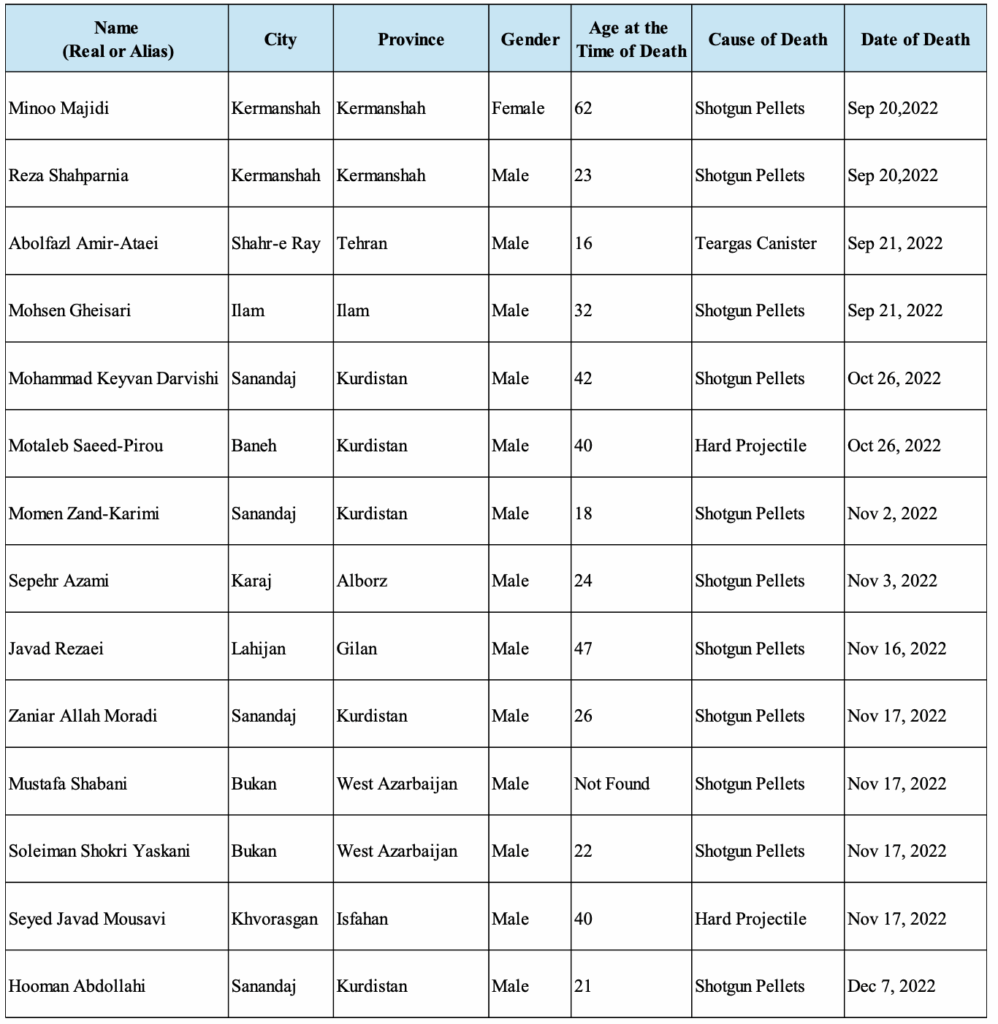

Appendix II – Individuals Injured by the Use of Less-Lethal Weapons in the 2022 Protests
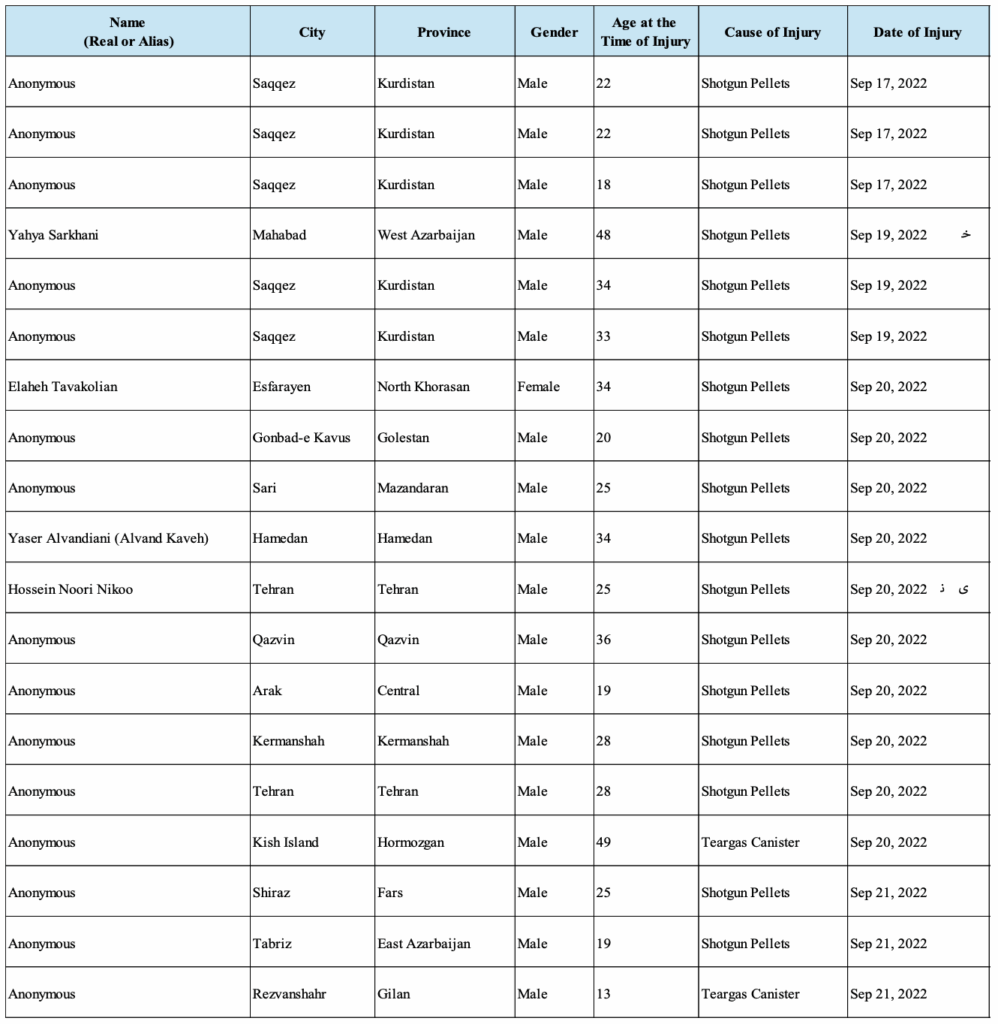
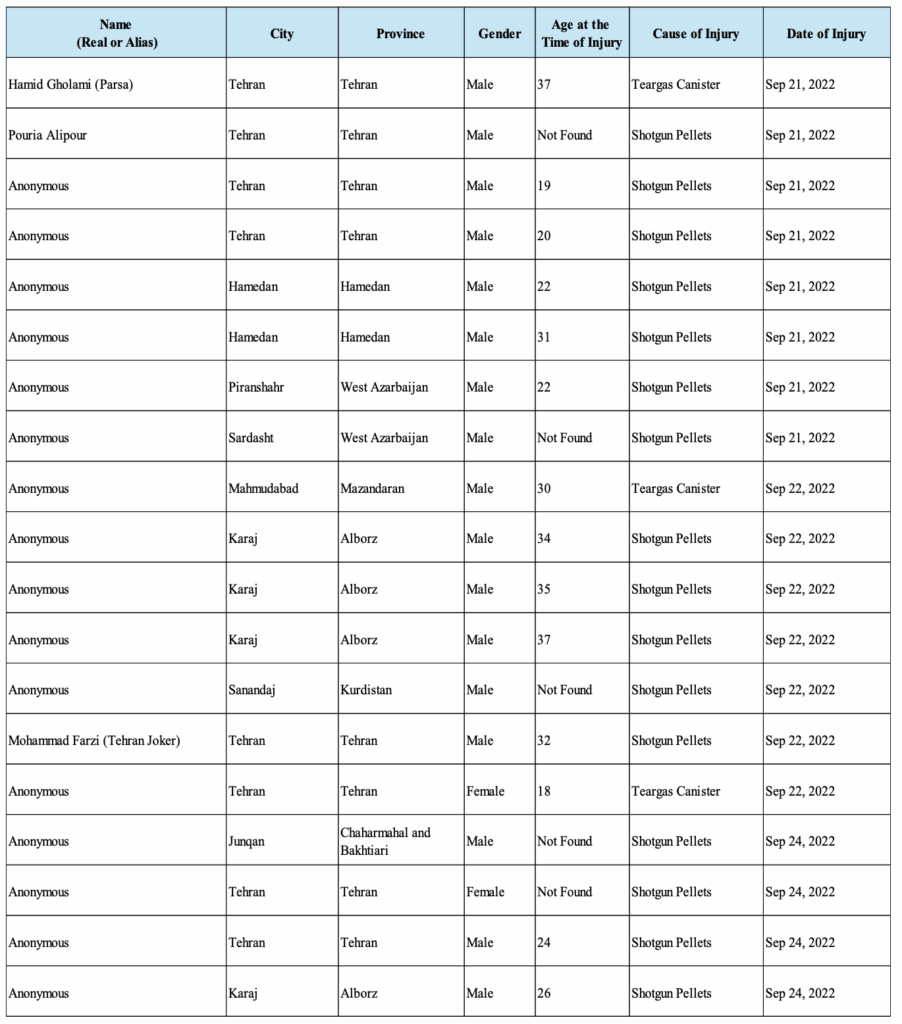
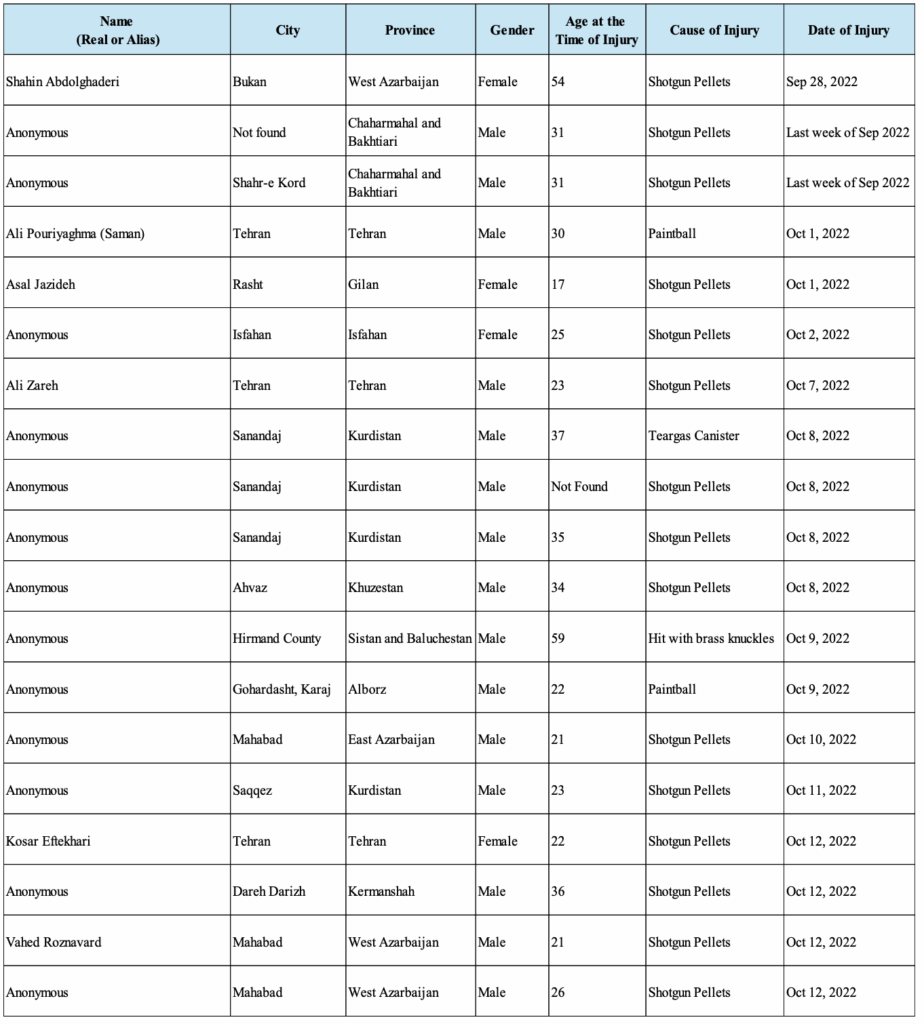
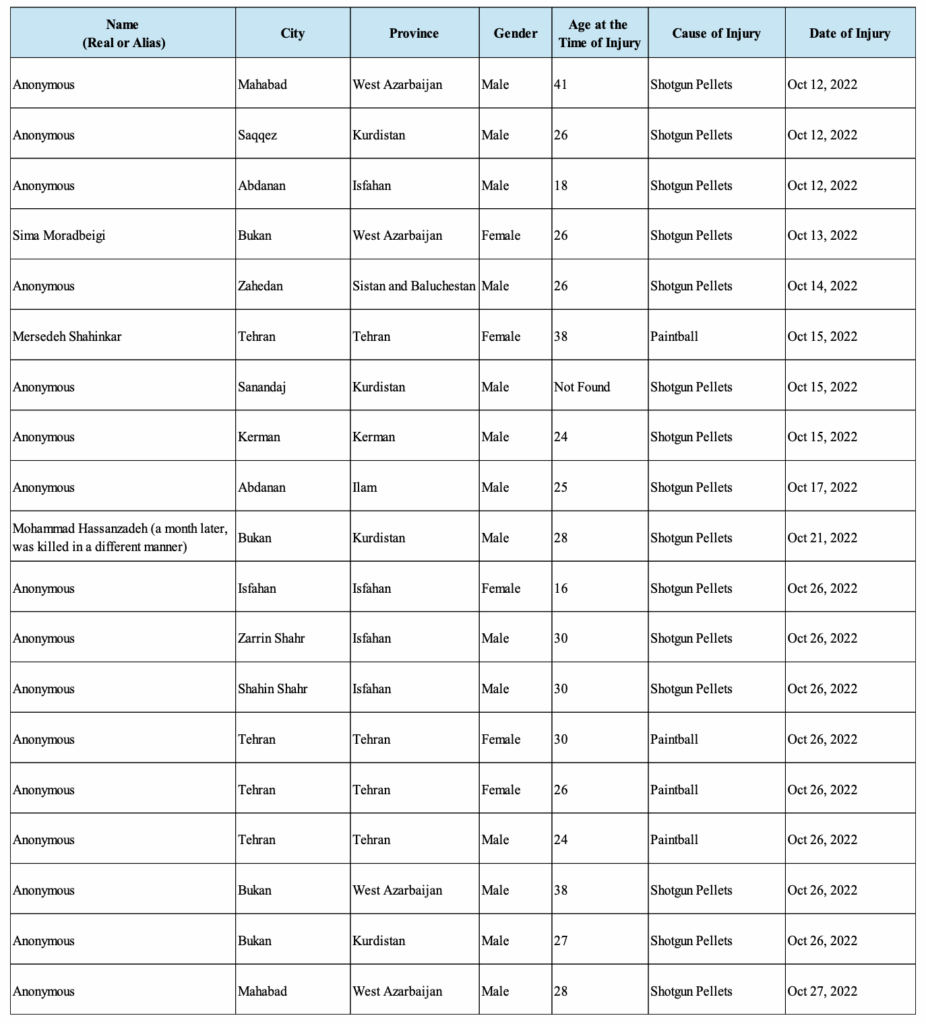
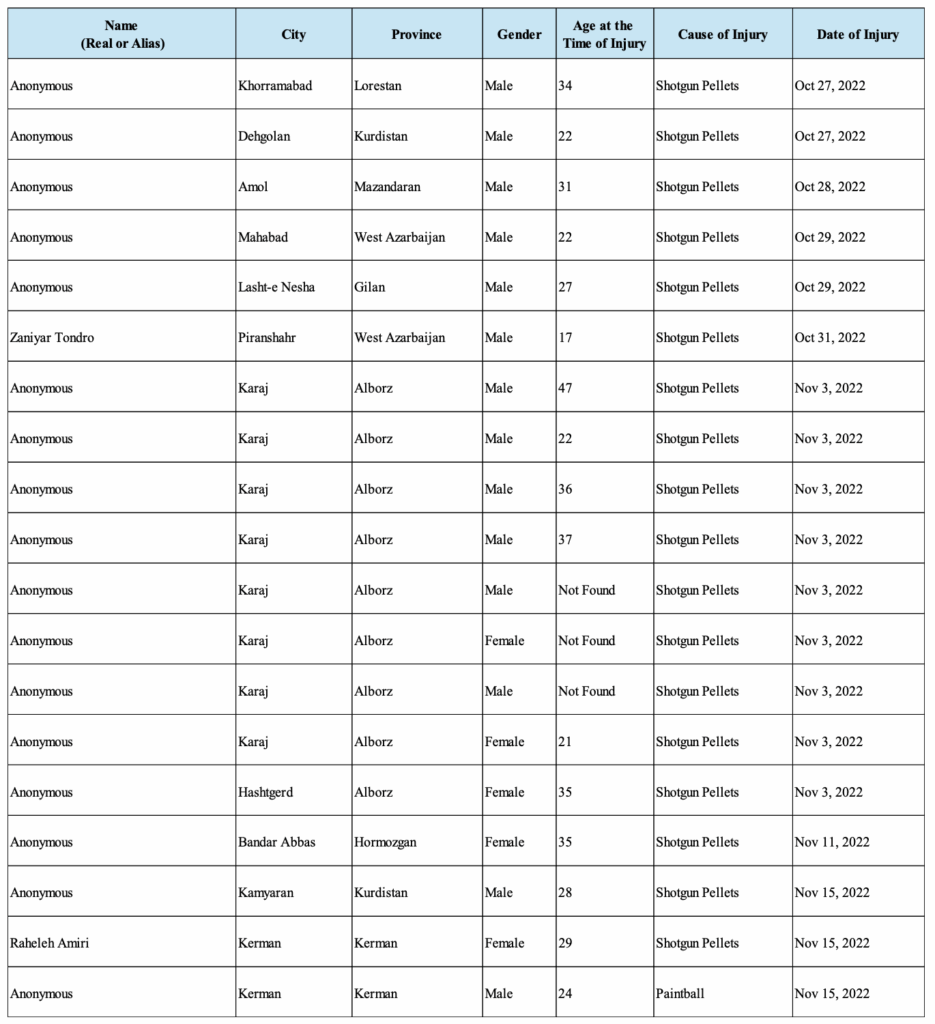
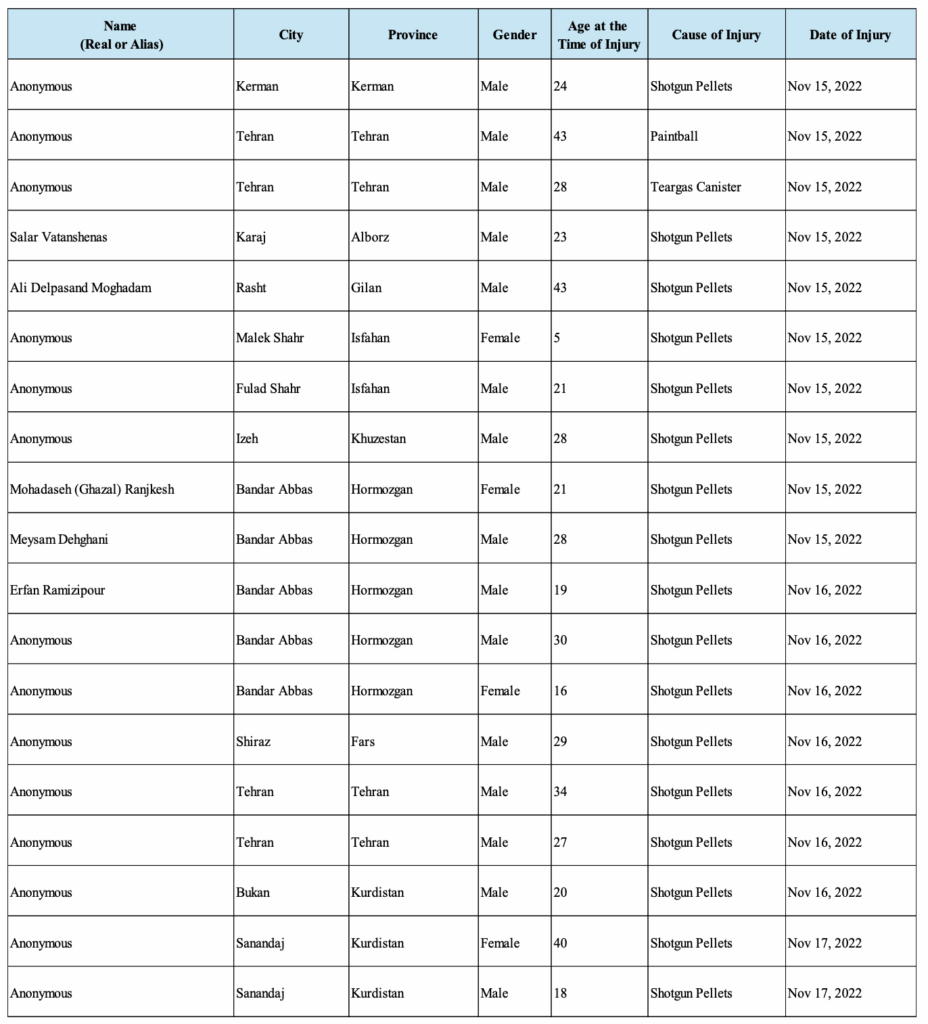
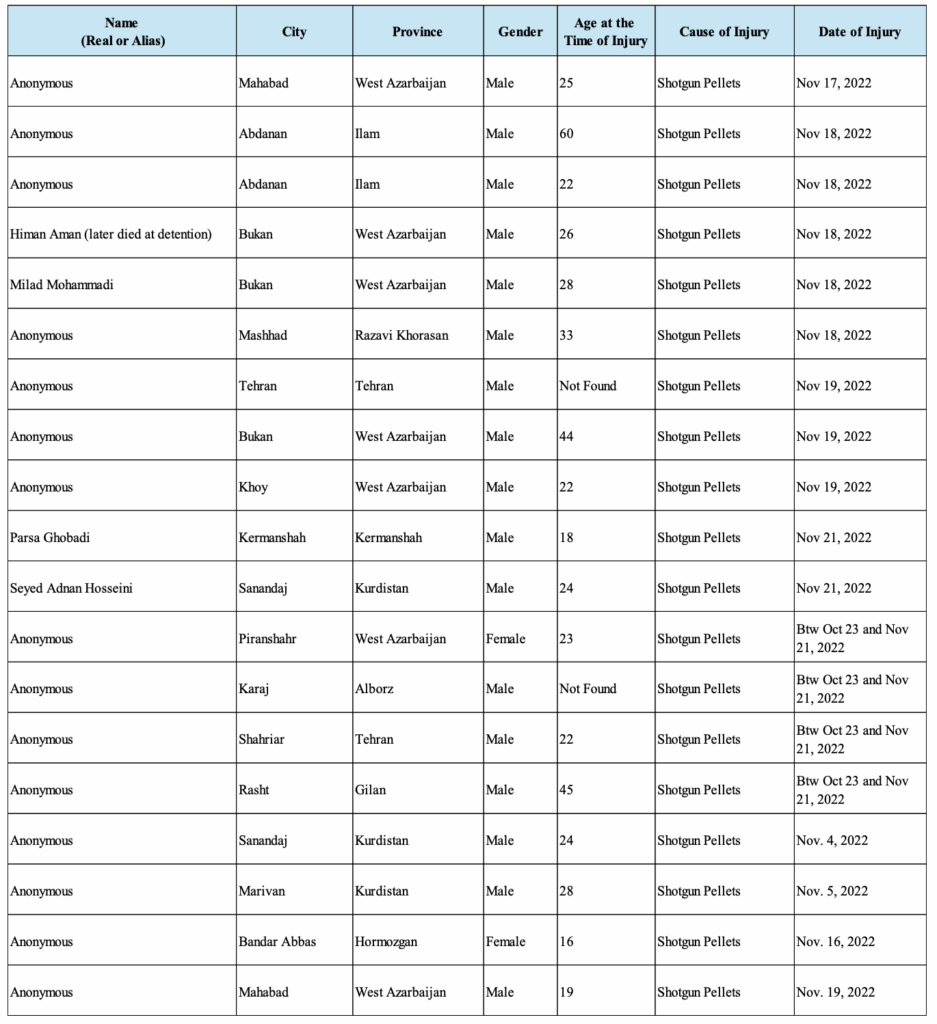
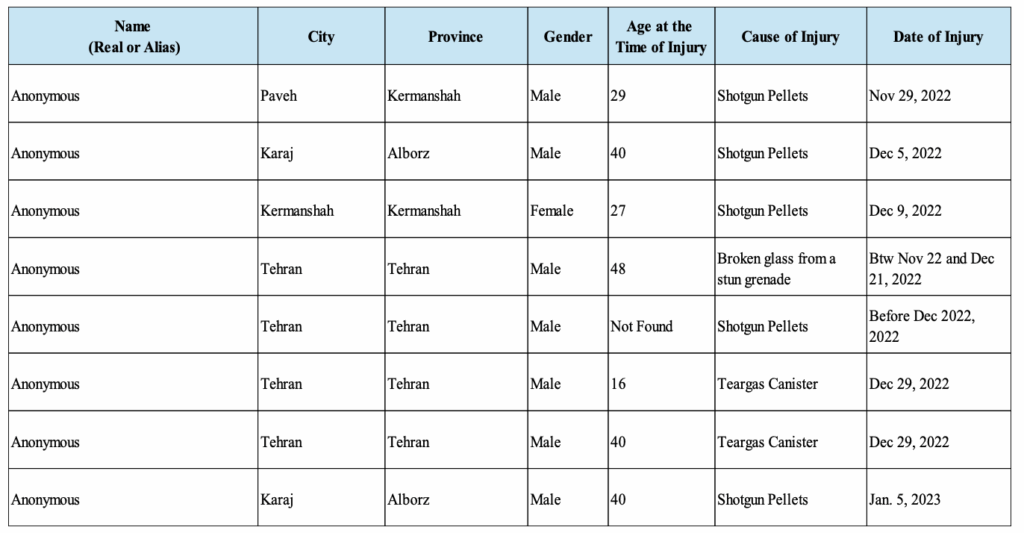


[1] H Rastgoo, Decoding Iran’s Politics: The November 2019 Fact Sheet, IranWire (Dec. 19, 2019), https://iranwire.com/en/features/66568/.
[2] Aida Ghajar, Blinding As A Weapon (27): A Father Of Two Shot In Both Eyes And Killed, IranWire (Mar. 17, 2023), Blinding As A Weapon (27): A Father Of Two Shot In Both Eyes And Killed.
[3] Aida Ghajar, Robbed of Sight, but Spirit Unbroken: An Iranian Protester’s Resilience, IranWire (Mar. 6, 2024), Robbed of Sight, but Spirit Unbroken: An Iranian Protester’s Resilience.
[4] ⚔ Iranian Militarism ⚔, Gurdān Hāay Amniyatī Emām ʿalī (ʿ) [Imam Ali (AS) Security Brigades], telegram (Apr. 23, 2021), https://t.me/Iranian_Militarism/13386.
[5] Experts: Michael Eisenstadt, Washington Institute for Near East Policy, https://www.washingtoninstitute.org/experts/michael-eisenstadt (last visited May 6, 2025); see also About Us, Chiron Resources, available at http://www.chiron-resources.com/about.html (last visited May 6, 2025) (profile of Chris Cobb-Smith); see also N. R. Jensen-Jones, Forum on the Arms Trade, available at https://www.forumarmstrade.org/nrjenzenjones.html (last visited May 6, 2025) (profile of N. R. Jensen-Jones); see also @caliber obscura, X, available at https://x.com/CalibreObscura (last visited May 6, 2025) (page of caliber obscura).
[6] Aida Ghajar et al., The Islamic Republic’s Use of Blinding as a Weapon of War Against Protesters, IranWire (Sept. 21, 2023), https://static.prod.iranwire.com/pdfcomponent/Blinding_as_a_Weapon_of_Suppression_IUhe.pdf.
[7] Office of the U.N. High Comm’r for Hum. Rts., Guidance on Less-Lethal Weapons in Law Enforcement (2020), https://www.ohchr.org/sites/default/files/Documents/HRBodies/CCPR/LLW_Guidance.pdf [hereinafter Guidance on Less-Lethal Weapons in Law Enforcement]; see also G.A. Res. 34/169, Basic Principles on the Use of Force and Firearms by Law Enforcement Officials, U.N. Doc. A/CONF.144/28/Rev.1 (1990), available at https://www.un.org/ruleoflaw/blog/document/basic-principles-on-the-use-of-force-and-firearms-by-law-enforcement-officials/.
[8] Tarkhīṣ Mavād Avalīyih Tā Saghfi 90 Darṣad Bidūn Kud Rahgīrī [Release of Raw Materials up to 90% Without a Tracking Code], mehr (Oct. 11, 2023), ترخیص مواد اولیه تا سقف ۹۰ درصد بدون کد رهگیری – خبرگزاری مهر | اخبار ایران و جهان | Mehr News Agency.
[9] Hakir Hāay “Qiyām Tā Sarnigūnī” Sirvir Hāay Majlis Irān Rā Hak Kardand [The Hackers of “Uprising Until Overthrow” Have Hacked the Servers of Iran’s Parliament], bbc persian (Feb. 13, 2024), https://www.bbc.com/persian/articles/clj95gy023jo.
[10] Az Sūyi Ravābiṭ ʿumūmī Majlis Muntashir Shud: Tūżīḥātī Darbārih Az Dastras Khārij Shudani Sāyt Hāay Majlis [Issued by the Public Relations Office of the Parliament: Clarification Regarding the Websites of the Parliament Going Offline], isna (Feb. 13, 2024), توضیحاتی درباره از دسترس خارجشدن سایتهای مجلس – ایسنا.
[11] قیام تا سرنگونی (t.me/ghyamsarnegouni), Bastih Jāmiʿ Ḥimāyat Hami Jānibih Az ʿavāmil Dūr Zanandih Taḥrīm Hā Bi Vizhih Dar Ṣurati Lū Raftan Va Datgīrī [A Comprehensive Package for Full Support of Those Circumventing Sanctions, Especially in the Event of Exposure or Arrest], telegram (Feb.13, 2024), https://t.me/ghyamsarnegouni/3107.
[12] Irān ‘Sitād Tadābīr Vīzhih Muqābilih Bā Taḥrīm’ Tashkīl Dādih Ast [Iran Has Established a ‘Special Task Force for Countering Sanctions’], bbc persian (June 30, 2010), https://www.bbc.com/persian/iran/2010/06/100630_l03_nuc_sanctions.
[13] Jahāngīrī Khabar Dād: Rāh Andāzī Sitād Muqābilih Bā Taḥrīm Bā Taṣvīb Shūrāy ʿālī Amnīyat Miī [Jahangiri Announced: The Establishment of the Headquarters for Combating Sanctions Was Approved by the Supreme National Security Council], Sharq Daily (June 30, 2018), https://www.pishkhan.com/news/93379.
[14] Dar Nishasti Namāyandigān Dūlat Va Bakhshi Khuṣūṣī Tihrān Maṭraḥ Shud: Sitād Muqābilih Ba Taḥrīm Tashkīl Shavad [In a Meeting Between Government and Private Sector Representatives in Tehran, It Was Proposed: A Task Force to Counter Sanctions Should be Established], Otagh Iran Online (Jul. 11, 2018), ستاد مقابله با تحریم تشکیل شود | اتاق ایران آنلاین.
[15] t.me/ghyamsarnegouni, supra note 11.
[16]S.C. Res. 1929, U.N. Doc. S/RES/1929 (June 9, 2010), https://www.un.org/securitycouncil/en/s/res/1929-%282010%29.
[17] Id.
[18] Estigbāl Irān Az ‘Pāyān’ Taḥrīm Hāay Taslīḥātī Sāzmān Milal Mutaḥid [Iran Welcomes the ‘End’ of United Nations Arms Sanctions], bbc persian (Oct. 17, 2020), https://www.bbc.com/persian/iran-54587382; see also Pāyān Taḥrīm Taslīḥātī Irān, 5 Sāl Pas az Barjām [The End of Iran’s Arms Embargo, 5 Years After the JCPOA], Euro News (Oct. 18, 2020), available at https://parsi.euronews.com/2020/10/17/the-end-of-iran-s-arms-embargo-five-years-after-jcpoa (discussing expiration of Iran’s arms embargo); see also Eʿlām Rasmī Pāyān Taḥrīm Hāay Taslīḥātī Shūrāy Amnīyat ʿalayhi Irān [Official Announcement of the End of Security Council’s Sanctions against Iran], KhabarOnline (Oct. 18, 2020), available at https://www.khabaronline.ir/news/1826974 (discussing the expiration of U.N. sanctions).
[19] Bayānīyīh Darbārih Pāyān Maḥdūdīyat Hāyi Qaṭʿnāmih 2231Shūrāy Amnīyat Sāzmān Milal Mutaḥid [Statement on the End of Restrictions Imposed by the UN Security Council Resolution 2231], Ministry of the Foreign Affairs of the Islamic Republic of Iran (Oct. 18, 2023), https://mfa.gov.ir/portal/newsview/731863; see also Pāyān Rasmī Taḥrīm Hāyi Shūrāy Amnīyat ʿalayhi Irān Muṭābiq Qaṭʿnāmih 2231 [Official End of Security Council Sanctions Against Iran in Accordance with Resolution 2231], tabnak (Oct. 21, 2024), available at https://www.tabnak.ir/fa/news/1266907 (discussing the expiration of U.N. sanctions against Iran).
[20] Council Regulation (EU) No 264/2012, 2012 O.J. (L 87) 26 (Eur-Lex), https://eur-lex.europa.eu/legal-content/EN/TXT/HTML/?uri=CELEX:02012D0035-20120123 [hereinafter EU Council Regulation]; see also Council Regulation (EU) No 267/2012, 2012 O.J. (L 88) 1 (Eur-Lex), https://eur-lex.europa.eu/legal-content/EN/TXT/HTML/?uri=CELEX:32012R0267; see also Council Regulation (EC) No 428/2009, 2009 O.J. (L 134) 1 (Eur-Lex), https://eur-lex.europa.eu/legal-content/EN/TXT/HTML/?uri=CELEX:32009R0428; see also EU Common Military ListCouncil Common Position 2008/944/CFSP, 2008 O.J. (L 335) 99 (Eur-Lex), https://eur-lex.europa.eu/legal-content/EN/TXT/HTML/?uri=CELEX:52023XG0228(01).
[21] Asāsnāmih Bunyād Taʿāvūn Nīrūyi Entiẓāmī Jumhūrī Eslāmī Irān [Statute of the Cooperative Foundation of the Law Enforcement Force of the Islamic Republic of Iran], Vekalat Online, https://www.vekalatonline.ir/laws/9757/اساسنامه-بنیاد-تعاون-نیروی-انتظامی-جمهوری-اسلامی-ایران/ (last visited May 19, 2025).
[22] Id.
[23] Raʾyī Shuʿbih Dīvān ʿidālati Edārī Darbārih Bunyād Taʿavūn Najā Va Ṣalāḥīyat Divān ʿidālati Edārī [Ruling of the Administrative Justice Court Branch regarding the NAJA Cooperation Foundation and the jurisdiction of the Administrative Justice Court], Specialized Encyclopedia of Wiki Hoghoogh (Aug. 4, 2013) رای شعبه دیوان عدالت اداری درباره بنیاد تعاون ناجا و صلاحیت دیوان عدالت اداری – ویکی حقوق.
[24] Treasury Sanctions Iran’s Interior Minister and Senior Law Enforcement Officials in Connection with Serious Human Rights Abuses, U.S. Department of Treasury (May 20, 2020), https://home.treasury.gov/news/press-releases/sm1015.
[25]Shirkati Nājī Pārs [Naji Pas Co.], rasmio, https://web.archive.org/web/20241120125931/https://rasmio.com/company/10102553397/%D8%B4%D8%B1%DA%A9%D8%AA%20%D9%86%D8%A7%D8%AC%DB%8C%20%D9%BE%D8%A7%D8%B3/ (last visited May 19, 2025); see also Shirkati Nājī Pārs [Naji Pas Co.], Sabtnama, available at https://web.archive.org/web/20250128230918if_/https://sabtnama.com/Company/5977 (last visited May 19, 2025) (profile of Naji Pars Co.).
[26] Sabtnama, supra note 25.
[27] Bistu Yikūmīn Namāyishgāh Ipās 2024 – 1403 +ʿaks [21st IPAS Expo 2024 – 1403 + Picture], Ario Iman Security Equipment, https://arioimen.com/blog/3818/ایپاس-تهران / (last visited May 27, 2025); see also Bistu Duvūmīn Namāyishgāh Bīnalmilalī Ipās 2025 [22nd International IPAS Exhibition 2025], IPAS Expo, available at https://ipasexpo.com/ (last visited May 28, 2025) (discussing IPAS Exhibition of 2025 in Tehran).
[28] Ḥużūr 29 Kishvar Dar Namāyishgāh Ipās 2017 [Participation of 29 Countries in the IPAS 2017 Exhibition], isna (Oct. 14, 2017), https://www.isna.ir/news/96072211886.
[29] Mona Hoobehfekr, Eftitāḥ Hafdumīn Namāyishgāh Bīnalmīlalī Lavāzim Va Tajhīzātt Pulīsī, Amnīyatī Va Emanī “Ipās 2018” [Opening of the 17th International Exhibition of Police, Security, and Safety Equipment “IPAS 2018”], isna (Oct. 1, 2019), https://www.isna.ir/photo/97070905313.
[30] rasmio, supra note 25.
[31] Pazhuhish Tūsiʿih Nājī [Naji Research and Development], Karboom, https://karboom.io/companies/پژوهش-توسعه-ناجی/overview (last visited May 19, 2025); see also Tajrubih Kār Dar Pazhuhish Va Tūsiʿih Nājī Rā Dārīd [Do You Have the Experience of Working for Naji Research and Development?], Tajrobeh Hay kari, available at https://tajrobe.github.io/پژوهش-و-توسعه-ناجی (last visited May 19, 2025) (discussing some details about Naji Research and Development Co.).
[32] Shirkati Nājī Pūshish Sīstān va Balūchistān Quṭbi Pūshāk Niẓāmī Kishvar Ast [The Company Naji Pooshesh Sistanand Baluchestan is the National Hub for Military Clothing Production], irna (Dec. 14, 2014) https://www.irna.ir/news/81427317.
[33] Najm Kārt Farājā Chīst Naḥvih Sabti Nām va Shārzhi Ān [What is Najm Faraja Card, How to Register and Recharge It], 24nevish, https://www.24nevis.ir/news/breaking-news/what-is-najm-kart-faraja/ (last visited Jul. 8, 2025).
[34] Nigāhī Bi Faʿālīyat Hāy Eqtiṣādī Bunyād Taʿāvun Nīrūy Entiẓāmī Az Bānkdārī Tā Sākhtimān Sāzi [A Look at the Economic Activities of NAJA Cooperation Foundation, From Banking to Construction], tejarate farda (Feb. 8, 2014), از بانکداری تا ساختمانسازی; see also Shikl Gīrī Va Tūsiʿih Faʿālīyat Hāyi Eqtiṣādī Bunyād Taʿāvun Dar Guftigū Bā Yikī Az Mudirān Sābiq Bunyād: Bunyādguzārī Bunyād [The Formation and Development of the Economic Activities of the Cooperation Foundation in an Interview with One of its Former Directors: Foundation’s Establishment], tejarate farda (Feb. 8, 2014) available at https://www.tejaratefarda.com/بخش-اقتصاد-35/13866-بنیانگذاری-بنیاد (discussing some details about NAJA Corporate Foundation).
[35] Aṣgharīyān Dar Guftigū Bā Danishjū: Bakhsh Khuṣūṣī Tulīd Kunandih 95 Darṣad Tajhīzāt Amnīyatī Va Emanī [Asgharian in an Interview with Daneshjoo: The Private Sector Produces 95% of Security and Safety Equipment], snn (Oct. 22, 2022), https://snn.ir/fa/news/1036954.
[36] rasmio, supra note 25.
[37] Financial Action Task Force (FATF), International Standards on Combating Money Laundering and the Financing of Terrorism & Proliferation: The FATF Recommendations (2023), https://www.fatf-gafi.org/recommendations.html.
[38] Id. See also Eftitāhiyih Davāzdhumīn Namāyishgāh Ipās 2013 [The Opening of the 12th IPAS Expo 2013], Fars (Sept. 28, 2013), available at https://farsnews.ir/Photo/1380357960000283145/افتتاحیه-دوازدهمین-نمایشگاه-ایپاس-۲۰۱۳ (discussing IPAS Exhibition of 2013 in Tehran).
[39] Marking International Women’s Day, Treasury Sanctions Iranian Officials and Entities for Serious Human Rights Abuses, U.S Department of Treasury (Mar. 18, 2023), https://home.treasury.gov/news/press-releases/jy1327; see also Search the Sanctions List – Reza Asgharian, Office for Foreign Assets Control (OFAC), available at https://sanctionssearch.ofac.treas.gov/Details.aspx?id=41198 (last visited May 20, 2025) (identifying Reza Asgharian as a designated individual on the OFAC sanctions list).
[40] Omid Shams, Special Report: What Equipment Is Used To Suppress Iran Protests, Which companies Provides Them?, IranWire (Nov. 7, 2022), https://iranwire.com/en/politics/109507-from-armored-vehicles-to-kalashnikovs-equipment-used-to-suppress-iran-protests/.
[41] U.S Department of Treasury, supra note 39.
[42] Darbārih Mā [About Us], Naji Pars Amin Co., https://najipars.ir/about-us/ (last visited May 20, 2025).
[43] U.S Department of Treasury, supra note 39.
[44] Exports Data from Türkiye to Iran Under Commodity Code 9303, UN Comtrade Database, https://comtradeplus.un.org/TradeFlow?Flows=X&CommodityCodes=9303&Partners=364&Reporters=792 (last visited May 26, 2025) (Click on “Preview” to view the results) [hereinafter Exports Data from Türkiye to Iran Under Commodity Code 9303].
[45] Exports Data from Türkiye to Iran Under Commodity Code 930320, UN Comtrade Database, https://comtradeplus.un.org/TradeFlow?Flows=X&CommodityCodes=930320&Partners=364&Reporters=792 (last visited May 26, 2025) (Click on “Preview” to view the results) [hereinafter Exports Data from Türkiye to Iran Under Commodity Code 930320].
[46] Exports Data from Türkiye to Iran Under Commodity Code 9306, UN Comtrade Database, https://comtradeplus.un.org/TradeFlow?Frequency=A&Flows=X&CommodityCodes=9306&period=all&Partners=364&Reporters=792 (last visited May 26, 2025) (Commodity Code 9306 covers the following items: bombs, grenades, torpedoes, mines, missiles and similar munitions of war and their parts; cartridges and other ammunition and projectiles and their parts, including shot and cartridge wads) (Click on “Preview” to view the results) [hereinafter Exports Data from Türkiye to Iran Under Commodity Code 9306].
[47] Exports Data from Türkiye to Iran Under Commodity Code 930629, UN Comtrade Database, https://comtradeplus.un.org/TradeFlow?CommodityCodes=930629&Reporters=792&Partners=364&Flows=X (last visited May 28, 2025) (Click on “Preview” to view the results) [hereinafter Exports Data from Türkiye to Iran Under Commodity Code 930629].
[48] Exports Data from Türkiye to Iran Under Commodity Code 9305, UN Comtrade Database, https://comtradeplus.un.org/TradeFlow?Frequency=A&Flows=X&CommodityCodes=9305&period=all&Partners=364&Reporters=792 (last visited May 28, 2025) (Click on “Preview” to view the results).
[49] Pardāzān Sīstim Namād Ārmān [Pardazan System Namad Arman], Niroobit, https://niroobit.com/company/589 (last visit May 23, 2025); see also Press Release Iranian National Charged With Illegally Exporting Electrical Equipment to Iran, United States Attorney’s Office, District of Columbia (Mar. 9, 2023), available at https://www.justice.gov/usao-dc/pr/iranian-national-charged-illegally-exporting-electrical-equipment-iran (announcing charges against an Iranian national).
[50] United States Attorney’s Office, supra note 49; see also Pardazan System Namad Arman, IranWatch, available at https://www.iranwatch.org/iranian-entities/pardazan-system-namad-arman (last visit May 23, 2025) (discussing some details about Pardazan System Namad Arman).
[51] IranWatch, supra note 50; see also Sanctions List Search: Pardazan System Namad Arman, Office of Foreign Assets Control (OFAC), available at https://sanctionssearch.ofac.treas.gov/Details.aspx?id=23479 (last visit May 23, 2025) (identifying Pardazan System Namad Arman as a designated entity on the OFAC sanctions list).
[52] United States Attorney’s Office, supra note 49; see also Sanctions List Search: Mehdi Khoshghadam, Office of Foreign Assets Control (OFAC), available at https://sanctionssearch.ofac.treas.gov/Details.aspx?id=42303 (last visited May 23, 2025) (identifying Mehdi Khoshghadam as a designated individual on the OFAC sanctions list).
[53] Amvaj Nilgoun Bushehr Co., Iran Watch, https://www.iranwatch.org/iranian-entities/amvaj-nilgoun-bushehr-co (last visited May 23, 2025).
[54] Id.
[55] Id. See also Sanctions List Search: Amvaj Nilgoun Bushehr Co., Office of Foreign Assets Control (OFAC), available at https://sanctionssearch.ofac.treas.gov/Details.aspx?id=42319 (last visited May 23, 2025) (identifying Amvaj Nilgoun Bushehr Co. as a designated entity on the OFAC sanctions list).
[56] Iran Watch, supra note 53.
[57] Arzi Dūlatī Bi Chi Kasānī Taʿaluq Mīgīrad Va Chiṭūr Ān Rā Bigīrīm? [Who Is Eligible for Official-subsidized Currency and How Can We Get It?], tabnak (Jan. 9, 2024), https://www.tabnak.ir/fa/news/1214700; see also Dānistanī Hāyi Safar: Sabti Nām Arzi Dūlatī Chigūnih Ast? Naḥvih Daryāft Arzi Dūlatī 1403 [Travel Facts: How is the Registration for Official-rate Currency? How to Receive Official Currency in 2024], Fly Today (Apr. 14, 2024), available at https://www.flytoday.ir/blog/راهنمای-دریافت (discussing how to obtain official-rate currency); see also Maryam Sinaiee, Inside Iran’s Maze of Multiple Exchange Rates, Iran International (Apr. 30, 2025), available at https://www.iranintl.com/en/202504309977 (discussing the system of different currency rates in Iran).
[58] Tużīḥ Bānk Markazī Darbārih Arzi Tarjīḥī Va Nirkhi Tavarūm [Central Bank’s Explanation about Preferential Currency and the Inflation Rate], donya-e-eqtesad (Apr. 15, 2023), توضیح بانک مرکزی درباره ارز ترجیحی و نرخ تورم; see also Sayed Esmail Davoudi, Arzi Tarjīḥī Chi Būd Va Chi Mīshavad? [What Was the Preferential Currency, and What Will It Become?], irna (May 11, 2022), available at https://www.irna.ir/news/84747554 (discussing the preferred currency rate); see also Dar Mūridi Arzi Tarjīḥī Dar Vīkī Tābnāk Bishtar Bikhānīd [Read More About Preferential Currency on Tabnak Wiki], tabnak, available at در مورد ارز ترجیحی در ویکی تابناک بیشتر بخوانید (last visited May 23, 2025) (discussing the preferred currency rate).
[59] Ḥazfi Arzi Dūlatī Az 200 Qalam Kālā / Kālā Hāyī Asāsī Girān Mīshavand? [Removal of Official-Subsidized Currency for 200 Items / Essential Goods Will Become More Expensive], fardaye-eghtesad (Jan. 6, 2024), حذف ارز دولتی از ۲۰۰ قلم کالا / کالاهای اساسی گران میشوند؟ – فردای اقتصاد.
[60] Treasury Targets Shadow Banking Network Moving Billions for Iran’s Military, U.S. Department of Treasury (June 25, 2024), https://home.treasury.gov/news/press-releases/jy2431.
[61] Id.
[62] Id.
[63] Id.
[64] Id.
[65] Crypto Exchange Binance Helped Iranian Firms Trade $8 Billion Despite Sanctions, i24 news (Nov. 05, 2022), Crypto Exchange Binance Helped Iranian Firms Trade $8 Billion Despite Sanctions – i24NEWS.
[66] Israel Seizes Cryptocurrency Said to Be Used to Finance Hezbollah, Iran’s Revolutionary Guard, voa (June 27, 2023), Israel Seizes Cryptocurrency Said to Be Used to Finance Hezbollah, Iran’s Revolutionary Guard.
[67] Barrisī Kāmil Ṣarāfī Nūbītix [Complete Review of Nobitex Cryptocurrency Exchange], Donyaye Trade (Sept. 9, 2023), https://donyaye-trade.com/article/nobitex-exchange-review.
[68] Katelyn Peters et al., Binance Exchange, Investopedia (Nov. 22, 2023), https://www.investopedia.com/terms/b/binance-exchange.asp; see also Federico Maccioni, Binance Still to Choose Location for Global Headquarters, CEO Teng Says, Yahoo Finance (Dec. 9, 2024), available at https://ca.finance.yahoo.com/news/binance-still-choose-location-global-182307242.html (reporting the news about Binance headquarters).
[69] Interviews with Witnesses (2024) (available in the archives of IranWire and IHRDC); see also فریبرز کرمی زند (@f_karamizand), X (Oct. 24, 2022, 1:47 p.m.), available at https://x.com/F_karamizand/status/1584602452703457280 (discussing less-lethal weapons in possession of law enforcement and security forces) (In Persian).
[70] IranWire Citizen Journalist, Iran’s Revolutionary Guards and the Politics of Sports, IranWire (Jan. 27, 2016), https://iranwire.com/en/society/61614/; see also Hanieh Ahmadi, Dar Guftigū Bā Tilivīzīūn Didban Irān Maṭraḥ Shud; Fāʾizih Hāshimī Rafsanjānī: Ebrāhīm Raʾīsī Khudash Taṣmīm Gīr Nīst Oū Rā Idārih Mī Kunand / Agar Dūlat Mī Khāhad Muvafaq Shavad Bāyad Moḥammad Mukhbir Rā Kuntrul Kunad/ Enqilābī Garī Yīk Shū Va Namāyish Ast/ Vazīr Varzish Kārihiyy Nīst, Muʿāvīn Āqāy Naqdī Vizārat Varzish Rā Edārih Mīkunad + Fīlm [Brought up in an Interview with Didban Iran TV; Faezeh Hashemi Rafsanjani: “Ebrahim Raisi Is Not a Decision-maker Himself/ He Is Being Managed by Others/ If the Government Wants to Succeed, They Must Control Mohammad Mokhber/ Revolutionary Rhetoric Is a Show and a Performance/ Minister of Sports is a Nobody; It Is Mr. Naghdi’s Deputy Who Runs the Ministry of” + Video], Didban Iran, available at https://www.didbaniran.ir/بخش-سیاسی-3/124136- (last visited May 23, 2025) (discussing Faezeh Hashemi Rafsanjani’s criticisms of different individuals); see also Payam Younesipour, Yadgār Hāy Ebrāhīm Raʾīsī Dar Varzish; Eʿdām, Suʾ Istifādih, Sarkūb [Ebrahim Raisi’s Heritage in Sports: Executions, Abuse, Repression], IranWire (May 21, 2024), available at https://iranwire.com/fa/features/129695 (discussing Ebrahim Raisi’s administration in the management of sports federations).
[71] Fidrāsīūn Tīrandāzī Jumhūrī Eslāmī Irān [Shooting Sports Federation of the Islamic Republic of Iran], Islamic Republic of Iran Shooting Sports Federation, https://www.irissf.ir/ (last visited June 14, 2025).
[72] Intiqād Raʾīs Fidrāsīūn Tīrandāzī Az Raʾīs Sābiq: Chirā Hāshimī 31 Hizār Yurū Rā Zamān Khudash Bardāsht Nakard [President of Shooting Sports Federation Criticizes the Former President: Why Didn’t Hashemi Withdraw the 31 Thousand Euros When He Was in Charge], isna (Jan. 6, 2024), https://www.isna.ir/news/1402101611313; see also Sardār Qurbānī Mushāvir Raʾīs Sitād Kul Nirū Hāy Musalaḥ Shud [General Ghorbani Was Appointed Advisor to the Chief of Staff of the Armed Forces], tasnim (Jan. 1, 2016), available at https://www.tasnimnews.com/fa/news/1394/10/11/958919 (discussing General Ghorbani’s appointment to an advisory position); see also Payam Younesipour, Troubled ex-IRGC Commander Is New Head of the Iranian Shooting Federation, IranWire (Feb. 22, 2022), available at https://iranwire.com/en/sports/71348/ (discussing the new management of the Shooting Federation).
[73] Muḥamadī: Murabīyān Irānī Dar Olimpīk Pārīs Dirakhshidand [Mohammadi: Iranian Coaches Shone at the Paris Olympics], tasnim (Aug. 1, 2024), https://www.tasnimnews.com/fa/news/1403/05/11/3132419; see also Musayībzādih Mudīr ʿāmīl Jadīd Bāshgāh Nīrūyī Zamīnī Shud [Mosayebzadeh Has Been Appointed As the New CEO of the Ground Forces’ Club], alborz varzeshi (Jan. 26, 2021), available at https://alborzvarzeshi.com/News/d?id=4842&ts=13991107155924966 (discussing Mosayebzadeh’ new appointment).
[74] Anjuman Pīntbāl Jumhūrī Eslāmī Irān [Paintball Association of the Islamic Republic of Iran], Paintball Association of the Islamic Republic of Iran, https://paintball.ir/pa/ (last visited June 13, 2025); see also Fidrāsīūn Varvish Hāy Hamigānī [Iran Sport for All Federation], Sports for All Federation, available at https://register.isfaf.ir/ (last visited June 13, 2025) (In the alphabetical list of “sports disciplines,” the name of paintball appears.)
[75] Hiʾt Raʾīsih Anjuman Pīntbāl Jumhūrī Eslāmī Irān [Board of Directors of the Paintball Association of the Islamic Republic of Iran], Paintball Association of the Islamic Republic of Iran, https://paintball.ir/هیات-رئیسه-انجمن/ (last visited June 13, 2025); see also Rezā Āzarīyān Sarparasti Anjuman Pīntbāl Shud [Reza Azarian Was Appointed As the Head of Paintball Association], Sports for All Federation (Mar. 16, 2025), available at https://isfaf.ir/News/1692/رضا-آذریان-سرپرست-انجمن-پینت-بال-شد (discussing the appointment of Reza Azarian).
[76] Bā Ḥukmi Majd Ārā; Bārān Chishmih Raʾīsih Anjuman Pīntbāl Fidrāsīūn Varvish Hāy Hamigānī Shud [With a Decree from Majdara, Baran Cheshmeh Was Appointed the Head of the Sports for All Federation’s Paintball Association], borna (Apr. 20, 2016), https://borna.news/fa/amp/news/394945.
[77] Khalīlī: Hadafi Fidrāsīūn Varvish Hāy Hamigānī Burdani Varzish Bi Miyān Mardum Ast/Saʿī Dārīm Mīzān Faʿālīyati Badanī Irānī Hā Tā 1410 Bi 30 Daghīghih Birisad [Khalili: The Goal of the Sports for All Federation Is to Bring Sports to the People/ We Are Striving to Increase the Average Physical Activity of Iranians to 30 Minutes Per Day by the Year 2031], Sports for All Federation (Aug. 19, 2024), خلیلی هدف فدراسیون ورزشهای همگانی بردن ورزش به میان مردم است .
[78] Lavāzim Va Tajhīzāt Pīntbāl [Paintball Supplies and Equipment], Paintball Association of the Islamic Republic of Iran, مارکر پینت بال (تفنگ مخصوص ورزش پینت بال) | مرجع پینت بال ایران (last visited May 23, 2025) (displaying BT-4 Combat Paintball Gun for sale); see also Lavāzim Va Tajhīzāt Pīntbāl [Paintball Supplies and Equipment], Paintball Association of the Islamic Republic of Iran, available at هاپر | مرجع پینت بال ایران (last visited May 23, 2025) (displaying DYE hopper for sale); see also Empire BT-4 Combat Paintball Gun, ANSgear, available at https://ansgear.com/bt-4-combat-paintball-gun/ (last visited June 5, 2025) (displaying Empire BT-4 Combat Paintball Gun model); see also Dye Rotor R-2 Paintball Loader (Chameleon), Paintball Sports, available at https://paintballsports.co.uk/dye-rotor-r-2-paintball-loader-chameleon/ (last visited June 5, 2025) (displaying Empire DYE Rotor Paintball Loader model).
[79] Correspondence with the United Paintball Federation (2024) (available in the archives of IranWire and IHRDC).
[80] Majmūʿih Qavānīn Pīntbāl 1394 [Paintball Regulations Collection, 2015], Paintball Association of the Islamic Republic of Iran, https://paintball.ir/قوانین-و-مقررات/ [hereinafter Paintball Regulations Collection]; see also Paintball Association of the Islamic Republic of Iran, supra note 74.
[81] Paintball Regulations Collection.
[82] Shirkati Khadamāt Varzish Tīrandāzī Va Shikār Zūbīn [Zubin Sport Shooting and Hunting Services Co.], rasmio, https://rasmio.com/company/10103120314 (last visited May 23, 2025); see also Vāridāt Tajhīzāt Va Silāḥ Tīranāndāzī 20 Barābar Afzāyīsh Yāftiyh Ast Mushkil Ṣudūr Parvānih Ḥaml Silāḥ Ḥal Shavad [Imports of Shooting Equipment and Firearms Has Increased Twentyfold; the Problem of Issuing Firearm Carry Permits Should Be Resolved], isna (Jul. 6, 2009), available at https://www.isna.ir/news/8804-06119 (discussing the rise in the importation of shooting equipment).
[83] Pardākht Yīk Mīlīyārd Tumān Bi Fidrāsīūn Tīrandāzī Barāy Kharīd Muhīmāt [Payment of One Billion Tomans to the Shooting Sports Federation for Purchasing Ammunition], mehr (Dec. 23, 2019), https://www.mehrnews.com/news/4805278.
[84] Mujaviz Vāridāt Fishang Fidrāsīūn Tīrandāzī Akhz Shud [Import License for Ammunition Has Been Obtained by the Shooting Sports Federation], irna (Apr. 15, 2018), https://www.irna.ir/news/82886922.
[85] Firearms Examiner Training, National Institute of Justice (NIJ), Archived | Firearms Examiner Training | Alternate Materials | National Institute of Justice (last visited May 23, 2025); see also What Is Shotgun Gauge?, Orvis, available at Guide To Shotgun Gauge | Orvis (last visited May 27, 2025) (explaining the gauge in shotguns).
[86] How Do Shotgun Shells Work?, Liberty Safe, How Do Shotgun Shells Work? | What Are Shotgun Shells Filled With? (last visit on June 6, 2025); see also Shotgun Shell Sizes: Comparison Chart and Commonly Used Terms, Gun News Daily (June 5, 2025), available at https://gunnewsdaily.com/shotgun-shell-sizes-comparison-chart-terms/ (explaining shotgun shell size and other relevant details).
[87] A Comprehensive Guide to Shotgun Shell Types and Their Application, Fusion Firearms (May 11, 2023), https://fusionfirearms.com/videovault/post/a-comprehensive-guide-to-shotgun-shell-types-and-their-applications.
[88] National Institute of Justice, supra note 85; see also Shotshell Science: Resources to Choose the Right Load, Federal Premium (May 27, 2025), available at Federal2019-Shotshell.pdf (discussing shotgun shells and other relevant details).
[89] National Institute of Justice, supra note 85.
[90] Id. See also Shotgun Slugs, Remington, available at https://www.remington.com/shotshell/slugger-rifled-slug/ (last visited May 27, 2025) (discussing ammunition of different gauges).
[91] Earshad Alijani, Chigūnih Nīrū Hāy Amniyatī Irān Bā Gulūlih Hāy “Ghīr Jangī” Bi Ghaṣdi Kushtani Muʿtarizān Shilīk Mīkunand [How Iranian Security Forces Shoot Protesters with “Non-military” Bullets with the Intent to Kill], France 24 (Nov. 7, 2022), چگونه نیروهای امنیتی ایران با گلولههای «غیر جنگی» به قصد کشتن معترضان شلیک میکنند; see also Shams, supra note 40.
[92] @iranwire, Shilīk Mustaghīm Maʾmūrān Bi Muʿtariżān [Direct Shooting of the Protesters by the Security Forces], instagram (Oct. 3, 2022), https://www.instagram.com/p/CjP-U40ta1C/?utm_source=ig_embed&ig_rid=17113c8d-d561-4571-8143-c517e7614a14.
[93] Unleashed Violence: Repression of Protests in Kurdish Areas of Iran, from September to December 2022, IHRDC (June 30, 2023), https://iranhrdc.org/protests-in-the-kurdish-areas-of-iran/.
[94] Aida Ghajar, Blinding as a Weapon (50): Hit by up to 300 Pellets, Rendered Sightless, IranWire (Oct. 9, 2023), https://iranwire.com/en/blinding-as-a-weapon/121346.
[95] tasnim, Dovūmīn Razmāyish Amnīyatī Yīgān Vīzhih Fātihīn Tihrān Buzurg [The Second Security Drill of the Fatehin Special Unit of Greater Tehran], aparat (Oct. 11, 2023), https://www.aparat.com/v/w69czh0; see also Soheilofsky (@soheil34874913), X (Nov. 27, 2021, 4:31 a.m.), available at https://x.com/Soheil34874913/status/1464527345650479108 (showing Sayyad shotguns in the possession of security forces); see also Iran Defense commentary – unofficial (@irandefense), X (Sept. 27, 2022, 11:44a.m.), available at https://x.com/IranDefense/status/1574787070991687681 (displaying less-lethal weapons in the possession of security forces); see also Kurdistan Human Rights Network (@kurdistanHRN), X (Mar. 18, 2023, 6:14 p.m.), available at https://x.com/KurdistanHRN/status/1637215868777111562 (displaying IRGC forces in Javanrud, Kermanshah Province, on Nov. 21, 2022); see also Sarollah Ankooti, Razmāyish Hilīburn Nīrū Hāy Yīgān Vīzhih – Kirmān [Heliborne Maneuvers of Special Forces Unit – Kerman], tasnim (Oct. 10, 2021), available at https://www.tasnimnews.com/fa/media/1400/07/18/2586942 (displaying FARAJA Special Units’ training in Kerman in 2021); see also Pezhman Ganjipour, Mānūvri Mūtūr Savārān Basījī [Basiji Motorcyclists Maneuvers], imna (Nov. 25, 2022), available at https://www.imna.ir/photo/622016 (showing Basij forces drill in the city of Isfahan in Dec. 2022).
[96] Rizhih Mutūrī Gurdān Imām ʿalī (ʿ) Shahristān Dilfān Ostān Luristān [Motorized Parade of the Imam Ali (AS) Battalion of Delfan County, Lorestan Province], aparat, https://www.aparat.com/v/Q1D28 (last visited May 29, 2025); see also Durūd Bi Bachi Hāay Gurdān Imām ʿalī Shahristān Burūjird [Hail to the Young Men of Imam Ali Battalion of Borujerd County], aparat, available at https://www.aparat.com/v/dm09z (last visited May 29, 2025) (displaying Imam Ali Battalions in Lorestan Province); see also Gurdān Amnīyatī Imām ʿalī (ʿ) [Imam Ali (AS) Battalion], aparat, available at https://www.aparat.com/v/oib6364 (last visited May 29, 2025) (showing Imam Ali Battalions in Isfahan Province); see also Rizhih Mutūrī Basījīyān [Motorcycle Parade of the Basijis], aparat, available at https://www.aparat.com/v/v61gc9h (last visited May 29, 2025) (displaying Basiji forces in Semnan Province); see also Fīlm / Rizhih Iqtiār Va Amnīyat Gurdān Hāay Amnīyatī Imām ʿalī [Video / Imam Ali Battalions’ Power and Security Parade], aparat, available at https://www.aparat.com/v/bRPB5 (last visited May 29, 2025) (showing Imam Ali Battalions in Mazandaran Province); see also Gurdān Amnīyatī ʿamalyāt Vīzhih 141 Mālik Ashtar [Security Battalion for Special Operations 141 Malek Ashtar], aparat, available at https://www.aparat.com/v/g57io75 (last visited May 29, 2025) (displaying IRGC security units in Mazandaran Province).
[97] Mohsen Azarkhani, Bi Munāsibat Haftih Basīj Sharḥī Khulāṣih Vār Az Gurdān Hāay Basīj [On the Occasion of Basij Week, a Brief Overview of the Basij Battalions], telegram (Nov. 20, 2021), https://t.me/Iranian_Militarism/17967.
[98] Archives of IranWire and IHRDC, supra note 69.
[99] ⚔Iranian Militarism⚔, Kitāb Āmūzish Bikārgīrī Va Istifādih Az Silāḥ Sāchmih Zanī Shātgān Māhir (Iskūrt Irānī)/ Silāḥ Āmnīyatī-Entīzāmī Va Żidi Shūrish [Training Manual for the Deployment and Use of the Maher Shotgun (Iranian Escort) / Security, Law Enforcement, and Riot Control Weapon] of Imam Ali Security Unit of Bushehr Province, telegram (Oct.15, 2023), https://t.me/Iranian_Militarism/34334 [hereinafter Training Manual for the Deployment and Use of the Maher Shotgun]; see also ⚔Iranian Militarism⚔, Kitāb Āmūzish Nigahdārī va Bi Kār Gīrī Az Silāḥ Shātgān Sākhti Ṣanāyī ʿ Shahīd Kāvih Va Shahīd Hamidānī Dar Mudil Hāay Mukhtalif Hamchūn Māhir Va Ṣayād [Training Manual for the Maintenance and Use of Shotgun Weapons Manufactured by Shahid Kaveh Khorasan and Shahid Hemdani Industries, in Various Models Such as Maher and Sayyad] of Shahid Motosellian 1st Security Battalion in Alborz County, telegram (Dec. 17, 2023), available at https://t.me/Iranian_Militarism/36393 [hereinafter Training Manual for the Maintenance and Use of Shotgun Weapons Manufactured by Shahid Kaveh Khorasan and Shahid Hemdani Industries].
[100] Exports Data from Türkiye to Iran Under Commodity Code 9303.
[101] Exports Data from Türkiye to Iran Under Commodity Code 930320.
[102] ⚔ Iranian Militarism⚔, Silāḥ Hāay Māsbirg 500 Bikārgīrī Shudi Tavasuṭ Radi Hāay Mukhtalif FĀRĀJĀ [Mossberg 500 Weapons Used by Various Echelons of FARAJA], telegram (Jan. 15, 2025), https://t.me/Iranian_Militarism/53218; see also Jang Afzar (@military.tactical.ir), Māsbirg 500 [Mossberg 500], instagram (Mar. 13, 2025), availabeat https://www.instagram.com/military.tactical_/reel/DHJZMFXJ0vD/ (discussing Mossberg 500 shotgun); see also⚔ Iranian Militarism⚔, Taṣvīr Muntashir Shudi Tavasuṭ Kahbarguzārī Irnā Az Marāsim Runamāyī Emrūz Silāḥ Hāay Enfirādī Sākhti Vizārati Difāʿ [Image Released by IRNA News Agency From Today’s Unveiling Ceremony of Personal Weapons Manufactured by the Ministry of Defense], telegram (Mar. 7, 2021), available at https://t.me/Iranian_Militarism/12458 (displaying one model of domestically manufactured shotguns); see also ⚔Iranian Militarism⚔, Az Dīgar Silāḥ Hāay Rūnamāyī Shudi [Among Other Weapons Unveiled], telegram (Mar. 7, 2021), available at https://t.me/Iranian_Militarism/12466 (showing one model of domestically manufactured shotguns).
[103] About Us, Hatsan Co., https://hatsan.com.tr/en/about-hatsan/ (last visited May 20, 2025); see also Omid Shams, Which Companies, Individuals Supply Iran With Equipment Used For Repression, IranWire (Nov. 15, 2022), available at https://iranwire.com/fa/features/109716 (discussing the supply chain for equipment used in repression).
[104] Hatsan Arms Profile and History, Datanyze, https://www.datanyze.com/companies/hatsan-arms/372592127 (last visited May 20, 2025); see also Beyşehir’in av tüfekleri Almanya’da görücüye çıktı [Beyşehir’s Hunting Rifles Were Showcased in Germany], Anadolu’da Bugün (Mar. 4, 2022), available at Beyşehir’in av tüfekleri Almanya’da görücüye çıktı (discussing the showcasing of Beyşehir’s Hunting Rifles in Germany) (In Istanbul Turkish).
[105] ⚔ Iranian Militarism ⚔, Kumānī Hatsān [Hatsan Company], telegram (Jan. 15, 2025), https://t.me/Iranian_Militarism/53195.
[106] Shams, supra note 103.
[107] Iran-Hatsan Airguns (iran hatsan), facebook, https://www.facebook.com/AIRGUNS.IR (last visited May 20, 2025) (In Persian and Istanbul Turkish).
[108] ⚔Iranian Militarism⚔, supra note 4; see also مش قربون (@mashghorboun), X (Oct. 10, 2022, 5:57 a.m.), available at https://x.com/mashghorboun/status/1579410722773434368 (showing a plainclothes security force member holding a shotgun); see also ܢܘܕܪܢܐ (@nezaregar73), X (Oct. 27, 2022, 6:55 a.m.), available at https://x.com/nezaregar73/status/1585585911206666242 (displaying members of FARAJA holding shotguns); see also ⚔Iranian Militarism⚔, Tamrīn Pāksāzī Sākhtimān Takāvarān Amnīyatī Bi Hamrāh Silāḥ Hāay Sāchmih Zanī Māhir [Security Rangers Practice Clearing a Building with “Maher“ Pellet Shotguns], telegram (Mar. 14, 2024), available at https://t.me/Iranian_Militarism/38565 (showing IRGC security units wielding shotguns in a drill); see also Shams, supra note 4;
see also Iran Defense commentary – unofficial, supra note 95.
[109] Escort Tactical & Law Enforcement Shotguns, C.I.D. Praha s.r.o, Hatsan taktické modely katalog ke stažení.pdf (last visited June 3, 2025).
[110] Escort Aimguard with Fixed Stock, Hatsan Co., https://hatsan.com.tr/en/urun/escort-aim-guard/ (last visited June 2, 2025).
[111] Pump Action Escort Slugger, Escort Shotguns USA, https://escortshotgunsusa.com/product/escort-slugger/ (last visited June 2, 2025).
[112] Pump Action Escort Slugger Tact, Escort Shotguns USA, https://escortshotgunsusa.com/product/escort-slugger-tact/(last visited June 2, 2025).
[113] Hatsan Escort Defender 14” 12/76 Pump Action Shotgun, Hatsan Co., https://hatsan.com.pl/product-eng-107376-Hatsan-12GA-repeating-rifle-ESCORT-DEFENDER.html (last visited June 2, 2025).
[114] Training Manual for the Deployment and Use of the Maher Shotgun; see also Training Manual for the Maintenance and Use of Shotgun Weapons Manufactured by Shahid Kaveh Khorasan and Shahid Hemdani Industries.
[115] The Global Army of Imam Mehdi, Āshnāyī Va #Āmūzish Silāḥ Shātgān Eskūrt Maḥṣūl Shirkat Hātsān Tūrkiyīh [Introduction and #Training on the Escort Shotgun, a Production of the Turkish Company Hatsan], eitaa (Jul. 15, 2023), https://eitaa.com/sepahe_mahdi?q=هاتسان [hereinafter “Introduction and #Training on the Escort Shotgun, a Production of the Turkish Company Hatsan”].
[116] Id.
[117] About Akkar, Akkar Co., https://www.akkar.com.tr/about-akkar-2-278 (last visited May 20, 2025).
[118] Id. See also Akkar Silah San. ve tic. ltd. sti. (Turkiye) [Akkar Arms Industry and Trade Limited Company (Türkiye)], EMIS, available at Akkar Silah San. Ve Tic. Ltd. Sti. Company Profile – Turkiye | Financials & Key Executives | EMIS (last visited May 20, 25) (discussing Akkar Co. profile).
[119] Mehmet Akdal, LinkedIn, https://www.linkedin.com/in/mehmetakdal/?originalSubdomain=tr (last visited May 20, 2025).
[120] fars, supra note 38; see also Iranian Defensive Power, Dū Gūnih Shātgān Dārāy Qundāq Ki Shibāhat Hā va Tavāvūt Hāayī Bā Silāḥ Māhir Dāshtih Va Dar Sāl Hāay Guzashtih Mushāhidih Shudi Budand [Two Types of Shotguns with Stocks That Had Similarities and Differences with Maher Rifle and Had Been Observed in Past Years], telegram (Nov. 3, 2017), available at https://t.me/iranian_defensive_power/1020 (displaying two shotguns akin to the Moher shotgun at the IPAS exhibition in Tehran in 2017); see also Tajhīzāt Va Adāvāt Yīgān Haāy Vīzhīih FĀRĀJĀ [FARAJA Special Units’ Equipment and Tools], aparat (May 22, 2022), available at https://www.aparat.com/v/k87tqov (showing a propaganda clip about FARAJA Special Units); see also IranWire Exclusive Sources (available in the IranWire archive).
[121] Karatay 612 HD Telescopic Shotgun, Akkar, https://akkar.com.tr/karatay-612-hd-telescopic-2-467 (last visited June 6, 2025); see also Karatay 612 TAC Folding, Akkar, available at https://www.akkar.com.tr/karatay-612-tac-folding-2-412 (last visited June 6, 2025) (displaying Karatay 612 TAC Folding model).
[122] aparat, supra note 120.
[123] Id.
[124] Id. See also Karatay 612 HD Black, Akkar, available at https://www.akkar.com.tr/karatay-612-hd-black-2-400 (last visited June 6, 2025) (displaying Karatay 612 HD Black).
[125] Tajhīzāt#Pulīs 1401#Pulīs_Hūshmand1401# Iqtidār_Amniyat_Ārāmish# Safīr_Shahīd# Yigān_Vīzhih [Equipment #Police 2022 #Smart-Police 2022 # Power-Security-Tranquility #Martyr-Ambassador #Speciak-Unit], aparat (May 25, 2022), https://www.aparat.com/v/a84q1gz.
[126] Correspondence with the Turkish Company Akkar (2024) (available in the archives of IranWire and IHRDC).
[127] Defense Industries Organization (DIO), IranWatch, https://www.iranwatch.org/iranian-entities/defense-industries-organization-dio (last visited June 6, 2025)
[128] Asasnamih Sazman Ṣanayiʿ Difaʿ Milī [Charter of the National Defense Industries Organization], Tehran 1361 (1982), https://rc.majlis.ir/fa/law/show/106423; see also Eṣlaḥ Asasnamih Sazman Ṣanayiʿ Difaʿ Milī [Amended Charter of the Defense Industries Organization], Tehran 1365 (1986), available at https://rc.majlis.ir/fa/law/show/109588; see also Sāzmān Ṣanayiʿ Difaʿ [Defense Industries Organization], Mindex, مرکز صادرات | سازمان صنایع دفاع (last visited June 6, 2025) (discussing the Defense Industries Organization affiliated with the Ministry of Defense and Armed Forces).
[129] Archives of IranWire and IHRDC, supra note 126.
[130] Sarsılmaz At A Glance, Sarsılmaz, https://www.sarsilmaz.com/en/frontend.bakis (last visited May 22, 2025) (In Istanbul Turkish); see also Products, Sarsılmaz, available at https://www.sarsilmaz.com/en (last visited May 27, 2025) (discussing different products of Sarsılmaz); see also Sarsılmaz (Sarsılmaz Silah Sanayi A.Ş.) [Sarsılmaz (Sarsılmaz Arms Industries)], AmmoTerra, available at https://ammoterra.com/company/sarsilmaz-silah-sanayi-a-s-1 (last visited May 28, 2025) (Sarsılmaz Co. profile); see also Sarsılmaz – Turkey’s Experts Producing the Highest Quality and Selection of Guns, Defence Turkey (May 2019), available at https://www.defenceturkey.com/en/content/sarsilmaz-turkey-s-experts-producing-the-highest-quality-and-selection-of-guns-3452 (an interview with the President of Sarsılmaz).
[131] Defence Turkey, supra note 130; see also Latif Aral Alis, LinkedIn, available at https://www.linkedin.com/in/latif-aral-alis-b231ba76/ (last visited May 28, 2025) (profile of Latif Aral Alis).
[132] 2024 TTPOA Conference, Vendors, SAR, Texas Tactical Police Officers Association, https://www.ttpoa.org/conferences/2024-ttpoa-conference/vendors/195 (last visited May 28, 2025).
[133] AmmoTerra, supra note 130.
[134] Brian C. Sheetz, SAR Arms Turkish Technology Comes of Age, NRA American Rifleman (Sept. 5, 2013), https://www.americanrifleman.org/articles/2013/9/5/sar-arms-turkish-technology-comes-of-age; see also Turkish Weapon SARSILMAZ Becomes a Police Weapon in the US, Sarsılmaz, available at Turkish weapon SARSILMAZ becomes a police weapon in the US (last visited May 28, 2025) (discussing Sarsılmaz’s evolution into a police weapon due to its high quality).
[135] Sarsılmaz; 143 Years World Brand, Sarsılmaz (Apr. 9, 2025), https://sarsilmaz.com/public/uploads/1738761377en.pdf.
[136] Iran Nakhjir Store (@irannakhjirco), Sārsīlmāz; Qismati Aval [Sarsılmaz, Part 1], instagram (June 4, 2022), https://www.instagram.com/irannakhjirco/p/CeYtKiAgDVg/?img_index=1.
[137] Yigān Vīzhih – Maʿnāyī Vāqiʿī Jānfishānī Barāy Amnīyat [Special Unit: The Real Meaning of Self-Sacrifice for Security], aparat, https://www.aparat.com/v/l10kzy7 (last visited May 29, 2025); see also Pump Action Shotgun M204 STD, Sarsılmaz, available at https://www.sarsilmaz.com/en/product/m204-std (last visited June 6, 2025) (displaying Sarsılmaz M204 STD model); see also ⚔Iranian Militarism⚔, Cūmpānī Sārsīlmāz [Sarsılmaz Co.], telegram (Jan. 15, 2025), available at https://t.me/Iranian_Militarism/53193 (explaining that Sarsılmaz M204 model has been purchased for the use of different units of FARAJA); see also Sarsılmaz M206 W, AmmoTerra, available at https://ammoterra.com/product/sarsilmaz-m206-w (last visited June 9, 2025) (displaying Sarsılmaz M206 W model).
[138] Cheddite, the Origins of the Dragon, Cheddite Italy, https://www.chedditeitaly.it/en/azienda/ (last visited May 29, 2025); see also Choose Your Ideal Cartridge, Cheddite Italy, available at https://www.chedditeitaly.it/en/pagina-cartucce-da-caccia/ (last visited May 29, 2025) (discussing different ammunition manufactured by Cheddite Italy); see also War profiteer profile: Cheddite, War Resisters’ International (Oct. 4, 2023), available at https://wri-irg.org/en/story/2023/war-profiteer-profile-cheddite (discussing that the products of Cheddite Co. have been used for the oppression of peaceful protests in at least three countries); see also Sarkūb Dar Irān, Muhimāt Sākhti Farānsih [Repression in Iran, Ammunition from France], France 24 (Nov. 10, 2024), available at https://observers.rfi.fr/fa/ گزارش-های-تحقیقی/20241018-سرکوب-در-ایران-مهمات-از-فرانسه (discussing that Cheddite Co. manufactured ammunition, funneled through Türkiye to Iran despite EU sanctions, was used to brutally suppress the 2022 protests).
[139] France 24, supra note 138; see also Andrea Andreani, LinkedIn, available at https://www.linkedin.com/in/andrea-andreani-b4294b17/?originalSubdomain=it (last visited May 30, 2025) (Andrea Andreani’s profile); see also Eley Hawk Ltd, LinkedIn, available at https://www.linkedin.com/company/eley-hawk-limited/ (last visited May 30, 2025) (discussing Eley Hawk Ltd’s profile and stating that it’s affiliated with Maxam Group); see also About Us, Eley Hawk Ltd, available at https://www.eleyhawkltd.com/about (last visited May 30, 2025) (discussing Eley Hawk Ltd’s profile and stating that it is based in the UK).
[140] Cheddite France, Pappers, https://www.pappers.fr/entreprise/cheddite-france-319200721 (last visited May 30, 2025) (In French); see also Paolo Pederzoli, LinkedIn, available at https://www.linkedin.com/in/paolo-pederzoli-014ba913/?originalSubdomain=fr (last visited May 30, 2025) (profile of Paolo Pederzoli).
[141] FN Browning Group And Sofisport Enter Exclusive Negotiations To Form World-Class Supplier, Gun Trade World (Nov. 18, 2024), https://www.guntradeworld.com/fn-browning-group-and-sofisport-enter-exclusive-negotiations-form-world-class-supplier.
[142] France 24, supra note 138.
[143] Alessandro De Pascale and Emanuele Giordana, After Italian Bullets Discovered in Myanmar, Legislators Focus on Arms Loopholes, Il Manifesto (Jul. 20, 2021), https://global.ilmanifesto.it/after-italian-bullets-discovered-in-myanmar-legislators-focus-on-arms-loopholes.
[144] Ershad Alijani and Derek Thompson, Chigūnih Fishang Hāyi Sākhti Yīk Shirkati Farānsavī-Itālīyāyī Barāy Sarkūb Dar Irān Estifādih Mīshavad [How Ammunition Manufactured by a Franco-Italian Company is Used for Repression in Iran], france 24 (Nov. 26, 2022), چگونه فشنگهای ساخت یک شرکت فرانسوی-ایتالیایی برای سرکوب در ایران استفاده میشود; see also EU Council Regulation.
[145] France 24, supra note 144; see also France 24, supra note 138.
[146] Ershad Alijani and Derek Thompson, EU-made ammunition used in Iran repression: Iranians demand answers, France 24 (Dec. 16, 2022), EU-made ammunition used in Iran repression: Iranians demand answers – The Observers.
[147] Exports Data from Türkiye to Iran Under Commodity Code 930629.
[148] Exports Data from Türkiye to Iran Under Commodity Code 9306.
[149] U.N. Secretary-General, Clarifying the Concepts of “Sphere of Influence” and “Complicity”: Report of the Special Representative of the Secretary-General on the Issue of Human Rights and Transnational Corporations and Other Business Enterprises, U.N. Doc. A/HRC/8/16 (May 15, 2008), https://digitallibrary.un.org/record/633721?ln=en&v=pdf; see also Int’l Comm’n of Jurists, Report of the International Commission of Jurists Expert Legal Panel on Corporate Complicity in International Crimes (2008), available at Report of the ICJ Expert Legal Panel on Corporate Complicity in International Crimes | ICJ (clarifying the legal standards for holding corporations and their officials criminally and civilly responsible for complicity in severe human rights abuses, offering guidance to businesses on how to avoid such involvement); see also Nevsun Res. Ltd. v. Araya, 2020 SCC 5, [2020] 443 D.L.R. 4th 183 (Can.), https://www.canlii.org/en/ca/scc/doc/2020/2020scc5/2020scc5.html (discussing the Supreme Court of Canada’s recognition that customary international law prohibitions on forced labor, torture, and slavery form part of Canadian common law, thereby permitting Eritrean refugees to pursue claims against a Canadian mining company for alleged abuses abroad and establishing that private corporations may be held liable for violations of fundamental human rights norms.)
[150] Guiding Principles on Business and Human Rights: Implementing the United Nations “Protect, Respect and Remedy” Framework, U.N. Doc. HR/PUB/11/04 (2011), guidingprinciplesbusinesshr_en.pdf.
[151] Loi n° 2017-399 du 27 mars 2017 relative au devoir de vigilance des sociétés mères et des entreprises donneuses d’ordre, J.O. n° 0074 du 28 mars 2017, p. 5635 (Fr.), https://www.legifrance.gouv.fr/eli/loi/2017/3/27/ECFX1509096L/jo/texte (discussing the French Duty of Vigilance Law, which requires large companies to create and implement a vigilance plan to prevent severe human rights and environmental violations in their operations and supply chains); see also Gesetz über die unternehmerischen Sorgfaltspflichten in Lieferketten [Supply Chain Due Diligence Act], Aug. 16, 2021, BGBl. I S. 2959 (Ger.), available at https://www.gesetze-im-internet.de/lksg/ (discussing the German statute that imposes due diligence obligations on large companies in Germany to identify and address human rights and environmental risks in their supply chains, with a focus on their direct suppliers.); see also Lov om virksomheters åpenhet og arbeid med grunnleggende menneskerettigheter og anstendige arbeidsforhold (åpenhetsloven), 2021-06-18, nr. 99, available at https://lovdata.no/dokument/NL/lov/2021-06-18-99 (discussing the Norwegian Transparency Act, which requires companies to conduct due diligence on human rights and decent working conditions and to provide information to the public about their findings.); see also Council Directive (EU) 2024/1232, 24 Apr. 2024, on Corporate Sustainability Due Diligence and Amending Directive (EU) 2019/1937, 2024 O.J. (L 123) 1, available at https://eur-lex.europa.eu/eli/dir/2024/1232/o (discussing the official EU directive that, once transposed into national law by member states, will create a binding legal obligation for a wide range of large companies to conduct human rights and environmental due diligence across their value chains).
[152] Wassenaar Arrangement on Export Controls for Conventional Arms and Dual-Use Goods and Technologies, Jan. 12, 1996, 36 I.L.M. 343, WA-DOC-19-Public-Docs-Vol-I-Founding-Documents.pdf.
[153] Ṣanāyīʿ Shahīd Kāvih Khorāsān [Shahid Kaveh Khorasan Industries], Faaltarin Production and Services Data Bank, https://www.faaltarin.com/shop/?id=18244 (last visited June 2, 2025); see also Irān Ustūvār, 44 Sāl Eftikhār / Kūdām Aslaḥi Hāay Kamarī Dar Kishvar Tūlīd Mī Shavad? [Resolute Iran, 44 Years of Pride / Which Sidearms Are Manufactured in the Country?], fars (Feb. 5, 2023), available at https://farsnews.ir/politics/1675574460000485488 (discussing Iran’s domestic small arms manufacturing for its military and security forces); see also Murūrī Bar Tārīkh Yīk Bumbi Qadīmī / Dū Nārinjak Āndāz Muhim Irān Rā Bishnāsīd [Review of the History of an Old Bomb / Get to Know Two Important Iranian Grenade Launchers], yjc (Sept. 25, 2020), available at https://www.yjc.ir/fa/news/7503879 (discussing two Iranian-made grenade launcher models); Charkhi Ṣanāyīʿ Buzurg Bidūn Faʿālīyat Kūchak Nimī Charkhad [The Wheels of Large Industries Do Not Turn Without the Activity of Small Industries], irna (Aug. 15, 2019), available at https://www.irna.ir/news/83438343 (reporting on Seyyed Hadi Alavi-Gol’s speech at a public event).
[154] Soheilofsky (@soheil34874913), X (Oct. 18, 2022, 3:21p.m.), https://x.com/Soheil34874913/status/1582451807548162048 (In Persian); see also Behnam Alimohammadi, Namāyīshgāhī Bā Ṭaʿmi Fishang, Tīrbār Va Żidi Havāyī: Gālirī ʿaks: Jadīdtarīn Tajhīzāt Pulīs Irān Dar Namāyishgāh [An Exhibition With a Taste of Bullets, Machine Guns and Anti-aircraft Guns — Photo Gallery: The Latest Iranian Police Equipment at the IPAS Expo 2016], shabakeh monthly (Oct. 19, 2016), available at گالری عکس: جدیدترین تجهیزات پلیس ایران در نمایشگاه «ایپاس 2016» | شبکه (reporting about the IPAS Expo of 2016 in Tehran); see also ⚔Iranian Militarism⚔, Basījīyān Tīp Yīkum Ḥażrati Zahrā Sipāh Muḥammad Rasūl Āllah Tihrān Buzurg Musalaḥ Bi Silāḥ Hāayi Tahājumī “5.56-CQ” Va “Sāchmih Zani Māhir” [Basijis of Hazrat Zahra 1st Brigade of Greater Tehran’s Prophet Mohammad Corps, Armed With Assault Rifles “5.56- CQ” and “Maher Shotgun”], telegram (Nov. 30, 2023), available at https://t.me/Iranian_Militarism/35872 (displaying Basiji forces holding CQ-56 and Maher shotguns); see also ⚔Iranian Militarism⚔, Silāḥ Sāchmih Zan Yūz [Yuz Pellet Shotguns], telegram (Jan. 15, 2025), available at https://t.me/Iranian_Militarism/53212 (showing Yuz shotgun manufactured by Shahid Kadeh Khorasan Industries); see also ⚔Iranian Militarism⚔, Silāḥ Sāchmih Zan Ṣayād 2 Va Yūz Bā Kārbūrd Shikārī [Sayyad 2 and Yuz Pellet Shotguns for Hunting], telegram (Jan. 15, 2025), available at https://t.me/Iranian_Militarism/53238 (displaying Sayyad 2 and Yuz shotguns for hunting).
[155] ⚔Iranian Militarism⚔, Silāḥ Sāchmih Zan Māhir [Maher Pellet Shotgun], telegram (Jan. 7, 2025 and Jan. 15, 2025), https://t.me/s/Iranian_Militarism?q=صنایع شهید کاوه خراسان.
[156] Id. See also ⚔Iranian Militarism⚔, Amīr Sartīp Kīyūmars Ḥiydarī Farmāndih NIZĀJĀ Dar Ḥāli Tisti Tīrandāzī Silāḥ Sāchmih Zan Māhir Irānī Dar Naqshi Trap Shooting Shotgun Yā Żidi Ahdāf Parvāzī Jahati Muqābilih Bā FPV Hā Va Rīz Parandih Hā [Brigadier General Kioumars Heydari, Commander of the Ground Forces of the Islamic Republic of Iran (NEZAJA), Is Testing the Firing of an Iranian-made Maher Shotgun in the Role of Shotgun Trap Shooting or Anti-aerial-target Shooting to Counter FPVs and Micro-drones], telegram (Mar. 10, 2025), available at https://t.me/Iranian_Militarism/57071?single (showing Brigadier General Kioumars Heydari testing an Iranian-made Maher shotgun); see also Iranian Defensive Power, Aslaḥih Pulīsī Māhir (Sāchmih Zanī) [Maher Police Weapon (Pellet Shotgun) Shotgun], telegram (Nov. 3, 2017), available at https://t.me/iranian_defensive_power/1018 (displaying Maher shotgun in IPAS Expo of 2017 in Tehran); see also Alimohammadi, supra note 154.
[157] ⚔Iranian Militarism⚔, supra note 156.
[158] Iranian Defensive Power, Prūtūtāypi Marbūṭ Bi Aslaḥih Māhir, Irāʾih Shudi Dar Nāmāyishgāh Hāay Sāl Hāay Guzashtih [Prototype Related to Maher Gun, Introduced at An Exhibition in the Past Years], telegram (Nov. 3, 2017), https://t.me/iranian_defensive_power/1019.
[159] Archives of IranWire and IHRDC, supra note 126.
[160] Iranian Defensive Power, Aslaḥih Pulīsī Ṣāyād Sākhti Ṣanāyīʿ Jang Afrāzsāzī Vizārati Difāʿ [Sayyad Police Weapon Manufactured by the Defense Industries Organization of the Ministry of Defense], telegram (Nov. 3, 2017), https://t.me/iranian_defensive_power/1023; see also Iranian Defensive Power, Taṣvīr Digarī Az Aslaḥih Pulīsī Ṣāyād Dar 3 Mudil Dar Sāl Hāay Guzashtih [Another Picture of Sayyad Police Weapon in 3 Models from the Past Years], telegram (Nov. 3, 2017), available at https://t.me/iranian_defensive_power/1024 (displaying three models of Maher shotguns manufactured for law enforcement); see also ⚔ Iranian Militarism ⚔, Shātgān Ṣāyād 2 Sifārish Entiẓāmī Bi Hamrāh Muhimāt Gīuj 12 Sāchmih Pīlāstīkī [Sayyad 2 Shotgun, as Ordered by the Police, with Gauge 12 Pellet Ammunition], telegram (Nov. 8, 2022), available at https://t.me/Iranian_Militarism/25570 (showing a Sayyad 2
shotgun alongside its ammunition and other equipment); see also Soheilofsky, supra note 154.
[161] ⚔Iranian Militarism⚔, Shāt Gān Ṣāyād Sākhti Irān [Sayyad Shotgun, Made in Iran], telegram (Feb. 7, 2021), https://t.me/Iranian_Militarism/11831.
[162] ⚔Iranian Militarism⚔, Ṣilāḥ Ṣāyād 2 [Sayyad 2 Shotgun], telegram (Jan. 15. 2025), https://t.me/Iranian_Militarism/53222; see also Mossberg 500, Mossberg, available at https://www.mossberg.com/firearms/shotguns/500.html (last visited June 9, 2025) (discussing details about Mossberg 500 shotgun).
[163] ⚔ Iranian Militarism ⚔, Ṣilāḥ Hāay Māsbīrg 500 Bi Kār Gīrī Shudi Tavasuṭi Radi Hāay Mukhtalif NĀJĀ [Mossberg 500 Guns Used by Various Units of FARAJA], telegram (Jan. 15, 2025), https://t.me/Iranian_Militarism/53218.
[164] Iran Defense commentary, supra note 95; see also ⚔Iranian Militarism⚔, supra note 163; see also Ganjipour, supra note 95.
[165] Āshnāyī Bā Sāzmān Ṣanāyiʿ Difāʿ [Getting to Know the Defense Industries Organization], hamshahri online (Feb. 10, 2013), https://www.hamshahrionline.ir/news/200836.
[166] Ṣanāyiʿ Muhimāt Sāzī Va Mitālūgī (Mahām) [Ammunition Manufacturing and Metallurgy Industries (Maham)], Iran Research & Development on Importing & Exporting Company (IRDIE), https://web.archive.org/web/20241114080321if_/http://iranindustrial.com/fa/details/10976 (last visited June 10, 2025); see also Shirkati Ṣanāyiʿ Shahid Shīrūdī (ṢĀṢĀD) [Shahid Shiroudi Industries Company (SASAD)], Faaltarin Production and Services Data Bank, available at https://www.faaltarin.com/shop/?id=12299 (last visited June 10, 2025) (Shahid Shiroudi Industries Co. profile); see also ⚔Iranian Militarism⚔, Taṣāvīrī Az Muhimāt LIBRA SNAIL Kalībr 19×9 MM Tūlīdī Ṣanāyiʿ Muhimāt Sāzī Shahīd Shīrūdī Gurūh Mahām Zīr Majmūʿih ṢĀṢĀD Vizārati Difāʿ [Images of LIBRA SNAIL Ammunition, 19×9 mm Caliber, Produced by Shahid Shiroudi Ammunition Industries, Maham Group, a Subsidiary of SASAD’s Ministry of Defense], telegram (Feb. 10, 2025), available at https://t.me/Iranian_Militarism/54983 (displaying different ammunition manufactured by Shahid Shiroudi Industries Co.).
[167] Faaltarin Production and Services Data Bank, supra note 166.
[168] Zindīnāmih ‘Muṣṭafā Muḥammad Najār,’ Fardi Pishnihādī Brarāyī Taṣadī Vizārati Difāʿ [Biography of ‘Mostafa Mohammad Najjar,’ Proposed Candidate for the Post of Defense Minister], irna (Aug. 14, 2005), https://www.irna.ir/news/9520210.
[169] Raʾīs Gurūh Muhimāt Sāzī Va Mitālūgī Sāzmān Ṣanāyiʿ Difā ʿ: Tasliḥāt Sunatī, Jāyī Khūd Rā Bi Taslīhāt Hushmand Mīdahand (Head of the Ammunition and Metallurgy of Defense Industries Organization: Traditional Weapons Are Giving Way to Smart Weapons], isna (Dec. 28, 2001), https://www.isna.ir/news/8010-01524/.
[170] Mohsen Azarkhani, Gūyā Nūʿi Jadīdī Az Muhīmāt Kālībri Gīyji 12 Barāyi Istifādih Dar Anvāʿ Silāḥ Hāayi Żidi Shūrish Mānandi Shārgān Tavasuṭi Vizārati Difāʿ Tahīyih Va Sākhtih Shudih and Ki Qābīlīyati Shūk Dahandigī Dārand [It Seems a New Type of 12-gauge Caliber Ammunition Has Been Prepared and Manufactured by the Ministry of Defense for Use in Various Riot-control Weapons Such as Shotguns, Which Have Shock-Inducing Capability], telegram (Jan. 3, 2022), https://t.me/Iranian_Militarism/18913.
[171] france 24, supra note 144; see also france 24 supra note 138.
[172] Tīrandāzī Bi Muʿtariżān Dar Bāghi Sipahsālār Tihrān Hamzamān Bā Chihlum Mahsā Āmīnī [Shooting at Protesters in Bagh-e Sepahsalar, Tehran, Coinciding with the Chehelum of Mahsa Amini], voa (Oct. 26, 2022), https://ir.voanews.com/a/tehran-shooting-mahsa-amini-protest-/6806136.html; see also IranWire, supra note 92; see also Soroush Alavi (@soroush_alavi), X (Nov. 17, 2022, 8:40 a.m.), available at https://x.com/Soroush_Alavi/status/1593237561580965889 (displaying IRGC security units walking through the streets of Tehran while holding paintball guns); see also Aida Ghajar and Omid Shams, Blinding As A Weapon Of War, IranWire (Jan. 19, 2023), available at https://iranwire.com/en/politics/112823-blinding-as-a-weapon-of-war/ (discussing the use of metal and hard-rubber shotgun pellets by security forces against protesters in 2022); see also Farzad Seifikaran, Gurūhān Takāvari Amnīyatī Navāb; Fātiḥān Quds Yā Sarkubgarān Mardum? [Navab Security Commando Battalion: Conquerors of Quds or Oppressors of the People?], Radio Zamaneh (Jan. 16, 2023), available at https://www.radiozamaneh.com/748036/ (discussing the role of IRGC security forces in the suppression of the 2022 protests).
[173] Aida Ghajar, Kowsar Eftekhari: He Smirked and Shot at My Eye, IranWire (Apr. 12, 2024), https://iranwire.com/en/blinding-as-a-weapon/127404-kowsar-eftekhari-he-smirked-and-shot-at-my-eye/; see also Kosar Eftekhari (@kosareftekharii), Pūr Az Vīrānih Hāayi Ārizū Hāyam … [I’m Filled with the Feeling That My Dreams Have Been Left in Ruins …], instagram (Oct. 22, 2022), https://www.instagram.com/reel/CkBP49lsg7e/?utm_source=ig_web_copy_link&igsh=MzRlODBiNWFlZA%3D%3D (elaborating Kosar Eftekhari’s personal experience and feelings after being shot in the eye).
[174] Tippmann Pneumatics Receives Investment from Summit Partners, Tippmann (June 24, 2004), https://web.archive.org/web/20100206034052/http://tippmann.com/asiapacific/about_us/pressReleaseDetails.aspx?id=234; see also Ron Goldblatt, G.I. Sportz Acquires Tippmann Sports, Tippmann (Dec. 20, 2013), available at https://web.archive.org/web/20171013022737/paintball.tippmann.com/blog/bid/329326/G-I-Sportz-Acquires-Tippmann-Sports (discussing the acquirement of Tippmann Sports by G.I. Sports in 2013); see also About Us, Tippmann, available at https://tippmannarms.com/about-us/ (last visited June 10, 2025) (discussing the background and profile of Tippmann Arms Co.); see also Tippmann Sports, PB Sports, available at https://pbsports.com/collections/tippmann-sports (last visited June 10, 2025) (discussing the profile and different products of Tippmann Sports Co.).
[175] About Us, KoreOutdoor, https://koreoutdoor.com/about/ (last visited Aug. 21, 2025); see also Official Press Release – Kore Outdoor Announces Completion of Sale to Ironbridge Equity Partners and Management, KoreOutdoor (Aug. 26, 2022), available at https://koreoutdoor.com/official-press-release-kore-outdoor-announces-completion-of-sale-to-ironbridge-equity-partners-and-management/ (discussing Kore Outdoors’s announcement that Ironbridge Equity Partners acquired a controlling interest from Fulcrum Capital Partners); see also Kore Outdoor, Private Equity Info, available at https://privateequityinfo.com/directory/private-equity-portfolio-company/3/kore-outdoor (last visited Aug. 21, 2025) (profile of KoreOutdoor Co.); see also Kore Outdoor Management Team, KoreOutdoor, available at https://koreoutdoor.com/team/ (last visited Aug. 21, 2025) (KoreOutdoor Management Team profiles).
[176] Hossein Zohrevand, Tamrīn Pīntbāll Yīgān Vīzhih Fātihīn [Fatehin Special Unit’s Paintball Practice], tasnim (June 12, 2018), https://www.tasnimnews.com/fa/media/1397/03/22/1628279; see also Akbar Tavakoli, Razmāyish Yīgān Vīzhih Fātihīn [Fatehin Special Unit Drill], irna (Oct. 9, 2023), available at https://www.irna.ir/photo/85252680 (displaying images of IRGC Fatehin Secial Unit’s drill in Tehran); see also Gurdān 103 Ḥażrati Emām Ḥussīn (ʿalayhi Sālām): Barnāmih Razm Nazdīk Pīntbāll Vīzhih Razmandigān Va Basījīyān [103rd Imam Hussain (peace be upon him) Battalion: Close-Combat Paintball Program for Combatants and Basij Members], basij news (June 18, 2023), available at https://basijnews.ir/fa/news/9520581 (reporting about Basij forces paintball training in Isfahan); see also Pīntbāll Dar Yīgān Vīzhih [Paintball in Special Unit], aparat (Mar. 19, 2024), available at https://www.aparat.com/v/u923pr5 (showing FARAJA Special Unit members practicing with Tippmann paintball guns); see also Karami Zand, supra note 69; see also Tasnim, supra note 95; see also HRA Urges Tippmann Sports LLC to Condemn the Iran Government’s Use of its Equipment in the Repression of Protests, hrana (Oct. 25, 2022), available at https://www.en-hrana.org/statements/hra-urges-tippmann-sports-llc-to-condemn-the-iran-governments-use-of-its-equipment-in-the-repression-of-protests/ (HRANA open letter urging Tippmann Sports LLC to condemn and prevent the Iranian regime from using its products in suppressing protests).
[177] Tippmann 98 Custom Paintball Gun – Platinum Series Ultra Basic, Tippmann Parts, https://tippmannparts.com/products/tippmann-98-custom-paintball-gun-platinum-series-ultra-basic (last visited June 14, 2025).
[178] نخسا (t.me/nakhsa), Ḥużūr Tīm Hāay NĀKHSĀ Va Barkhurd Bā Āshūbgarān Va Eghtishāshāt Dar Shahr Hā Mashhad, Karaj, Zāhidān … Va Manāṭiq Mukhtalif Va Ḥasās Tihrān [The Presence of NAKHSA Teams and Their Engagement with Rioters and Disturbances in the Cities of Mashhad, Karaj, Zahedan … and Various Sensitive Areas of Tehran], telegram (Oct. 2, 2022), https://t.me/nakhsa/370.
[179] NĀKHSĀ; Sākhtār Māshīn Sarkūb Dar Jumhūrī Eslāmī Chīst? [NAKHSA: What is the Structure of the Repression Apparatus in the Islamic Republic?], bbc persian (Sept. 25, 2022), https://www.bbc.com/persian/iran-63025248.
[180] Dye Paintball, ANS Gear, https://ansgear.com/paintball-manufacturers/dye-paintball (last visited June 12, 2025); see also Dye Precision, datanyze, available at https://www.datanyze.com/companies/dye-precision/12010148 (last visited June 12, 2025) (profile of DYE Precision Co.); see also Dye Precision CNC, Craft, available at https://craft.co/dye-precision-cnc (last visited June 12, 2025) (profile of DYE Precision CNC).
[181] M2 MOSAIR, DYE Paintball, https://shop.dyepaintball.com/collections/m2-mosair-1 (last visited June 12, 2025); see also M3+, DYE Paintball, available at https://shop.dyepaintball.com/collections/m3 (last visited June 12, 2025) (displaying DYE M3 paintball gun model); see also نخسا (t.me/nakhsa), Barkhūrd Bidūni Mumāshāt NĀKHSĀ Va Bargardāndani Amnīyat Bi Shahr Hāay Mukhtalif Bā Mushti Āhanīn Va Bidūn Eghmāż Va Giriftani Entiqām Shuhādāyi Mudāfiʿ Amnīyat Eīn Eghtishāshū Ham Nimūnih Kār [NAKHSA’s Uncompromising Response and the Restoration Security to Various Cities with an Iron Fist and Without Leniency, Along with Taking Revenge for the Martyrs who Defended Security Against Unrest. This is Sample Work], telegram (Nov. 17, 2022), available at https://t.me/nakhsa/381 (showing NAKHSA statements about its involvement in the suppression of the 2022 protests); see also نخسا (t.me/nakhsa), Rūz Mard Bar Dilāvar Mardān NĀKHSĀ Mubārak Bādd [Happy Men’s Day to the Brave Men of NAKHSA], telegram (Jan. 13, 2025), available at https://t.me/nakhsa/459 (displaying a propaganda video about NAKHSA activities).
[182] t.me/nakhsa, supra note 181.
[183] نخسا (t.me/nakhsa), Taṣāvīr Vīzhih Az ʿamalyāti Nīrū Hāayi NĀKHSĀ Dar Irān Ābān 1401 Va Barkhūrd Bā Eghtishāshgarān [Exclusive Images of the Operations of NAKHSA Forces in Iran, November 2022, and Their Engagement with Rioters], telegram (Nov. 17, 2022), Telegram: View @nakhsa.
[184] Id.
[185] نخسا (t.me/nakhsa), ʿamalyāti Nīrū Hāayi #NĀKHSĀ Az Sharq Tā Gharbi Kishvar Dar Kunturuli Eghtishāshāt [Operations of # NAKHSA Forces from the East to the West of the Country in Controlling the Riots], telegram (Oct. 26, 2022), https://t.me/nakhsa/372.
[186] Guidance On Less-Lethal Weapons in Law Enforcement.
[187] Qanun-e Be-Kargiri-ye Asleheh Tavasut Mamurin Niru Haahy Musalah Dar Mavared Zaruri [Law on the Use of Firearms by Armed Forces Personnel in Necessary Circumstances], Tehran 1373 (1995), https://rc.majlis.ir/fa/law/show/92500.
[188] Id. art. 1, 11.
[189] Id. art. 3.
[190] Id. art. 4.
[191] Id. art. 4. See also Qanuni Assasi Jumhuri Islami Iran [Constitution of the Islamic Republic of Iran] 1368 [1989], art.27, https://rc.majlis.ir/en/law/show/132239.
[192] Law on the Use of Firearms by Armed Forces Personnel in Necessary Circumstances, art. 6.
[193] Juzvih Āmūzishī Naḥvih Estifādih Az Tufabgi Shātgān Barāyi Yīgān Vīzhih Pulīs [Training Manual on the Use of the Shotgun for the Police Special Unit] (available in the archives of IranWire).
[194] Training Manual for the Maintenance and Use of Shotgun Weapons Manufactured by Shahid Kaveh Khorasan and Shahid Hemdani Industries.
[195] Id.
[196] Guidance on Less-Lethal Weapons in Law Enforcement.
[197] Id.
[198] Eʿtirāżāt Dar Irān / Pārih Kardani Banir Khāminiehiyy Va Ṣidāyi Shilīk Mustaghīm Esfarāyīn 30 Shahrīvar [Protests in Iran / Tearing of Khamenei’s Banner and the Sound of Direct Gunfire in Esfarayen, September 22], voa (Sept. 22, 2022), https://ir.voanews.com/a/iran-esfarayen-khamenehei-/6757560.html.
[199] Pārih Kardani Banir Khāminiehiyy Tavasuṭ Mardum Dar #Esfarāyīn#mahsaamini#Guzārishgar Manūtū [People in #Esfarayen Tear Down Khamenei’s Banner #mahsaamini#Manoto Reporter], facebook (Sept 22, 2022), https://www.facebook.com/watch/?v=682921056017950.
[200] BBC Persian (@bbc persian), Vīdiʾūyī Jadīd Az Laḥẓih Tīrandāzī Bi Elāhi Tavakulīyān Dar Esfarāyīn, ‘Dīdam Manū Hadaf Girift’ [New Video of the Moment of the Shooting at Elahe Tavakolian in Esfarayen; ‘I saw that he aimed at me’], instagram (Aug. 25, 2023), https://www.instagram.com/bbcpersian/reel/CwXSEZ-IsDS/.
[201] Id. See also Elahe Tavakolian (elahetavakolian14), Dar Tārīkh 30 Shahrīvar, Dar Esfarāyīn, Dar Ḥālī Ki Fāṣilihiyy Bīsyār Kūtāh Bā Muhājimīn Dāshtam, Bi Samti Chishmānam Shilīk Kardand [On September 21, in Esfarayen, While I Was at a Very Short Distance from the Attackers, They Fired at My Eyes], instagram (Mar. 14, 2023), available at https://www.instagram.com/p/CpyAM5dgckP/ (elaborating on Elahe Tavakolian’s personal experience and her
feelings about being shot in the eye).
[202] International Covenant on Civil and Political Rights, Dec. 16, 1966, 999 U.N.T.S. 171, 6 I.L.M. 368 (entered into force Mar. 23, 1976), https://www.ohchr.org/en/instruments-mechanisms/instruments/international-covenant-civil-and-political-rights [hereinafter ICCPR]; see also Rome Statute of the International Criminal Court, July 17, 1998, 2187 U.N.T.S. 90, https://www.icc-cpi.int/resource-library/documents/rs-eng.pdf [hereinafter Rome Statute].
[203] VOA, Shilīk Bi Ṣūrati Muʿtariż Pīsh Az Bāzdāsht Dar Ekbātān Tihrān — Chahārshanbih 16 Āzar [Shooting at the Face of a Protester Before Being Arrested in Tehran’s Ekbatan — Wednesday, December 7], YouTube, https://www.youtube.com/watch?v=i8f0s34FWH0&t=3s (last visited June 10, 2025).
[204] Masoud Kazemi, Mūridi Khāṣi Mihrdād Samāk; Pīchiīdigī Parvandih Qatl Bā Shilīk Farmāndih Entiẓāmī [A special Case of Mehran Samak; the Complexity of the Murder Case Involving the Shooting by the Police Commander], iran international (Apr. 5, 2024), https://www.iranintl.com/202404049822 ; see also Farin Assemi, Jān Bākhtigān Eʿtirāż Hāayi Irān; Shīrīn ʿlizādih, Zanī Ki Az Gulūlih Khūrdanash Fīlm Girift [Casualties of the Protests in Iran: Shirin Alizadeh, the Woman Who Filmed Herself Being Shot], bbc persian (Aug. 29, 2023), available at https://www.bbc.com/persian/articles/ckk1n03496ro (discussing the details of Shirin Alizadeh’s extrajudicial killing); see also IHRDC, supra note 93 (explaining the extrajudicial killing of Motaleb Saeed-Pirou and Yahya Rahimi in Kurdistan Province).
[205] BBC Persian (@bbcpersian), X (Oct. 2, 2022, 3:34 p.m.), https://x.com/bbcpersian/status/1576659223781560321 (In Persian).
[206] Aida Ghajar, Blinding as a Weapon (52): “I’ve held on to those pellets as souvenirs”, IranWire (Oct. 24, 2023), https://iranwire.com/en/blinding-as-a-weapon/121846.
[207] Manoto Reporter, Shilīk Mustaqīm Chand Maʾmūr Libās Shakhṣī Bi Mardum Dar Mihr Shahri Karaj [Direct
Shooting by Several Plainclothes Agents at People in Mehrshahr, Karaj], YouTube (Sept. 23, 2022), https://www.youtube.com/watch?v=ozXp83eYfyc.
[208] IranWire, supra note 92.
[209] Center for Human Rights in Iran (@ICHRI ), X (Oct. 10, 2022, 3:02pm), https://x.com/ICHRI/status/1579547979111075840.
[210] BBC Persian (@bbc persian), Chandīn Vīdīū Az Eʿtirāż Shahrvandān Tihrān Dar Yīk Estgāh Mitrū Dar Shabaki Hāay Ejtimāʿ ī Muntashir Shudi Ast [Several Videos of Tehran Residents Protesting at a Metro Station Have Been Circulated on Social Media], instagram (Oct. 12, 2022), https://www.instagram.com/reel/Cjn1MKsIH3O/.
[211] ایران اینترنشنال (@IranIntl), X (Nov. 16, 2022, 3:53 p.m.), https://x.com/IranIntl/status/1592984243793264647 (In Persian).
[212] Guidance On Less-Lethal Weapons in Law Enforcement.
[213] Aida Ghajar, Blinding As A Weapon (14): Rashidi, Shot With 16 Pellets In The Head, IranWire (Feb. 22, 2023), https://iranwire.com/en/blinding-as-a-weapon/114062.
[214] VOA, Shilīk Gāz Ashk Āvar Va Partāb Ashyāʾ Az Sūyī Maʾmūrān Amnīyatī Bi Sūyī Mardum Dar Maḥalih Maāʾīn Tihrān [Firing of Tear Gas and Throwing of Objects by Security Forces at People in the Madain Neighborhood of Tehran], YouTube (Sept. 22, 2022), https://www.youtube.com/watch?v=NcbKaRU9Knk.
[215] Aida Ghajar, Blinding as a Weapon (51): My Face can be Used as Evidence in a Just Court, IranWire (Oct.11, 2023), https://iranwire.com/en/blinding-as-a-weapon/121352.
[216] Aida Ghajar, Blinding as a Weapon (47): Blinded Protester Tells Attacker, “I Forgive You”, IranWire (Jul. 17, 2023), https://iranwire.com/en/blinding-as-a-weapon/118581.
[217] Eʿtirāżāt Irān; Muʿtariż 16 Sālih, Hasht Māh Pas Az Eṣābati Gulūlih Gāz Ashk Āvar Bi Sarash, Dar Guzasht [Iran Protests: The 16-year-old Protester Died Eight Months After Being Struck in the Head by a Teargas Canister], bbc persian (May 27, 2023), https://www.bbc.com/persian/iran-65731212; see also Maryam Dior (@mmaryamdior), instagram, https://www.instagram.com/mmaryamdior/ (last visited on June 11, 2025) (In Persian).
[218] IranWire, X (Nov. 1, 2022, 10:33 a.m.), https://x.com/iranwire/status/1587452899860385793 (In Persian).
[219] Id.
[220] Cora Engelbrecht, Hundreds of Protesters in Iran Blinded by Metal Pellets and Rubber Bullets, new york times (Nov. 19, 2022), https://www.nytimes.com/2022/11/19/world/asia/iran-protesters-eye-injuries.html.
[221] Ghajar, supra note 3.
[222] Aida Ghajar, Blinding as a Weapon — An Iranian-German Eye Surgeon’s Dedication to Help His Compatriots, IranWire (Oct. 14, 2023), https://iranwire.com/en/blinding-as-a-weapon/121515.