

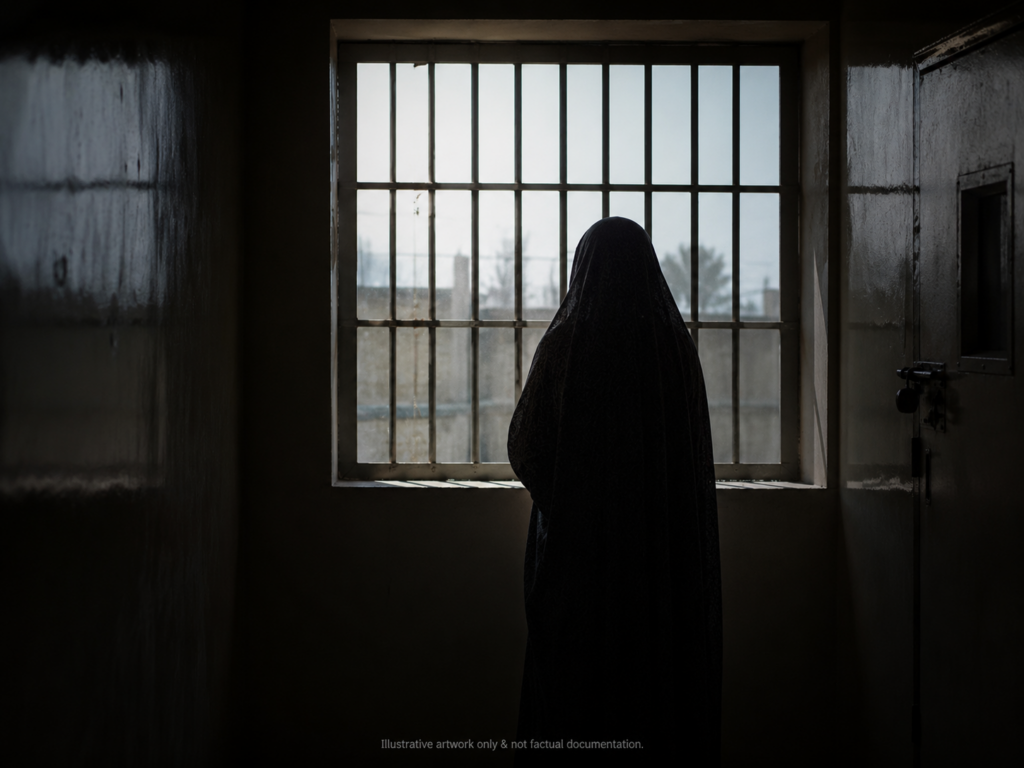

Name: Maryam*
Interviewing Organization: Iran Human Rights Documentation Center (IHRDC)
Date of Interview: May 8, 2026
Interviewer: IHRDC Staff
This statement was prepared pursuant to an audio interview with Ms. Maryam. There are 10 paragraphs in the statement.
The views and opinions of the witness expressed herein do not necessarily reflect those of the Iran Human Rights Documentation Center.
*Pseudonym assigned to protect the witness’s identity.
Statement
- I was in high school when my father was arrested over financial debts. This was in the late 1990s. They did not tell us everything clearly, not even me who was already a grown up at the time. My father was very well off financially. He had studied economics, and everybody liked him. Everything was going well. My father decided to go to Eastern Europe for business. He was exporting goods from Iran there. For about a year, he travelled back and forth. My mother also went there two or three times. Eventually, it was decided that the whole family would move to Eastern Europe. I think they may have been worried that things would not work out the way they wanted. They ran into difficulties. At one point, one of the shipments was not insured and was lost. That was the beginning of my father’s financial decline.
- Our lives had been very comfortable, but things reached the point where one of my father’s creditors came from Iran and stayed in our home. He had come to recover the money he was owed. At that time, we were living in Eastern Europe. My mother sold everything that could be sold and gave the money to the creditor. Then my mother and we children returned to Iran. My father stayed behind, hoping that he could resolve the situation. But after a while, he realised that he couldn’t. My father was very attached to us. He called all the time and would read us uplifting poems. Interestingly, all of his creditors in Iran were his friends. As far as I remember, there were several of them, working together. They reassured and encouraged him to return to Iran. They told him that nothing would happen to him. These people had invested in my father’s business, but the project failed and never took off. My father was owed almost as much money by someone else as he himself owed to these people. However, that person was also unable to repay his debt. My father never had that man imprisoned, but his own friends had my father imprisoned. I think my father’s debt was around 30 million Tomans, which was a substantial amount of money at the time. My father was not born into wealth. He had studied, worked very hard, and built everything he had, himself. He was simply unlucky, and the investment he had made, failed.
- My father was held in Qasr Prison. For reasons I still do not understand, he was kept in the prison’s quarantine unit the entire time and was never moved to a ward. During that period, there were also people who said they wanted to help him, but it was all talk. I remember seeing my mother going to court, but they never told us the details. I don’t exactly know the details of the court proceedings.
- By the time we returned to Iran, we had lost our home. We lived with my grandmother for a while. My mother then started working, doing sewing and patchwork embroidery. A number of people owed my father small amounts of money. He had lent them money and told them to repay it whenever they were able to. He did not even have any written record of these loans. He gave my mother a list of these people and asked her to contact them and see whether she could recover any of the money. My father was generous and always looked out for others. Everything we have today is the result of the good he did for other people. My mother only approached some of the people on that list, but she managed to collect enough money for us to rent a house. There were also people whose circumstances were so difficult that, after seeing how they were living, my mother never asked them to repay what they owed.
- My father spent more than three years in prison. My mother applied for a declaration of inability to pay on his behalf and worked tirelessly to secure his release. But we had nothing left. We had no property, no assets, and no money. We had lost everything. Eventually, she managed to obtain a day release arrangement for him, which allowed him to leave prison two days a week to work and earn money to repay his debts. As far as I can remember, my father managed to pay back a large portion of what he owed. Some of my father’s relatives and friends also helped and paid off part of the debts. A portion of the debts remained outstanding, but eventually became time-barred.
- While my father was still in prison, my mother was told that if she joined the Imam Khomeini Relief Committee, she would be eligible for loans. At the time I had started working as an accountant, and despite my objections she still did it. Later, I saw her Relief Committee membership card, and it upset me deeply. My mother was known for having a good credit record, so lenders were always willing to give her loans. However, we never received any money from the Setad-e Diyeh [Prisoners’ Relief Foundation].
- Every week, I would take the bus to go to visit my father. Sometimes my mother did not come. It was a difficult time. Every other week, we were allowed an in-person visit. We would sit with my father in the yard of Qasr Prison, opposite the quarantine section, talking and eating spicy Bandari sausage sandwiches. We bought the sandwiches from the prison shop. My father was a very sociable man, and we loved him very much. The rest of the visits were conducted through a glass partition, and I went every week. During that period, I remember that he was granted leave a few times. I remember that the deed to my maternal grandmother’s house was used as security for my father’s temporary release or prison leave. There was also an occasion when several people acted as guarantors for him.
- My friends at school, and their parents, knew what had happened to my father. Imagine going from a large house in an affluent part of the city to a 50-square-metre flat almost overnight. Our whole world changed. But I had some very good friends, and they are still very dear to me. Of course, later on I also experienced some strange and hurtful behaviour from other friends and relatives. When I was at university, I had a friend whose family had recently come into money. His father would hand her large bundles of cash right in front of me, even though they knew about my father’s situation. There was also a relative who had told everyone at a school next to mine about what had happened to my father.
- Some of my father’s debts were never waived by his creditors. Those same creditors kept him under a travel ban for the rest of his life. My father was a proud man, but there were times when he became utterly desperate. He wanted to get out of that situation, but he did not want to borrow money from anyone. While he was in prison, he once asked me to approach a few people and ask for help in securing his release. It was a very painful experience. I was hurt by their lack of understanding and, at times, by the hurtful advice they gave me. My mother knew nothing about it. Before that, she herself had gone to various people asking for help. She too had been through a great deal; it was a situation somewhat reminiscent of Bahram Beyzaie’s film Sagkoshi (Killing Mad Dogs). Of course, I knew they had no ill intention, but they came out with the strangest suggestions and comments. For example, after I had spent a long time explaining my father’s situation to one of them, he turned around and said, without really listening to a word I had said, “Why don’t you get married? Right now, you’re just another expense for your family!” At the time, I had already been working for about two years. In fact, I had been working since I was seventeen to cover my own expenses. I remember bursting into tears. I couldn’t understand how he could think he had the right to speak to me like that instead of offering help. They were unbelievably insensitive. The typical religious bazaar-merchant type. Those were very difficult days.
- After my father was released from prison, he tried very hard, but he was never able to return to his former success. He had been knocked down, and could never get back on his feet. I even took out a loan for him through my workplace, but it still wasn’t enough. He passed away about twelve years ago.